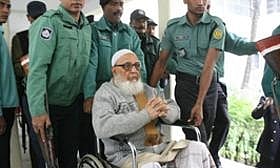
Azam's proceedings halted for a week
The tribunal dealing with war crimes will revive its proceedings against the Jamaat guru after a week Full Story
bdnews24.com News Service
bdnews24.com
Published :
24 Jun 2012, 07:29 AM
Updated :
09 Aug 2022, 03:56 PM
Dhaka, Jun 24 (bdnews24.com ) — The first war crimes tribunal of Bangladesh on Sunday adjourned Jamaat-e-Islami guru Ghulam Azam's case by a week.
The International Crimes Tribunal – 1, set up to deal with crimes against humanity during the 1971 War of Independence, indicted the former Jamaat chief on May 13.
Sunday was fixed for beginning deposition of the first prosecution witness against Ghulam Azam. But it transpired that the prosecution had not secured the summons for the witnesses and hence deposition would not be possible. Prosecutor Zead-Al-Malum had filed an application for issuing summons upon the witnesses.
The defence had filed two applications, one praying for more time to submit its list of witnesses and other materials and the other one prayed for adjournment. The prosecution had also filed an application for summons of witnesses.
Tajul Islam moved the defence petition saying that there was a huge volume of materials to be covered and although his team had prepared a list, it had not been completed. He said the defence needed two more weeks to complete its work satisfactorily.
After his submissions, the tribunal chairman, Justice Mohammad Nizamul Huq asked Tajul Islam, "Is that all?...That you need more time?"
"Yes, my lord," answered the defence counsel to the slight disapproval of the tribunal chair which was obvious as Justice Huq shook his head with the hint of a smile on his lips.
"How much time did you get?" asked the judge.
Tajul Islam: Not much your honour.
Justice Huq: Almost 40 days.
Prosecutor Malum provided the accurate figure. "42 days, my lord."
The chairman then asked the prosecutor for his submissions. Malum duly opposed both the prayers and cited some of the legal provisions showing that the defence could not be allowed further time. He said that granting such prayers were setting an undesirable precedence.
He continued to argue his case for a few more minutes, at which point, tribunal member Judge A K M Zaheer Ahmed intervened.
"Mr Prosecutor, let us say we reject the adjournment application and the time prayer. Where is your witness?"
"The two cannot be equated with each other, my lord. They are different issues," said Malum.
Judge Zaheer Ahmed: Yes but what happens to the trial if we reject the two petitions? Can we have the witnesses today?
Malum: I don't even have the summons with me. If the court's laws allow for the deposition to proceed under the circumstances, we could certainly have it then. We are already under much pressure due to the tribunal's 'accused-friendly' rules.
The judge's point that the trial could not proceed whether or not the defence prayers were granted, was completely lost on the prosecutor.
Justice Huq had heard enough and bade the defence counsels to their seats when they wanted a rebuttal to what Malum had said. "It is not at all necessary," he said.
In his order, the tribunal chair said that the order for issuance of witness summons would be given later. As for the defence prayers, the court observed that there were no witnesses to be produced, and as such 'was inclined to give the defence some more time'.
Justice Huq directed the defence submit its list of witnesses along with other materials that the defence would rely upon by Jul 1. He added, "In default the trial shall proceed." The deposition will also begin on the same day, according to the order.
A senior defence counsel, Mizanul Islam told the court that since the first prosecution witness would require special preparation, the prosecution should let him know in advance who would be deposed first.
Referring to the nine-strong list that he had already submitted to the court for summons, Prosecutor Malum said, "All nine will be deposed."
Judge Zaheer Ahmed said, "No no, how can that be possible?"
Justice Huq had at first indicated that the defence should prepare for all nine but then agreed with Mizanul Islam and said that the prosecution would let them know in advance.
Later in the day, the defence further pointed out that four of the witnesses on the list were not even named in the prosecution's list of witnesses in the case. However, the point was not discussed further.
Jamaat Guru in ICT-1
On Dec 12, 2011, the prosecution brought a 52-point charter of charges against Azam and appealed for his arrest. Later, following the tribunal order, charges were re-arranged and presented to the tribunal on Jan 5.
He was produced before the tribunal on Jan 11 and sent to jail the same day. Since that evening, Ghulam Azam has been kept at the prison cell of the Bangabandhu Sheikh Mujib Medical University for better treatment considering his delicate health. Azam was indicted on five charges by the tribunal on May 13.
The prosecution's numerous charges against him mainly consist of incitement, conspiracy, complicity and command responsibility for crimes against humanity.
A former chief of Jamaat-e-Islami, arguably the largest Islamist organisation in the subcontinent, Azam is allegedly among the key people who pioneered anti-liberation efforts in 1971 colluding with the Pakistani military junta of that time.
He is widely perceived to have been among core group of right-wing supporters of the Pakistani Army, who came out strongly in support of a united Pakistan.
Ghulam Azam, then chief of Jamaat, was instrumental in setting up the infamous Peace Committee at the national level. The Razakars, an auxiliary force set up mainly to actively thwart the liberation forces, are said to have been mobilised through the Peace Committees across Bangladesh.
Among the most notorious vigilante militia groups is the Al Badr, whose membership is said to have been mainly dominated by the Jamaat's student wing called the Islami Chhatra Sangha at that time.
The Al Badr is alleged to have spearheaded execution of the intellectual elites of Bangladesh just days before the victory on Dec 16, 1971.
Azam also spoke in favour of Pakistan to the Middle Eastern countries during the war, according to the prosecution.
He stayed in London for seven years after 1971 and returned to Bangladesh in 1978 during BNP founder Ziaur Rahman's rule. Having led Jamaat for long, Azam retired from active politics in 1999.
His party remains a key ally of the main opposition BNP. Two Jamaat leaders, also behind bars for war crimes charges, have even served as ministers during the BNP's last tenure in government between 2001 and 2006, when Azam's party was part of the ruling coalition.
bdnews24.com/ta/jr/1430h