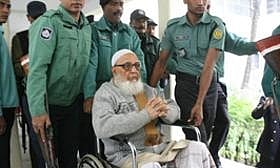
Azam's defence moves for transfer
ICT-1 Chairman had been involved with a People's Court that gave a verdict against the Jamaat guru, it says. Full story
bdnews24.com News Service
bdnews24.com
Published :
05 Jun 2012, 11:52 AM
Updated :
09 Aug 2022, 03:51 PM
Dhaka, Jun 5 (bdnews24.com) -- Former Jamaat-e-Islami chief Ghulam Azam on Tuesday moved the first war crimes tribunal to transfer his case to the second tribunal questioning the neutrality of the tribunal's Chairman.
Indicted on 5 charges of crimes against humanity by the tribunal, Ghulam Azam is said to have been pivotal for mobilising vigilante militia groups like the Razakar and Al Badr through Jamaat and its student wing, Islami Chhatra Sangha in 1971.
His defence counsel Barrister Abdur Razzaq moved an application on Tuesday praying that the case be transferred.
He said that since International Crimes Tribunal -1 Chairman, Justice Mohammad Nizamul Huq had been involved with a People's Court that gave a verdict against the Jamaat guru, there were reasonable grounds to question the court's impartiality.
He said several times, "Justice must not only be done, but must be manifestly and undoubtedly be seen to have been done."
The first tribunal was set up on Mar 25, 2010 to try crimes against humanity during the 1971 Liberation War.
Ghulam Azam's defence had filed four applications, two of which were disposed of, one of case transfer is being heard and another one, review of Azam's indictment order, is yet to be taken up for hearing.
Regarding the first application for privileged communication, Justice Huq allowed it for this Friday (Jun 8) between 9:30am and 12:30pm. As for the second application for adjournment, the judge allowed the application in part. But he added a line with the standard order barring the counsels from making any press statements after the communication with Azam.
Defence lawyer M Tajul Islam had moved the application praying for an adjournment of the case proceedings on the grounds of pending applications and lack of time for preparation. Justice Huq dismissed the first ground of pending applications saying that the fate of applications would in no way keep the case from proceeding on its normal course.
As for lack of preparation, the judge was more accommodating but clearly indicated that he would not adjourn the proceedings altogether. "Regarding preparation, we find some more time may be given but there is no reason to adjourn the opening statement."
Justice Huq said his court would hear the remaining two applications followed by the opening statement and then give dates for the defence, which would presumably mark the deadline for submitting list of defence witnesses and other material to be relied upon.
Abdur Razzaq took the podium to move the third petition citing previous cases in other parts of the world as well as those in Bangladesh where judges had either declined or been removed because of reasonable grounds to question their neutrality.
Razzaq was preceded by Supreme Court Bar Association President Zainul Abedin and Barrister Rafiqul Islam Miah, both of whom stood in favour of the petitioner.
Zainul Abedin said that the Justice Huq appeared to have some connection with a People's Court commissioned in 1992 which gave a verdict against Ghulam Azam for his alleged war crimes and the judge would duly consider the matter.
Miah said even if there were an iota of doubt in the mind of the accused then the judge would do better to consider the application and allow the transfer of the case.
Abdur Razzaq, the senior defence counsel representing the top Jamaat leaders, provided a detail of the tribunal chief's involvement in the People's Court. He also referred to a report of the Daily Sangbad of Apr 11, 1992 which had a lawyers' platform calling for legal measures regarding the verdict of the People's Court.
That court, with 12 judges, had found Ghulam Azam guilty of all 10 charges brought against him and observed that the crimes warranted a sentence similar to the death penalty.
The Sangbad report mentioned Justice Huq's name as being present in the meeting that called for appropriate legal measures as regards the People's Court verdict.
Justice Huq asked whether the defence had submitted any documents that proved his active involvement, to which the defence counsel referred to the report.
Razzaq had petitioned for removing the tribunal chair on the same grounds earlier which was turned down in another Jamaat leader Delwar HOssain Sayedee's case. Sayedee has been indicted by the same tribunal on 20 counts of war crimes including murder, rape, arson and loot.
Zead-Al-Malum stood for the prosecution and said, "This is another one of the defence' s bothersome and irritating applications only meaning to hamper and delay the proceedings of the case.
Justice Huq told him, "But if the defence feels that there is a reason to file an application because of a judge then they may."
Malum replied, "But I question their intention."
The hearing was adjourned until Wednesday as time had run out by then.
Jamaat Guru in ICT-1
On Dec 12, 2011, the prosecution brought a 52-point charter of charges against Azam and appealed for his arrest. Later, following the tribunal order, charges were re-arranged and presented to the tribunal on Jan 5.
He was produced before the tribunal on Jan 11 and sent to jail the same day. Since that evening, Ghulam Azam has been kept at the prison cell of the Bangabandhu Sheikh Mujib Medical University for better treatment considering his delicate health.
The prosecution's numerous charges against him mainly consist of incitement, conspiracy, complicity and command responsibility for crimes against humanity.
A former chief of Jamaat-e-Islami, arguably the largest Islamist organisation in the subcontinent, Azam is allegedly among the key people who pioneered anti-liberation efforts in 1971 colluding with the Pakistani military junta of that time.
He is widely perceived to have been among core group of right-wing supporters of the Pakistani Army, who came out strongly in support of a united Pakistan.
Ghulam Azam, then chief of Jamaat, was instrumental in setting up the infamous Peace Committee at the national level. The Razakars, an auxiliary force set up mainly to actively thwart the liberation forces, are said to have been mobilised through the Peace Committees across Bangladesh.
Among the most notorious vigilante militia are the Al Badr, whose membership is said to have been mainly dominated by the Jamaat's student wing called the Islami Chhatra Sangha at that time.
The Al Badr is alleged to have spearheaded execution of the intellectual elites of Bangladesh just days before the victory on Dec 16, 1971.
Azam also spoke in favour of Pakistan to the Middle Eastern countries during the war, according to the prosecution.
He stayed in London for seven years after 1971 and returned to Bangladesh in 1978 during BNP founder Ziaur Rahman's rule. Having led Jamaat for long, Azam retired from active politics in 1999.
His party remains a key ally of the main opposition BNP. Two Jamaat leaders, also behind bars for war crimes charges, have even served as ministers during the BNP's last tenure in government between 2001 and 2006, when Azam's party was part of the ruling coalition.
bdnews24.com/ta/bd/1730h