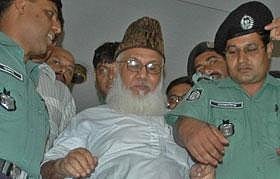
Argument against Nizami indictment Mar 27
Court hears prosecutor's arguments in support of the 15 charges it placed against Jamaat-e-Islami chief. Full story
bdnews24.com News Service
bdnews24.com
Published :
21 Mar 2012, 07:19 AM
Updated :
09 Aug 2022, 03:34 PM
Dhaka, Mar 21 (bdnews24.com) — The war crimes tribunal will hear the defence argument against indictment of Jamaat-e-Islami chief Matiur Rahman Nizami on Mar 27.
The International Crimes Tribunal, set up to deal with crimes against humanity during the 1971 Liberation War, however, deferred hearing defence arguments against indictment of another Jamaat leader Abdul Quader Molla's to Mar 28 as he could not be produced in the court due to a "miscommunication".
The court on Wednesday heard the prosecutor's arguments in support of the 15 charges it placed against Jamaat chief Nizami.
Prosecutor Syed Haider Ali took the court through the list of evidences — mainly documents and witnesses — substantiating the charges.
Regarding Jamaat assistant secretary general Quader Molla's case, the defence prayed for more time to argue against his indictment in the seven charges brought by the prosecution.
The tribunal was not in favour of granting the defence prayer but deferred the hearing to Mar 28 as the accused had not been brought to the court.
HAIDER ALI STEPS IN
Prosecutor Altaf Uddin Ahmed was the first to take the podium to present his arguments in support of the formal charges he had brought against the Jamaat chief.
Altaf Uddin began by saying that the court could frame charges as it saw fit based on the formal charges.
Tribunal chairman Justice Nizamul Huq, then told the prosecutor that the court expected him to substantiate the charges one by one.
At this point Prosecutor Syed Haider Ali came forward to assist his faltering colleague.
Justice Huq said, "Mr Haider Ali, do help us a bit."
Thereafter, prosecutor Altaf Uddin Ahmed stood by his side or scurried back and forth and occasionally sat down while Haider Ali went through the list of documents and witnesses.
Recalling a previous experience, Justice Huq asked Haider Ali if the page numbers he was providing were correct.
The court had adjourned proceedings due to a mix-up with page numbers of the volumes of documents in a case against Jamaat executive council member Delwar Hossain Sayedee. On that occasion, the conducting prosecutor — which is Syed Haider Ali coincidentally — could not resolve the matter and decided to stop witness testimony for the day.
On Wednesday, Justice Huq asked the prosecutor severally. "Are you sure the page numbers are correct?"
Haider Ali replied that they were indeed. Justice Huq reminded him that the court had had a different experience so far.
Upon conclusion, tribunal member Justice A T M Fazle Kabir said he had a minor query and wondered why the prosecution proposed to charge Nizami for such crimes as murder, abduction, rape and so forth for the first four charges.
He said those four charges mainly refer to the accused giving lectures at different locations in Bangladesh. As a result, the prosecution suggested that Nizami be charged for abetment and conspiracy.
The judge asked, "How can you charge him for murder because he had merely given a speech somewhere?"
Prosecutor Haider Ali said he agreed with the judge and the accused need not be charged for those crimes.
The tribunal chairman then pointed out that the relevant section of conspiracy stated "attempt, abetment or conspiracy to commit any such crimes"
He then asked the prosecutor, "But then you must specify conspiracy for committing which crimes. Otherwise it would remain vague."
Prosecutor Syed Haider Ali once again agreed.
Haider Ali then drew from his experience and said that spiritual command was as good as and sometimes, even more dangerous than a direct command.
"It is not that the matter is restricted to one or two persons but affects masses which can lead to massacre. And such things have indeed happened."
M Tajul Islam, one of the senior defence counsels handling the war crimes cases against Jamaat, expressed his reservations about the way the prosecution was handling the cases as Haider Ali had brought the arguments to a close in a short time. He wondered if that were enough.
The tribunal chairman said that it was up to the prosecution how they handled the case.
When another member of the defence team raised an objection about the page numbers saying they could not locate the evidence, the tribunal chairman personally took the defence through the list of documents.
Justice Huq read out the serial numbers of prosecution's witnesses and other documents for each charge while the defence took note.
Upon the defence counsel's request for more time to prepare, which Tajul Islam said would take "weeks together", prosecutor Haider Ali objected.
The tribunal, however, granted the defence prayer despite the objection for "ends of justice".
Tajul Islam was still not happy with the time but the tribunal did not pay heed to his protests. The defence will be expected to present their argument against the Jamaat chief's indictment on Mar 27.
'PRIVILEGED' COMMUNICATION
The tribunal chairman instantly granted Abdur Razzaq's request to consult with Nizami for about five to ten minutes.
But he then went on to relate an affair that he found rather objectionable concerning BNP MP Salauddin Quader Chowdhury's counsel Fakhrul Islam.
Justice Huq told the senior counsel that the tribunal instantly granted these requests for consulting with the accused. "Yesterday Mr Fakhrul Islam asked for privileged communication. But he was in [the prisoners' cell] along with other people for a long time."
"They showed me what went on in there on the CCTV. If the orders are flouted in this manner then we will have to exercise more caution in granting these requests."
On Tuesday, Fakhrul Islam had asked for some time to consult his client after the court fixed Mar 27 for the Chittagong MP's indictment. The request was instantly granted as is always the case.
However, the counsel, along with several of Salauddin Quader's family remained at the prisoners' cell and had lunch together. It was this reunion that the tribunal chief apparently referred to.
Justice Huq said he was reported about what had happened there only later in the day.
'MISCOMMUNICATION' WITH MOLLA
Abdur Razzaq took the podium as soon as the court had convened on Wednesday and said that the defence had filed an application regarding Jamaat assistant secretary general Molla's formal charge.
Razzaq told the tribunal that the prosecution had brought material changes to the formal charge and such changes could not be acceptable.
Tribunal chairman instantly agreed and said those changes would be "ignored". "We have already said that those changes will not be accepted."
When the tribunal chief indicated that the defence petition needed not even be heard, Abdur Razzaq made a "humble suggestion" that the court issued an order to that end.
Justice Huq told the defence to wait for the indictment order. "There will be an order whether we indict him or not. These things will be mentioned there clearly."
The court had asked prosecutor Mohammad Ali to correct certain "typing mistakes" as the formal charge was "full of mistakes" as put by the tribunal chief himself. Certain names and historical facts had to be corrected that would not change the character of the report and the defence had also agreed.
But the prosecutor brought material changes to the formal charges, in some places changing how Molla was accused and certain other details that neither the court nor the defence found acceptable.
Later in the day when Molla's case came up for hearing, the defence asked for more time to prepare its arguments against his indictment.
The prosecutor handling the case, Mohammad Ali, vehemently opposed the prayer and said it should be rejected.
The tribunal ruled that it was not inclined to give the defence any more time but the order noted that the accused "Abdul Quader Molla could not be produced due to a miscommunication".
Thus, since the accused was not present, the tribunal deferred the hearing to Mar 28.
MUNDANE AFFAIR
Proceedings at the tribunal have noticeably dulled over the last couple of days with tribunal member Judge A K M Zaheer Ahmed remaining absent on Wednesday for the third straight day.
The only tribunal member from the lower courts, he typically takes the lead in making his "minor" queries as he says.
However, counsels are often rather hard pressed to answer the judge's 'simple' questions put to them in the gentlest possible tone.
Having done a few stints as a district judge, Zaheer Ahmed has also shouldered the burden to act as the 'interpreter' for witnesses — and there have so far been only prosecution witnesses in Sayedee's case — explaining the complex questions in a simple, understandable manner.
The judge also provides pointers to the counsels regarding the legal points that they need to argue on by way of what he says "clarifying" the points that the other party had made.
The prosecution's arguments on Wednesday in support of Nizami's charges, where the judge had already made one query, presumably keeping the rest for later, was set to be an interesting hearing, but turned out to be a rather cut and dry affair.
However, on the last day (Sunday) that he was present, Judge Zaheer Ahmed mentioned twice that he would not speak up as much as he has so far, after Abdur Razzaq presented several newspaper reports with quotes of Zaheer Ahmed taken out of context and casting him in a negative light.
The judge had taken exception to the reports. He had notably refrained from speaking up and at one point even motioned with his hands shaking his head indicating that he would not speak.
"Haven't spoken today…won't anymore," he finally said.
bdnews24.com/ta/bd/1523h