Published : 18 Dec 2019, 02:02 PM
Updated : 17 Oct 2022, 11:50 AM


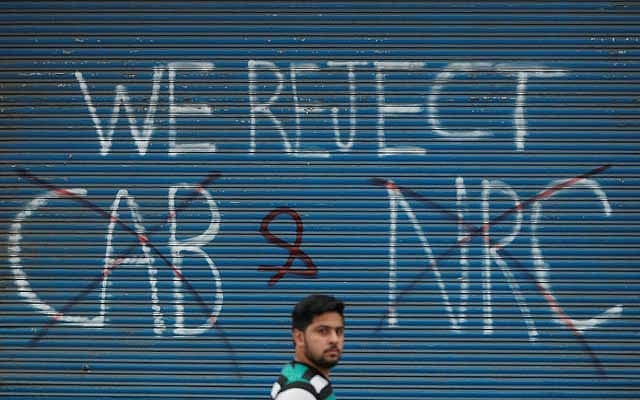
The unrest has spread to more than a dozen cities, and Prime Minister Narendra Modi has responded by deploying troops, enacting a curfew and shutting down the internet. Violent police confrontations have followed; police fatally shot several young men in Assam state, beat unarmed students with wooden poles in New Delhi, and used tear gas and batons to disperse protests elsewhere.
The citizenship law, which passed both houses of parliament last week, was seen by critics as part of Modi’s broader push to transform India into a place where being Indian is synonymous with being Hindu. India, with a population of 1.3 billion, is about 80% Hindu and about 14% Muslim.
The law, paired with a citizenship test that has left nearly 2 million people in danger of being declared stateless, has Indian Muslims fearing they are being targeted at a time when there has been a surge of anti-Muslim sentiment.
Here is the background to understand what is happening.
What is in the citizenship law that ignited the protests?
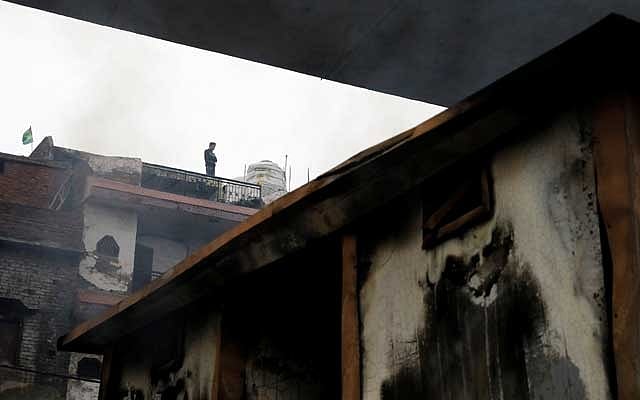
A resident stands on a roof as he watches a protest against a new citizenship law, in Seelampur area of Delhi, India, Dec 17, 2019. REUTERS
Government officials have said the law is intended to protect persecuted religious minorities in some neighboring countries. But it would not protect persecuted Muslims, including the Rohingya in neighboring Myanmar.
What is the citizenship test?
All 33 million residents of Assam, a state bordering Myanmar and Bangladesh, had to provide documentary evidence, such as a property deed or a birth certificate, showing that they or their ancestors lived in India before 1971. Those who could not would be declared foreign migrants, at risk of being sent to huge new detention camps.
More than 2 million people, many of them Muslims, failed to pass the test and could end up stateless. The governing party of Modi has vowed to extend the test to other parts of India.
The government has said the test was intended to root out immigrants from Bangladesh in the country illegally. India’s home minister, Amit Shah, has repeatedly referred to these migrants as “termites.”
What do the Indian Muslims fear?
Many of India’s roughly 200 million Muslims see the new citizenship law as blatantly anti-Muslim. Constitutional scholars say that it is the first time India has passed a law that treats people differently based on their religion, and that it flies in the face of the country’s commitment to equality.
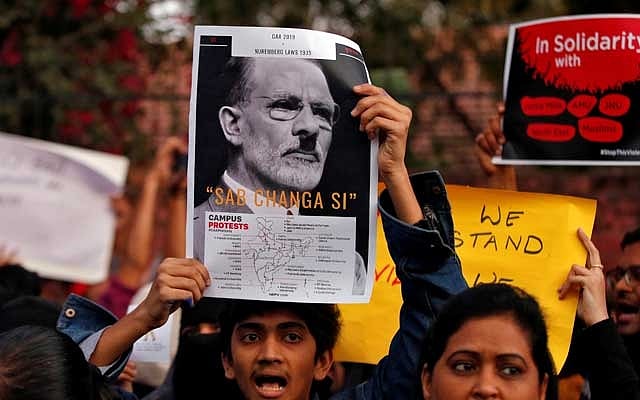
Demonstrators shout slogans during a protest against a new citizenship law and to show solidarity with the students of New Delhi's Jamia Millia Islamia university after police entered the university campus on Sunday following a protest against the new law, in Ahmedabad, India, Dec 17, 2019. REUTERS
Why are some non-Muslims opposed?
There is growing concern among progressives and Indians of other faiths that Modi is trying to dismantle India’s secular traditions and turn the country into a religious state as a homeland for Hindus. Many of Modi’s supporters among the Hindu right support the nationalist push, and Modi himself comes from an ideological background that emphasises Hindu supremacy. But there are many Hindus who want to keep India secular, as India’s founders, such as Mohandas K. Gandhi, had wanted.
In Assam, protests were led by Hindus who feared that the citizenship law could allow migrants to settle there and take their land. In this state, it is not so much a rivalry between Hindus and Muslims. It is more a case of locals versus foreigners. Many of the indigenous Assamese do not want any new migrants, no matter what religion they subscribe to.
© 2019 New York Times News Service