


Published : 11 Sep 2021, 01:34 PM
Updated : 08 Apr 2022, 01:12 PM


Several festivals taking place in September and October typically draw large crowds to temples, processions and markets. In the past, authorities have struggled to get devotees to follow health protocols. The Kumbh Mela, which drew millions of pilgrims to the banks of the Ganges River in the spring with hardly any testing or social distancing, was widely blamed for spreading the virus, as pilgrims carried infections back to their villages and towns.
Prime Minister Narendra Modi’s Hindu nationalist government faced criticism for allowing the Kumbh Mela to take place despite warnings that it would become a superspreading event. Last month, Modi’s government asked states to take “suitable measures to avoid large gatherings during the coming festive season,” and to impose local restrictions if needed.
At a news conference last week, Dr VK Paul, head of the national COVID-19 task force, reinforced the warning, saying, “We shall celebrate the festivals within the family — we should not have big gatherings.”
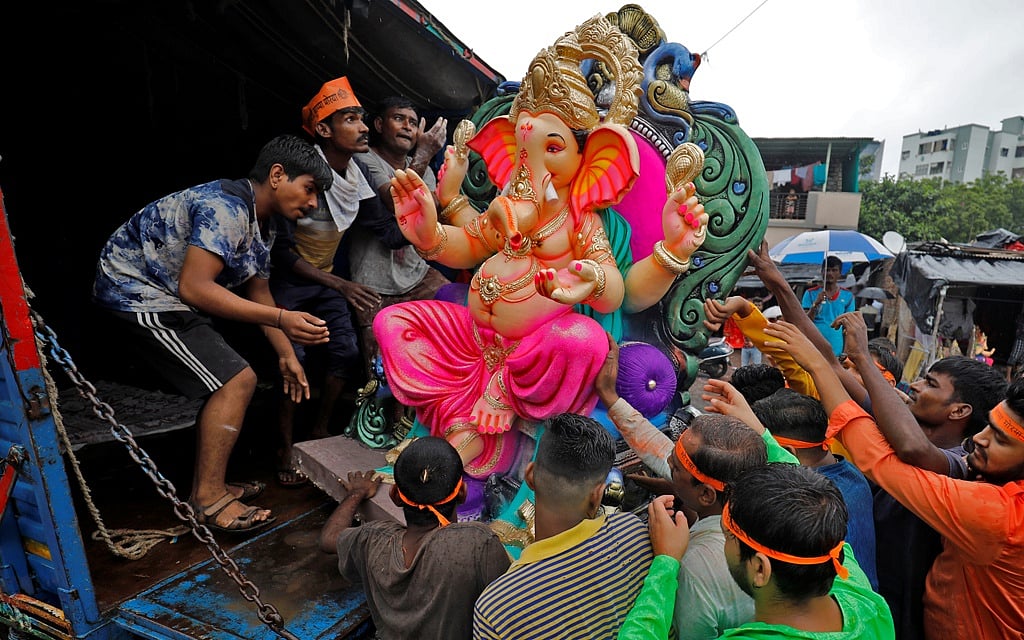
States have responded with varying measures in the days before a festival celebrating Ganesh, the Hindu elephant god. In the southwestern state of Karnataka, the government said that gatherings should be capped at 20 people and imposed a 9 p.m. curfew. In the southern state of Tamil Nadu, officials announced a ban on large celebrations and offered payments to idol-making potters whose businesses would be badly affected.
The western state of Maharashtra, among the worst hit by the spring COVID wave, draws some of the biggest crowds for the festival, known as Ganesh Chaturthi. In Mumbai, the state capital, authorities issued guidelines limiting processions to 10 people, all of whom must be fully vaccinated and masked, news media reported.
Although India’s outbreak has eased, the country continues to report nearly 40,000 new cases and nearly 400 deaths daily. With COVID fatigue kicking in and the economy still flailing, many states are reluctant to impose strict restrictions. Modi’s government has bet that a ramped-up vaccination drive can boost immunity and keep another wave from being as deadly as the last.
With localised virus surges taking place in a handful of states, Lahariya said that continued restrictions could help prevent a nationwide third wave as India’s vaccination rates remain relatively low.
After a slow start to vaccinations, India has administered more than 8 million doses per day over the past week. More than 700 million doses have been given nationwide, but less than one-fifth of the country’s roughly 900 million adults are fully vaccinated, according to official statistics.
In other news around the world:
— The French government Thursday announced that it had granted citizenship to more than 12,000 foreign essential workers to thank them for their service during the pandemic. Data from the Health Observatory of the Île-de-France region, an area that includes Paris, shows that immigrants made up one-quarter of essential workers who remained active during lockdowns. Of those working in the hospitals in the region, 23% are immigrants, though some may already be citizens.
— Singapore opened its borders to more countries and loosened quarantine rules for some inbound travellers Friday, even though its daily case count Thursday surged to over 400 for the first time since August 2020. But the number of severe cases has levelled off at an average of 23 per day this week, according to data released by Singapore’s Ministry of Health.
— In Vietnam, officials in Ho Chi Minh City, the epicentre of the country’s outbreak, said they planned to allow economic activity to resume in the city next week. “We cannot resort to quarantine and lockdown measures forever,” Prime Minister Pham Minh Chinh said last week, Reuters reported. “The COVID-19 pandemic is evolving in a complicated and unpredictable manner and may last for a long time.”
© 2021 The New York Times Company













