


Published : 25 Apr 2022, 11:11 AM
Updated : 03 Aug 2022, 10:05 AM


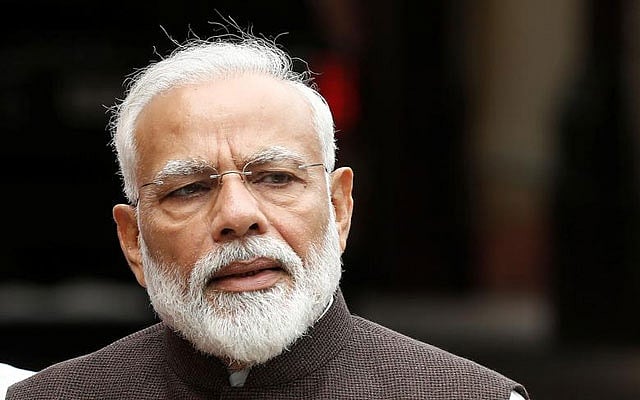
Security was tight for what was Modi’s first public meeting in Jammu and Kashmir since his government stripped the region of its long-held semi-autonomous status in 2019, splitting it into two federally controlled enclaves. Modi said then that the territory’s special status had encouraged separatism and stood in the way of economic development.
“The way your parents and your grandparents have suffered,” Modi said Sunday, addressing the region’s youth, “you will never have to endure those hardships. I will make sure, and I have come to assure you that.”
The message of development and integration with India has long found resonance here in Jammu, a Hindu-majority region, in contrast to mostly Muslim Kashmir, where people say they have yet to see any signs of development and resentment is growing.
“We had hardly any electricity and we used to light our homes sometimes by burning wood,” said Samita Devi, who lives in Palli, a village of more than 450 families near the border with Pakistan. Because of the new plant, “We are very, very happy,” she said.
The symbolism of the gesture was clear as Modi and some of his ministers travelled to Palli to hail what the government said would be the first of many carbon-neutral villages across India, thanks to the solar plant. He is hoping development will help quell decades of political turmoil in the disputed region, which still sometimes turns violent.
A new 500-kilowatt solar project to provide constant electricity to the farming village was meant to be a sign of change in Jammu, where development projects have accelerated in recent months.
But the heavy presence of police officers searching vehicles and staffing checkpoints underscores the fact that the region’s security problems remain a fixture of life in the Himalayan region.
After revoking Jammu and Kashmir’s semi-autonomous status, authorities cut communication lines in the region, sent in tens of thousands of troops and arrested known separatists, and even political moderates. For years, the moderates had argued that Kashmiris should accept some degree of Indian rule. Since then, repression has continued in the Kashmir Valley, which is home to about 8 million people.
Modi’s Hindu nationalist Bharatiya Janata Party won a majority of the seats in local assembly elections in Hindu-majority areas in 2014, but the Modi government’s attempt to install more loyal officials seems to have faltered. It now relies on many of the same politicians it once jailed to help keep the peace. A pledge to hold fresh elections in 2019 after the state of Jammu and Kashmir was demoted to federal territories status has yet to be fulfilled.
Kashmir has smouldered for decades. An insurgency that began in 1989 and cost tens of thousands of lives has largely dissipated, although militants still stage coordinated assaults. In recent months, there have been fewer street protests against the Indian army’s pervasive presence, but militants who want an independent Kashmir still attack Indian troops and sometimes kill civilians.
As recently as Friday, police said, two Indian migrant workers were shot and critically wounded by militants, who have often targeted laborers from outside the region. The day before that, two separate clashes caused the deaths of seven militants and an Indian soldier, according to police.
India has often placed blame for the unrest in Kashmir on Pakistan, which controls a part of the region and claims all of it.
Many ordinary Kashmiris say they feel under siege, and that the promised economic benefits from the region’s new status have yet to appear.
“There is no visible development and jobs, but we are feeling stressed, humiliated, powerless,” said Fida Hussain, a student in Srinagar, Kashmir’s largest city.
In the days leading up to Modi’s visit to Jammu, authorities detained many Kashmiris in what seemed to be an attempt to prevent protests. Last week, a student activist was arrested and charged under an anti-terrorism law because of an opinion article he wrote more than 10 years ago, which police said glorified terrorism.
On Sunday, as Modi brought electricity to Palli, he used the opportunity to highlight development proposals worth $2.6 billion that his government hopes will better integrate the region with India.
“Today is a very important day to speed up the development of Jammu and Kashmir,” Modi said.
In Palli thousands of village heads and residents gathered Sunday to listen, and chants of ‘Modi! Modi!’ echoed around the small village throughout his speech.
Hundreds of people, heads covered in saffron flags — the color is associated with Hinduism — walked for hours to attend the rally, where huge roadside billboards were installed to welcome Modi.
Thousands of people involved in village councils attended the public meeting, while many others across the country watched the prime minister via a video link.
In recent months, there has been a rise in attacks on village council representatives by militants in Kashmir, where they are seen as supporters of the Indian government. Four have been killed since last month.
“We have put our lives on risk to strengthen grassroots democracy and empower people,” said Bashir Ahmad Naik, a village council member, who travelled miles from Kashmir in a free bus provided by the territory’s government to attend the rally. “The prime minister should provide us security, support us and strengthen our hands.”
Apart from inaugurating the carbon-neutral village, Modi also participated in a ceremony to mark the beginning of construction of two 1,390-megawatt hydroelectric projects, and opened an all-weather road tunnel that will reduce traveling time to Kashmir from Indian cities south of it.
Kashmir must integrate with the rest of India, in the view of the Modi government, rather than retain its own distinct identity, said Noor Ahmad Baba, a former professor of political science at the University of Kashmir.
“Previous governments tried to accommodate differences, and there was a certain degree of adjustment and compromise by New Delhi; that is how leaders thought problems would be solved,” he said.
© 2022 The New York Times Company












