


Published : 05 Oct 2016, 11:36 AM
Updated : 11 Apr 2022, 10:15 PM


“Some experts tried to malign that and then they were given the opportunity to prove. But they failed to do so,” Deputy Election Commissioner Umesh Sinha told a group of Bangladesh journalists at his office in New Delhi on Tuesday.
Bangladesh could not introduce the EVM amid scepticism from the opposition parties. The EC also found errors in the two or three centres when they tried to introduce it in municipal elections in 2011-2012.
But the Indian EC that deals over 850 million voters in general elections said it is “time-tested and proven.”
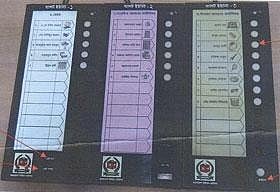
“It’s like a calculator, if you multiply two with two the results will be the four. It’s deliberately not a networked computer instrument. It is a standalone machine. If anybody tries to open it, the machine will go into factory settings mode,” Sinha said.
The Indian Election Commission has the supreme power during the elections and even the ministers have to follow their guidelines. They have the authority to nullify a candidature at any time.
Sinha said many countries are using the EVM now. Namibia has used the EVMs in the last general elections in 2014, for the first time.
“Yes it can be defective. If the machine gets defective then we have system replacing the machine in 15 minutes. Every machine has a number and the number is given to every political party and they know which machine is being used.”
He said the machine rarely goes out of order in the mid-way. “But if it happens, we have a system. The print out of the voting can be taken.”
The Indian elections are also free from the influence of the court, once set in motion. It can be challenged after the process is over and results are declared.
The deputy election commissioner said they still face three major challenges in elections -- influence of muscle power and money power and paid news, in which candidates try to use media to portray colourful pictures of them and malign others.
“We have been able to contain those in a great way. I would not say it’s a perfect situation. We have a very micro-monitoring system which is the key to success,” he said.
The chief election commissioner is appointed through a screening, which is being done entirely based on experiences of the senior bureaucrats. Based on that scrutiny, the panel sent the names to the President who finally appoints the chief.
The voting rate in the general elections has been increased to nearly 65 percent in the last elections in 2014 which was 58 percent in 2009.
Deputy election commissioner Sinha said they have 'electoral literacy' programmes focusing on school and college students to make them aware of exercising franchise.







