Published : 11 Oct 2026, 12:30 PM
Updated : 11 Oct 2026, 12:30 PM


India's Supreme Court has begun a special Sunday hearing into the crackdown on protests in Delhi, with lawyers alleging that police assaulted members of the legal profession and prevented them from meeting detained demonstrators.
The court is hearing challenges to Saturday's mass detentions and restrictions on public transport during demonstrations demanding the resignation of Chief Election Commissioner Gyanesh Kumar, according to Hindustan Times.
Senior advocate Sanjay Hegde, appearing for the petitioners, told the court that lawyers who went to Sanjay Colony Police Station in Maidan Garhi on Saturday were detained for hours and allegedly beaten, Hindustan Times reports, citing legal news website Bar & Bench.
Hegde also alleged that police threatened lawyers with criminal cases.
Raising concerns over lawyers being prevented from meeting detained protesters, he argued that access to justice also meant access to legal representation.
"This court operates through its AoRs (advocates-on-record). Access to justice is also access to lawyers. If lawyers are prevented from doing their duties, it's this court's dignity that is directly impacted," Hegde said.
AoRs are lawyers authorised to file cases and act for litigants before India's Supreme Court.
Another lawyer told the court that internet access had been unavailable throughout Saturday, according to LiveLaw.
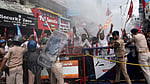
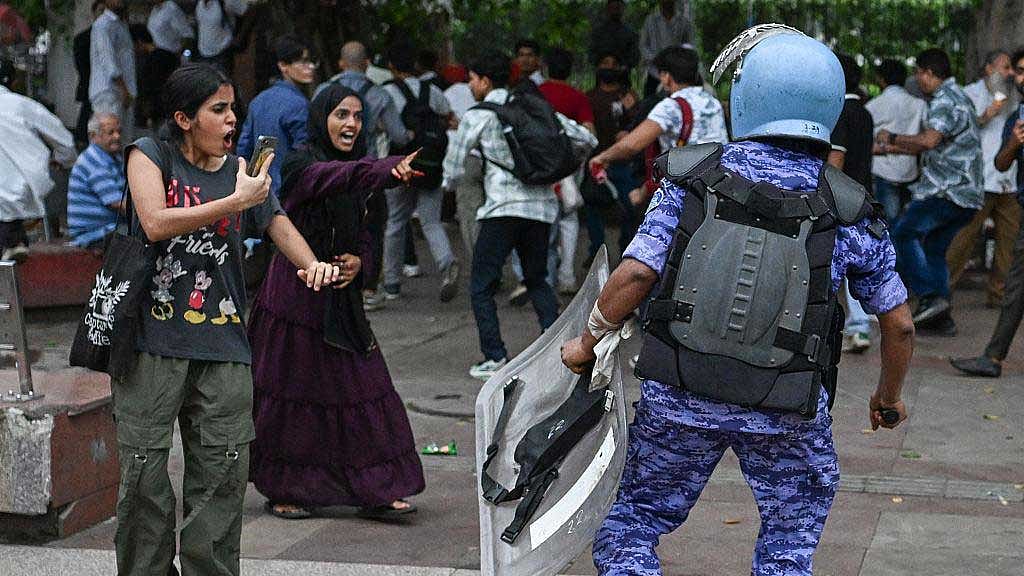
The special hearing follows a sweeping police operation against demonstrations organised by the Cockroach Janta Party (CJP) and opposition groups over alleged irregularities in revisions to India's electoral rolls.
More than 7,000 people were detained across the capital, according to Hindustan Times, including four former chief ministers and several CJP leaders. Prominent detainees have since been released.
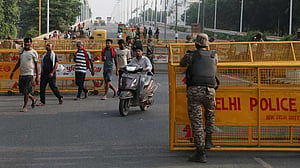
The court is hearing a contempt petition alleging that authorities defied its Oct 9 directions against a complete shutdown of Metro and railway services during the protests.
The petition names Union Home Secretary Govind Mohan, Delhi Police Commissioner Anurag Kumar and Delhi Metro Rail Corporation (DMRC) chairperson D Thara.
It alleges that authorities continued closing Metro stations and cancelling train services despite the court's directions to keep public transport operating, subject to proportionate security restrictions.
On Friday, a three-judge bench headed by Chief Justice Surya Kant had questioned the scale of the proposed restrictions, stressing that measures to maintain public order should not cause unnecessary disruption to ordinary citizens.
The Supreme Court is also hearing a habeas corpus petition filed by senior advocate and Trinamool Congress MP Menaka Guruswamy challenging the preventive detention of opposition leaders and other protesters.
Guruswamy argues that preventive detention cannot be used to suppress the constitutional right to peaceful assembly.
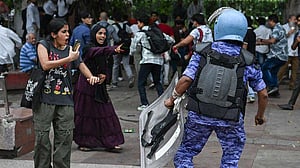
Other petitions filed in connection with the crackdown have alleged excessive police force, assaults on journalists and lawyers, and unlawful detention of demonstrators.
Rashtriya Janata Dal MP Manoj Kumar Jha has also approached the court over alleged police excesses, LiveLaw reports.
The proceedings raise questions about the legality of the detentions, the limits of police powers to restrict demonstrations and whether authorities complied with the Supreme Court's earlier directions.
Delhi police have defended the security measures on public-order grounds.
The CJP has called for renewed demonstrations despite the crackdown, while opposition parties have condemned the police response.
The protests are driven by allegations that revisions to India's electoral rolls have disenfranchised millions of voters and benefited Prime Minister Narendra Modi's Bharatiya Janata Party. The Election Commission and BJP deny wrongdoing.