Published : 28 Jan 2013, 04:47 PM
Updated : 20 Oct 2022, 03:33 PM




Also Read:
New RTA eyes easy visaAlso Read:
Bangladesh, India sign landmark pactsAlso Read:
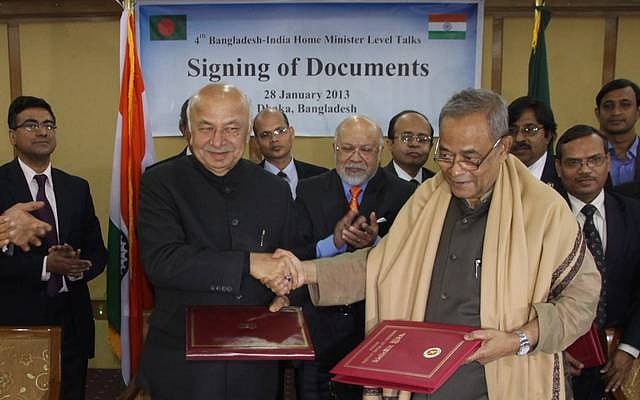
Chetia not yetIndian Home Minister Sushil Kumar Shinde and his Bangladesh counterpart Muhiuddin Khan Alamgir signed the agreements after their hour-long 4th ministerial meeting in Dhaka. They issued a joint statement later.
“The extradition treaty will help to increase cooperation among law enforcing agencies of the two countries and to curb criminal activities. The RTA (Revised Travel Arrangements) will ease the visa regime and will promote people to people exchanges,” read the joint statement.
“We shall embark on a new path of cooperation following the signing of the treaty and liberalizing the visa regime,” the Indian Home Minister said.
He said it (the treaty) would reinforce the spirit of friendship and partnership in the areas of security and cooperation and the new visa regime will lead to increased people-to-people contact.
Alamgir asked for immediate tracking, arrest and handover of the killers of Bangabandhu Sheikh Mujibur Rahman, a request that his Indian counterpart reciprocated with assurance of all possible assistance.
He claimed Bangladesh stood to gain more than India under the treaty since many Bangladeshi criminals were hiding in that country.
The Indian Home Minister, however, declined to disclose who will be picked first from Bangladesh under the treaty.
“We have to carefully disclose the names of those who will be covered by this treaty. It will be between the governments and it will not be disclosed in public at this moment,” he said.
Alamgir, however, said they would not be able to extradite ULFA’s General Secretary Anup Chetia immediately as he fell under the provision of refusal clauses mentioned in the treaty.
“This extradition treaty specifically provides for handing over of criminals, but political asylum seekers are a different category,” he explained.
“As of today, the person that you mention has filed an application before the Supreme Court of Bangladesh seeking asylum in this country," Alamgir said, adding that the Supreme Court will first have to dispose of his prayer for political asylum.
“After that, we will decide whether to treat this person or any other persons under this extradition treaty or in some other way.”
The Clause 1 of Article 6 of the treaty reads the extradition may be refused ‘if the offence of which it is requested is an offence of a political character’.
It, however, identified 13 offences that shall not be regarded as offence of political character that includes offences which are punishable as a criminal offence according to the obligations under multilateral treaties to which both Contracting States are Party.
Other offences are: murder, manslaughter or culpable homicide, assault (occasioning actual bodily harm, or causing injury, maliciously wounding or inflicting grievous bodily harm whether by means of a weapon, a dangerous substance or otherwise), the causing of an explosion likely to endanger life or cause serious damage to property; the making or possession of an explosive substance by a person who intends either himself or through another person to endanger life or cause serious damage to property; and the possession of a firearm or ammunition by a person who intends either himself or through another person’s to endanger life.
Besides, the use of a firearm by a person with intent to resist or prevent the arrest or detention of himself or another person; damaging property whether used for public utilities or otherwise with intent to endanger life or with reckless disregard as to whether the life of another would thereby be endangered; kidnapping, abduction, false imprisonment or unlawful detention, including the taking of a hostage; incitement to murder; any other offence related to terrorism which at the time of the request is, under the law of the Requested party, not to be regarded as an offence of a political character; and an attempt or conspiracy to commit any of the foregoing offences or participation as an accomplice of a person who commits or attempts to commit such an offence, will not be regarded as offences of a political character.
The Ministry of External Affairs will be the India’s central authority for the extradition while the Ministry of Home Affairs will be the central authority for Bangladesh.
Both the countries will be able to cancel the agreement with a six-month notice. The deal also does not mention a time limit on carrying out a request of exchanging prisoners.
In the absence of an extradition treaty, Bangladesh had to resort to pushing back the insurgent leaders and activists from India's northeastern states -- an arrangement necessarily shrouded in secrecy and deniability.
Last week, Bangladesh pushed back All Tripura Tiger Force (ATTF) chief Ranjit Debbarma and he is now standing trial in Tripura.
Bangladesh also expects to get custody of criminals like Subrata Bain and Sazzad Hossain. The Indian police detained Bain in the West Bengal and Hossain in Panjab’s Amritsar. Both of them have dozens of cases against them in Bangladesh.
Meanwhile, once the agreement to liberalise the visa regime between the two countries is put in force, tourists from the neighbouring countries will get visas for up to one year. This will allow them to travel more than once.
The visa will allow up to three persons to accompany a patient.
Until now, India has been granting Bangladeshi tourists visas for up to six months and there has been a provision of two months’ gap between entries, and allowed one person to accompany a patient.
Dhaka and New Delhi agreed upon inking the pacts during Alamgir’s India visit in last December.
Earlier in the day, the draft of the extradition treaty was approved by the Bangladesh cabinet. The Indian cabinet on Jan 24 approved the treaty.
This is the first visit of Shinde to a foreign country after getting his new assignment. He was previously the minister of power.
Alamgir’s December trip was also his first to any foreign country after taking the assignment.
Shinde said he pledged to visit Bangladesh first.
“I am happy to fulfil my pledge and I am here to my brother’s place,” he said.
He also said that India would be ‘happy’ to assist Bangladesh in training and capacity-building of Bangladeshi officers and police personnel at India’s ‘best institutes’.
The Indian Home Minister led his 15-strong team during the meeting while Bangladesh side consisted of 18 members including Prime Minister’s Advisor to International Affairs Gowher Rizvi.
The meeting also stressed the need of developing border posts for better facilitation of businesses.
Both sides agreed to allow development work within 150 yards of zero line, said the joint statement after the meeting.