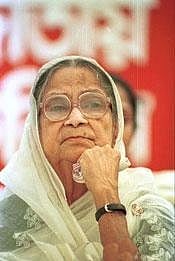
Poet Sufia Kamal remembered
Cultural and social organisations are marking the 97th birth anniversary of celebrated poet Sufia Kamal on Friday with a variety of programmes. The poet and writer, born in Barisal in 1911, was also throughout life a tireless social activist.
bdnews24.com News Service
bdnews24.com
Published :
20 Jun 2008, 08:34 AM
Updated :
24 Apr 2022, 08:35 PM
Dhaka, June 20 (bdnews24.com) – Cultural and social organisations are marking the 97th birth anniversary of celebrated poet Sufia Kamal on Friday with a variety of programmes.
Bangladesh Mahila Parishad, founded by Sufia, has arranged a lecture in her memory and a cultural programme at the BIAM auditorium, while a memorial programme is scheduled to be held at Chhayanat Sangskriti Bhaban at 7.30pm.
Sufia, born in Barisal in 1911, was a poet, writer and tireless social activist. She struggled throughout her life to establish a progressive society in which women could be empowered.
Sufia herself learnt Bangla, Hindi, English, Urdu, Arabic, Kurdish and Persian from home tutors, as women's education was prohibited during her childhood.
Her first poem, Bashanti (Of Spring), was printed in Saogat in 1926.
Sufia's literary career took off after her first poetry publication. Her first book of poems Sanjher Maya came out in 1938, bearing a foreword by Kazi Nazrul Islam. Sanjher Maya was translated into Russian in 1984, among other languages.
She was also the first editor of Shaptahik Begum.
In 1931 she became the first Bengali Muslim woman to be a member of the Indian Women's Federation.
Sufia Kamal was chairman of the Purbo Pakistan Mohila Committee formed in 1948. Her activism continued with the 1952 Language Movement. She established Wari Mahila Samity in 1954, Kachi-Kanchar Mela in 1956 and the Mahila Parishad in 1970.
Sufia's body of work reflects the struggle to preserve the Bengali language and culture against Pakistani influence and force. She also worked to bring those Pakistani officials to justice whom the Bangladeshis considered war criminals.
She operated a shelter in Kolkata during the communal riots in 1946, and during the struggle for independence in 1971, she worked to help women victims of the war.
Sufia Kamal died in 1999.
bdnews24.com/sm/my/rah/1419hours