Ancient Greece rises again in Singapore exhibit
Ancient Greece resurfaces in Singapore this week at an exhibit of classical sculptures and artefacts which aims to give Asians a glimpse of the cradle of Western civilization.
bdnews24.com News Service
bdnews24.com
Published :
07 Dec 2007, 08:17 PM
Updated :
17 Aug 2022, 04:42 PM
SINGAPORE, Dec 8 (bdnews24.com/Reuters) - Ancient Greece resurfaces in Singapore this week at an exhibit of classical sculptures and artefacts which aims to give Asians a glimpse of the cradle of Western civilization.
The 130 pieces, dating from the 5th century BC to the 1st century AD and loaned by the Louvre museum, form the first large-scale display of ancient Greek works in South East Asia.
They include larger-than-life marble statues of Greek gods, such as the "Venus of Arles", which weighs over 450 kg and an equally impressive rendition of her lover, Ares, the god of war.
Heads and busts, vases and vessels and ornaments made from marble, terracotta, gold, silver and bronze are also on show.
"These are aesthetic masterpieces with very obvious appeal," Szan Tan, the exhibition's National Museum of Singapore curator, told Reuters. "Even the workers uncrating them were stunned."
The artefacts, which have also been exhibited in China, are on loan from the Paris museum which is renovating its Greek and Hellenistic galleries for the first time in about 200 years. The Louvre rarely loans more than a dozen items at a time.
"Greek art is the foundation of all Western art and by coming to Asia, we were looking at a dialogue of civilizations," said Herve Barbaret, the Louvre's deputy executive director.
"We wanted to bring these masterpieces to a public that might not be very familiar with them," he told Reuters.
Unlike the Louvre, the Singapore showcase displays the pieces under four themes that expose visitors to the lives of the ancient Greeks. In Paris, the artefacts are normally grouped according to material or type and are in various galleries.
With the help of illustrations and quotations from historic texts, visitors can visualize ancient Athens, the lives of women and children, the sports competitions that preceded the Olympics, the dramas that form the basis of modern theatre and the faith and philosophy of a people whose influence lingers until today.
"Asia is so modern and Westernised in many ways and I believe many Asians would be surprised to see that the source of this modernity is actually ancient Greek civilization," Tan said.
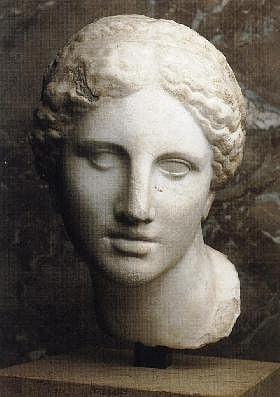
One of the exhibit's highlights is a marble head of Aphrodite, the goddess of love. Known as the "Kaufmann Head", it dates back to between the 3rd to 1st century BC and was discovered in Asia Minor in around 1885.
The head is sculpted in the style of renowned Greek artist Praxiteles and its slightly tilted head, oval face, hooded eyes and elongated neck were regarded as the epitome of beauty.
To help visitors appreciate this rare exhibit, and bring the cold stone to life, the museum is offering plays, film screenings, dance performances and lectures about the Greeks.
Fashionistas can also try on replicas of the gowns worn by the ancients in an interactive display, children get specially tailored tours and students and artists are welcome to borrow stools and sketch the artefacts and sculptures.
And for those seeking life-changing advice, Socrates offers some words of wisdom, pasted onto the gallery wall: "The righteous man has nothing to fear, neither in life, nor in death, and the Gods will not forsake him."
The exhibition titled "Greek Masterpieces from the Louvre" will be held at Exhibition Galleries, National Museum of Singapore, Dec 9, 2007 to Mar 16, 2008, 10 am - 6 pm daily. Find more information at www.nationalmuseum.sg
bdnews24.com/rah/0153hours