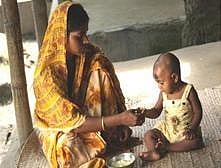
Volunteers to help fight U-2 malnutrition
The National Nutrition Services will appoint volunteers to support mothers with proper feeding practices, writes Nurul Islam Hasib
bdnews24.com News Service
bdnews24.com
Published :
29 Apr 2012, 04:21 PM
Updated :
09 Aug 2022, 03:43 PM
Nurul Islam Hasib
bdnews24.com Senior Correspondent
Dhaka, Apr 29 (bdnews24.com) – In its bid to intensify fight against malnutrition in Bangladesh, the National Nutrition Services (NNS) has decided to appoint volunteers to support mothers at home with proper under-2 feeding practices.
"They will work under the supervision of community clinics," Dr S M Mustafizur Rahman, programme manager of the newly-launched NNS told bdnews24.com.
Malnutrition still dogs the country, largely because of lack of knowledge about proper feeding practices, despite its progresses on a number of health indicators.
To rev up the fight, the government has mainstreamed nutrition interventions into health and family planning services, winding up the earlier National Nutrition Programme (NNP) in July 2011 when the ongoing five-year sector development programme HPNSDP launched.
"Three workers will be appointed under each community clinic," Dr Rahman said. They would be appointed once they completed the training of community healthcare providers, who oversee field workers around community clinics, he added.
Over 11,000 such clinics are operating across Bangladesh.
As the first two years of a child's life is considered as a 'window of opportunity' when poor nutrition can stunt their growth and permanently damage their ability to learn and succeed in school, the NNS has accorded under-2 nutrition top priority.
"It is critical to act during the first two years of a child's life. If the window of opportunity closes, it is too late to reverse the damage," said Dr Rukshana Haider, chairperson of Training and Assistance for Health and Nutrition Foundation.
According to Infant and Young Child Feeding Practices (IYCF) rules, a child has to be breastfed within first hours of birth and continue up to six months, and given homemade food after six months alongside the breastfeeding.
Starting homemade food before six months is too early, while it is very late if it starts after one year.
But Bangladesh Demographic and Health Survey (BDHS) showed only 21 percent families strictly follow the under-2 feeding practices in the country where 41 percent children are too short for their age while 36 percent are underweight.
"None has the knowledge of proper feeding practices until someone teaches them," programme manager Dr Rahman said.
"People do not know what type of food they should offer to their babies and when should they start."
He said based in the community, volunteers would be in the 'best position to help mothers cope with the day-to-day challenges of feeding their children'.
A paediatrician Dr Khurshid Talukder said many parents ask him if they should give their one-year baby fish and meat. "But it is already late."
Professor of neonatology Mohammad Shahidullah of Bangabandhu Sheikh Mujib Medical University said community level support was imperative to help mothers feed their babies properly.
"There should have supportive policy for mothers. Someone should show them the way of positing the babies during the breastfeeding," he said terming mothers complain of insufficient breast milk a 'myth'.
"When undernourished children become adult," he said, "they are more likely to suffer from chronic diseases like diabetes and heart diseases."
bdnews24.com/nih/nir/2204h