SPECIALLeprosy still burdens Bangladesh
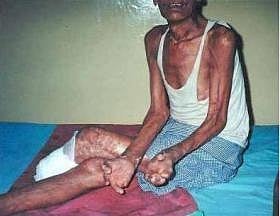
At least 5,000 people are being diagnosed with leprosy every year in Bangladesh, despite the fact that this age old debilitating disease was officially eliminated in 1998.
bdnews24.com News Service
bdnews24.com
Published :
30 Jan 2011, 07:07 AM
Updated :
10 Aug 2022, 04:17 PM
Nurul Islam Hasib
bdnews24.com correspondent
Dhaka, Jan 30 (bdnews24.com) –At least 5,000 people are being diagnosed with leprosy every year in Bangladesh, despite the fact that this age old debilitating disease was officially eliminated in 1998.
Experts blame prevalent stigma and lack of adequate government intervention for taking so long to eradicate the disease of which cure is available for free.
"Leprosy is eliminated in World Health Organisation's definition," Dr Aung Kya Jai Maug, medical director of Damien Foundation Bangladesh told bdnews24.com on the eve of world leprosy day Sunday.
"As the prevalent rate is below 1 per 10,000 people, WHO considers it eliminated," he said, adding, but its prevalence is more than one in highly endemic Bangladesh districts along the border.
Blaming continued stigma surrounding the disease, he said that they still saw patients coming at quite an advanced stage of disease and the main reason is they fear of rejection by the society if they are known to have the disease.
Monjuara, 22, of Banaripara upazila in Barisal, quit school in 2004 when she noticed white spots on her skin. Her parents told her not to disclose as they suspected it was leprosy.
Monjuara saw doctors in her upazila, but no one could identify the disease until a doctor in Barisal city advised her to go to the Dhaka's leprosy hospital.
The other day she was seen on her hospital bed with her bandaged fingers. Although she has been under treatment there for the past three months, she still hides the diseases for fear of social rejection.
Another patient, Chanda Rani Das, 36, was laying on the opposite bed of Monjuara for the last one month. No one except her brother comes to see her.
"I have two sons and two daughters. They do not come to see me. They are afraid," she said.
Recalling a case, an on-duty nurse said, a man with the disease was living with his family, but his food and belongings were separated. He was not even allowed to touch anything except his own.
"Many people still feel uncomfortable seeing leprosy patients. The patients themselves neglect the disease and hide it for fear of rejection," said Dr Abu Sayed Chowdhury at the leprosy hospital, adding, "They turn up at the hospitals after they suffer physical deformities including damaged hands, feet.".
"People worry about leprosy probably thinking that it spreads by airborne infection such as coughing and sneezing," said Dr Maug.
The first visible sign is a patch on the skin, sometimes associated with loss of feeling around that area, he said.
"But it is now believed that 99 percent people are naturally immune to the leprosy bacteria and once a patient begins treatment they are no longer infectious.
"Their deformities including damaged hands and feet, however, remain and that usually make family members and friends hard to accept the sufferers," he said, adding, that awareness is imperative to tackle the long-held worries and rejection about the disease.
But the government appears apathetic as it scrapped the national observance of world leprosy day in 2002.
Deputy programme manager of the government's leprosy eradication programme Dr Safir Uddin Ahmed said, the government scrapped observing the day nationally in 2002 as it was burdened with observing so many other days.
"Though people are still getting leprosy, the disease is not that much contagious like other communicable diseases," he told bdnews24.com.
He, however, acknowledged that people still reject leprosy patients. "But the attitude is changing."
Nilphamari, Gaibandha, Panchagar, Khagrachori and Bandarban are the leprosy endemic districts in the country. The disease can also be found in Dhaka slums.
Besides Bangladesh, many countries in Asia, Africa and South America still have the disease.
But Europe has been able to eradicate leprosy through proper treatment.
bdnews24.com/ nih/am/1300h