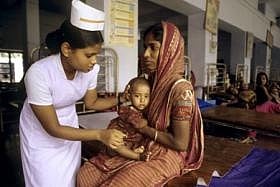
Scrap hospital fees for poor's access
Bangladeshis spend 65 percent out-of-pocket cost for health care, which in turn slips 5 percent of them into poverty every year, Nurul Islam Hasib was reading The Lancet.
bdnews24.com News Service
bdnews24.com
Published :
27 Sep 2012, 04:08 AM
Updated :
09 Aug 2022, 04:18 PM
Nurul Islam Hasib
Senior Correspondent
Dhaka, Sep 27 (bdnews24.com)—The world's leading general medical journal, The Lancet, says user fees 'should be scrapped' for greater public sector engagement in health system reforms to achieve universal health coverage (UHC).
The premier magazine made the call at its September issue in a collection of papers that make the ethical, political, economic, and health arguments in favour of universal health coverage. The papers were presented in New York at 6:30pm New York time on Wednesday to coincide with the UN General Assembly.
Responding to the challenge of inadequate resource for primary healthcare, extracting user fees have been encouraged from hospitals' patients in developing countries even by World Health Organisation before 2010's World Health Report that says it works as 'deterrents'.
WHO Director-General Margaret Chan has asserted that "universal coverage is the single most powerful concept that public health has to offer". At the centre of UHC is a package of services that are available when needed without causing financial hardship to the user.
The contemporary idea came as it was believed that small payments for each service would avoid wasteful use of health services or induce poor households to value the service more.
"Even a tiny user charge imposed at point of service can drastically reduce the access to health services by the poorest members of a poor community," Jeffrey D Sachs, Director, Earth Institute, Columbia University wrote in The Lancet.
Doing away with service fees, he argues, can lead to "a surge in access of health services". He termed the charging fees 'lazy thinking' and wrote from evidences that "even nominal co-payments can lead to massive exclusion of the poor from life-saving health services".
"Of course, the services must still be financed in some way. Public revenues rather than private out-of-pocket outlays (or private prepayments) will generally be needed," Sachs, also an acclaimed economist, wrote.
As every year 100 million people are pushed into poverty because they have to pay for health services directly, the WHO defines universal health coverage as access to healthcare without any economic hardship. And the key is to implement health insurance.
The idea of UHC is also being contemplated in Bangladesh where despite a robust health infrastructure people have to spend 65 percent out-of-pocket for care, which in turn slips 5 percent of them into poverty every year.
Though people get free drugs from hospitals, they have to pay a bit for every single service from an X-ray to a blood test – an amount government collects as user fees.
But officials say they are moving slowly towards UHC as they fear it could need additional money from the exchequer for implementation.
However, Jeanette Vega, Managing Director of The Rockefeller Foundation that supported the Lancet edition, in an interview earlier told bdnews24.com Bangladesh has all the prerequisites to adopt the idea of UHC.
Budget is not the problem to launch the relatively new idea, she said, "if a country has a clear political commitment".
Health rights activists Prof Rashid-e-Mahbub told bdnews24.com that healthcare becomes "inaccessible" to many poor Bangladeshi as "they have to pay for the service." "It discourages them."
He added they have long been pushing for identifying those poor and giving them a card as "pass so that they can get the free care at hospitals".
In The Lancet, the first of three Series papers explores the evidence on the links between expansions in coverage and population health outcomes.
The second paper looks at the political and economic dimensions of the transition to universal health coverage, and the third examines nine low-income and lower-middle-income countries in Africa and Asia that have implemented national health insurance reforms.
However, in the editorial it says universal health coverage in isolation is no guarantee of efficient and effective care.
"In addition to political will, UHC requires sufficient numbers of well-trained and motivated staff with adequate resources for prevention, diagnosis, treatment, and professional development, and—to thrive—a culture of good governance and aspirational attitudes."
"In this way, the spiral of impoverishment from disease can be replaced by one of prosperity driven by health."
The editorial said: "If governments question the popular support for resources allocated to health, they should consider that the first honour of the London Olympic Games went to the National Health Service, celebrated in the opening ceremony as a much cherished element of UK society."
The Lancet profiled the Rockefeller MD and the WHO Director General Margaret Chan in the edition.
bdnews24.com/nih/bd/0921h