Published :
21 Apr 2013, 03:27 PM
Updated :
09 Aug 2022, 10:32 AM
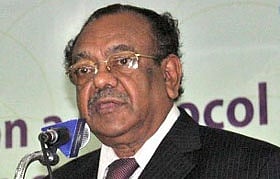
AFM Ruhal Haque finds it ‘not easy’ to implement the contemporary idea of ‘universal health coverage’ in the country.
“Every country has its own problem to implement it,” he said, “We have to find out our problems as well as ways to initiate it.”
The minister was speaking at a panel discussion on the closing of the two-day symposium on healthcare financing issues in Dhaka on Sunday.

Dhaka University’s Institute of Health Economics (IHE), with the support of Deutsche Gesellschaft fuer Internationale Zusammenarbeit (GIZ) GmbH and the Ministry of Health and Family Welfare, brought together global health economists for the symposium so Bangladesh could take pointers for its healthcare financing strategy.
The minister said his ministry found it difficult to deal with ‘health economics’ issues and wished to tie up with the IHE for ‘better collaboration and cooperation’.
He stressed on covering the poor first under the universal health coverage that his ministry targeted to implement by 2032.
The panel discussants highlighted the issues that need to be addressed before introducing the relatively new idea in Bangladesh to protect people from slipping into poverty and tackle emerging health challenges due to changing population.
In Bangladesh, a study shows people have to spend 65 percent out-of-pocket for medicare, which in turn pushes 5 percent of them into poverty every year.
The prepaid financing schemes ensure people’s access to healthcare without suffering a financial catastrophe.
Countries like Germany, Costa Rica, Mexico and Singapore where a large number of people are under formal employment are pooling a part of salaries for financing health services.
Many countries also use part of their general taxes or specific taxes like levying tax on tobacco products for health insurance.
In Indonesia, Sri Lanka, Kerala in India, Rwanda, and Ghana, the system has been developed within a decade despite resource constraints.
Speaking at the panel, Gonoshasthaya Kendra’s founder Dr Zafrullah Chowdhury identified healthcare providers’ ‘absenteeism’ in their workplace as a major impediment.
He said to implement universal health coverage ‘quality of care’ should be ensured first. But before going ahead, Bangladesh has to device its own way of implementing universal health coverage.
“If we try to replicate a country, it will not work here,” he said.
Health analyst Dr Mohammad Abdus Sabur said before moving ahead with the idea, the Ministry of Health and Family Welfare needed to increase its capacity to utilise money.
He said the ministry was getting less and less budgetary allocation every year, “but if you ask for more, the finance ministry would say you could not use whatever money was allocated”.
Dr Sabur said it would ‘not be possible’ to implement universal health coverage with the ‘unreliable public sector and too costly private sector’.
“People don’t know whether they will get doctors or medicines at public hospitals. They don’t have faith,” he said.
“You have to streamline your service providers where people will go for services. Unless they have faith, they will not enrol for the prepaid financing system,” he told bdnews24.com after the discussion.
Director of WHO’s Eastern Mediterranean Region’s Health System and Services Development Dr Sameen Siddiqi also said for Bangladesh it would be ‘difficult’ to introduce universal health coverage ‘without improving quality of care’ in the public as well as private sectors.
He said people ‘have to trust the quality of care’.
Dr Siddiqi acknowledged Bangladesh’s ‘historic successes’ in health’s programmatic reform like family planning, child health, but said ‘systematic reforms would be a challenge’.
“System reforms are much more structural reform. They are long term. They are as political as they are technical.”
Health economists from India, Indonesia, Philippines, Egypt and Germany joined the symposium with the local academics, practitioners and policymakers.
Organisers say the symposium has been organised in the backdrop of Bangladesh’s recently developed healthcare financing strategy for the next 20 years.