


Published : 05 May 2014, 01:47 PM
Updated : 19 Oct 2022, 07:29 PM


Also Read:
Team to probe watermelon deathsProf Mahmudur Rahman said they had tested a leftover part of that watermelon for 36 poisonous chemicals in the UN-FAO supported national food safety laboratory.
“We did not find any chemicals,” he told journalists on Monday.
The Institute of Epidemiology Disease Control and Research (IEDCR) was trying to find out the reason of the mass illness and deaths reportedly after consuming watermelon at Kumarkhali.
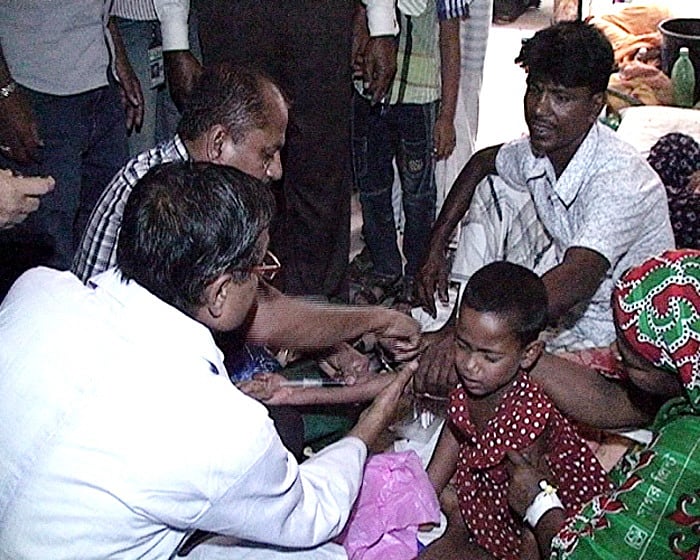
At least 30 people including seven members of a family fell ill on Apr 20 after consuming ‘a watermelon’. Out of them one died a day later.
The institute also look into the causes of a similar incident in Manikganj on Apr 22 where nine people were admitted after consuming edibles and did not find any chemical link.
Prof Rahman said they found “some bacterial growth” in that watermelon, but it was yet to specify the species.
But two victims were tested positive for E.coli bacteria, which is poisonous of its kind, that might cause diarrhoea, vomiting and stomach pain.
IEDCR sent the team on Apr 20 when the news of illness after eating watermelon spread. The team started conducting their investigations and collecting samples from Apr 21.
By this time, patients were given antibiotics for their conditions, meaning it would be less likely to get bacteria in patients’ blood samples collected after 24 hours.
At least 22 patients’ blood, 14 urine and 13 stool samples were tested for salmonella, shigella, campylobacter, cholera, rota virus and E.coli, the director said.
“The watermelon might be broken or cut when it was kept at home overnight before eating. That can give the chance to bacteria to grow,” he said, some of the patients complained they got rotten smell while eating.
He said the watermelon sample in which the lab found bacteria might also got infected after eating as they had collected a leftover part which was littered on the floor, a perfect environment for bacteria to grow.
“So scientifically we cannot come to any conclusion, but it is very unlikely there were chemicals in watermelon,” Prof Rahman said.
The National Food Safety Lab tested formalin, 16 types of organo-phosphorous compound which are insecticides use in crops, artificial dye that can be injected to look the watermelon red inside, and 20 organo-chlorine compounds.
“The lab tested those chemicals which are usually used in the field or any crops or fruits,” he said.
Though media had reported that two siblings –Anik and Smrity – died, the IEDCR director said they had found only one died.
‘Anik’ was shifted to the Rajshahi Medical College Hospital where he survived.
However, there had been no-autopsy of the deceased and IEDCR could not collect any sample from the deceased to arrive at any conclusion about the cause of death.
But their investigation found that everyone shared the watermelon, which was the only common item they ate in that period.
“In such mass illness, generally you will not find anyone in the family to take care of those who are sick. They suffered from diarrhoea and vomiting and the child (9-year-old) might have died due to lack of care,” Prof Rahman said.
File Photo







