


Published : 20 Jan 2014, 02:56 PM
Updated : 08 Aug 2022, 06:24 PM


More than 50 million children, one-third of the total population, between nine months and 15 years of age will receive the combined measles-rubella (MR) vaccine during the three weeks campaign, government’s EPI in a media briefing said.
The two viral infections almost have similar symptoms – rashes and fever. But rubella can cause birth defects.
Infants born to mothers who contract rubella in the early stages of pregnancy are prone to being born with heart defects, hearing and vision impairment and mental retardation.
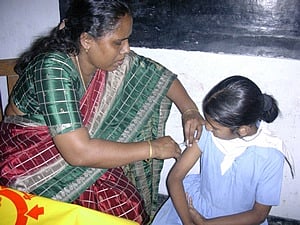
The vaccine will stop the transmission of rubella from mother to child during pregnancy and prevent children from being born with severe birth defects.
It will also protect children against measles, which is highly contagious, EPI officials said.
The Global Alliance for Vaccine and Immunisation (GAVI) is supporting the campaign in Bangladesh that will need Tk 2420 million only for buying vaccines.
Syed Abu Jafar Md Musa who oversees the Expanded Programme on Immunisation (EPI) said children below five years of age would also get an oral polio dose with the MR jab.
The campaign will start from schools on Jan 25. More than 120,000 outreaches, 24 in each union, will administer the vaccines from Feb 1.
Panic haunts authorities
Musa said the vaccine was ‘safe’ and that in the whole process WHO and Unicef were working closely with them, a message he sent out to infuse confidence among the parents so that they ensure their children received the life-saving dose.
Bangladesh’s immunisation programme is widely acclaimed globally.
Global Alliance for Vaccines and Immunisation (GAVI) has awarded it twice for maximum coverage.
But government officials are worried as a vitamin campaign last year amid political turmoil was marred by rumours of deaths after feeding vitamins.
The government assuaged concerns with its experts going on media to rubbish the claims which had gone viral on social media and TV.
“It’s safe,” President of Bangladesh Paediatric Association Prof Md Ruhul Amin said at the briefing urging all parents to take their children to a vaccine centre for the jab.
He said only on “rare occasion” would some problems occur. “And that is very simple. When you take an injection, the injected spot sometimes swells up. Body temperature of the child might rise. This is usual”.
He also appealed to media to see this ‘life-saving’ campaign happens ‘positively’.
The EPI official Musa said they had instructed their healthcare providers to stay at least an hour more after the last delivery to address any problem a child might face.
The campaign would run from 8am to 3pm.
“It’s a very big task. Our target is to reach 52 million. We need your help,” he also told media.
He said those who would suffer from ‘serious illnesses’ during the campaign would not be vaccinated.
“They (ill) can take the vaccine any day from our routine immunisation sites,” he said.
Rubella cases up
Bangladesh officially launched the combined (MR) vaccine in September 2012 as part of its routine immunisation programme replacing the only-measles vaccine for children.
According to the EPI, the ‘extensive’ vaccine campaigns helped lowering the number of measles cases, but rubella cases have gone up belatedly.
Last year, nearly 3,000 lab-confirmed rubella cases were found against only 211 measles cases.
They calculated the rubella prevalence at more than 19 in every one million people while measles cases stood at only 1.4 in a million.
“The effects are deadly, but once immunised, the vaccine give life-long protection,” said Prof Mohammad Shahidulla, a neonatologist at Bangabandhu Sheikh Mujib Medical University (BSMMU).
There is no nationwide study about the number of children born with birth defects, but child experts say they find many children with heart defects.
Most of them, experts believe, are linked to rubella infections from their mother when in the womb.
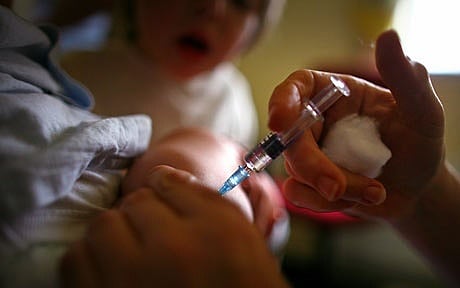
A decade old hospital-based study on 198 hearing-impaired children in Bangladesh found that 74 percent were linked to rubella infection of their mothers during early pregnancy.
The Paediatric Cardiology Department of BSMMU received around 3,000 children with heart defects at birth between 2004 and 2010.
The virus can also cause sudden abortion in 50 percent cases.
The WHO guidelines on rubella elimination say that its vaccination can be introduced in the national immunisation schedule only in countries where the measles vaccination coverage is high.
It aims to eliminate measles-rubella in at least five of its six regions in the world by 2020.
The measles coverage is above 85 percent in Bangladesh, according to the EPI that started off in 1979 to reduce child deaths from the vaccine-preventable diseases.
It conducts round-the-year immunisation programmes through its outreach centres across Bangladesh.
Also Read:
Measles-rubella vaccine launched






