'Keep eye on food companies, ads'
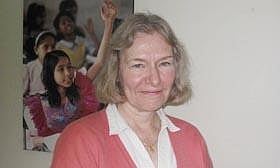
Jean Baker, Project Director of Bill and Malinda Gates Foundation's initiative, tells Nurul Islam Hasib Bangladesh should 'find a balance' in the advertised food and its effect on families.
bdnews24.com News Service
bdnews24.com
Published :
26 Oct 2012, 03:05 PM
Updated :
09 Aug 2022, 04:25 PM
Nurul Islam Hasib
Senior Correspondent
Dhaka, Oct 26 (bdnews24.com)—Bangladesh should take a 'fresh look' at the role of national and international food companies and their commercial adverts given the high burden of malnutrition, says an American nutritionist stressing proper under-2 feeding practices.
In an interview, Jean Baker, Project Director of Bill and Malinda Gates Foundation's initiative Alive & Thrive, told bdnews24.com that each country should 'find a balance' in the commercially advertised food and its effect on families.
Baker who has 30 years experience in working with international public health, mainly on nutritional issues, was in Bangladesh this week to launch a communication tools for promoting hand washing with proper under-2 feeding practices in a way to reduce stunting.
It has been launched at a time when a study found few people practice hygiene in Bangladesh where the burden of malnutrition is even higher than African nations like Uganda, Rwanda and Sudan.
The latest Bangladesh Demographic and Health Survey (BDHS) found 41 percent children under-5 are stunted while 36 percent are underweight.
"I was watching televisions (in Bangladesh) and looking at the commercials of junk food," Baker said, "It's worrying that fathers and mothers would spend money on crisps, or biscuits or other energy drinks which have little nutritional value, instead of buying eggs, fish or something else that are really good."
Alive & Thrive works on improving nutrition in infant and young children by increasing rates of exclusive breastfeeding and improving complementary feeding practices in three malnutrition-burdened countries –Bangladesh, Ethiopia and Vietnam, in three different geographies.
The six-year project with the Bill and Malinda Gates Foundation's $ 78.6 million grants started in 2008 targeting 16 million children of those countries.
Baker said there is a code of marketing for breast milk substitutes that related more to the formula milk. "But I think taking a fresh look at the role of advertising and the role of international and national food companies is important."
"We should try to shift the understanding so that families can buy real food, their kids get real food instead of those commercially advertised," she told bdnews24.com on Tuesday.
Baker said there was an ongoing debate in the United States that "these companies have social responsibilities to help address the nutrition issue in the United States where we have obesity that is over-nutrition."
"Many nutritionists feel that commercial companies are marketing foods that are not nutrition worthy."
She suggested generating statistics to learn what influences television commercials have on buying by families and strong government regulations to change behaviour (of taking food).
In the interview, Baker talked about a number of issues including global priorities on nutrition and the use of ready-to-use-therapeutic-food (RUTF) to correct malnutrition which face strong resistance by a section of Bangladeshi nutritionists who term it "a threat to local food".
"There were ups and downs on nutrition priorities. In 1990s nutrition was overturned by HIV. It got less attention, less funding that translated into less priority."
"But we are lucky in many ways now. There is much more global recognition of nutrition. There are a number of global initiatives," she said citing UN's Scaling Up Nutrition (SUN) movement and USAID's Thousand Days Campaign.
She said each country has the responsibility in sensitising its people about what is great for them. "It's not our (Alive & Thrive) job to suggest the government of Bangladesh, Ethiopia and Viet Nam what's appropriate."
Baker said RUTF saved lives in case of emergency situation of a severely malnourished child. "Now there are increasing interventions to see whether it can be used for prevention of malnutrition as well, but certainly not by eliminating local foods.
"We want families to feed what they have and what's available. The point of local food should always be emphasised."
The latest BDHS showed the rate of exclusive breastfeeding jumped to 64 percent in 2011 from 45 percent in 2007. Baker said, "It does suggest there are some changes occurring in Bangladesh in infant feeding practices that are changing in the right direction."
She said it was "quite encouraging and exciting" because changes in breastfeeding mean changes in mortality.
"And Bangladesh had done well in couple of MDGs including maternal and child mortality. So, trends are all going in the right direction."
But according to her, the challenge is in complementary feeding "because in many ways it is a less understood behaviour".
"And it is affected by a number of things including handwashing and hygiene."
Citing BDHS, she said, a lot of children become sick due to infection that affects their appetite and ability to absorb nutrients they need from foods.
"But if we change the practice in six to 12 months of a baby's age then lots of things can be avoided.
"We can avoid a lot of malnutrition. It also changes behaviour. If we can introduce a variety of foods in this age, the child will respond to the habit later on."
She said the Gates Foundation asked them to build a model approach that can be adopted by other countries of the region.
The communication tools she launched Monday night in Dhaka were focused on handwashing with running water and soap at the convenient place easy for the mothers to remember handwashing before preparing a variety of complementary foods for the child between six months and 24 months.
She said the adverts would go on televisions on Friday as their media monitoring found Friday a pick day for Bangladesh when women watch movies and husbands watch news.
bdnews24.com/nih/bd/1812h