


Published : 16 Jan 2014, 05:49 PM
Updated : 23 Apr 2022, 02:09 PM


Pankaj Saran said the initiative could be “short term as well as long term”.
He suggested a brainstorming roundtable in Dhaka.
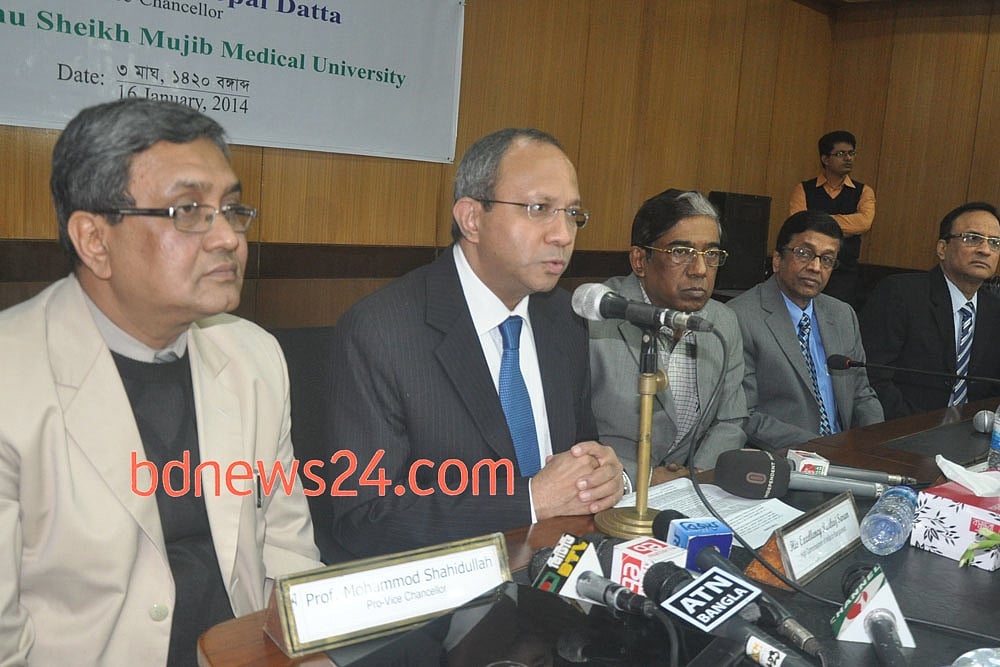
The envoy was speaking at the Bangabandhu Sheikh Mujib Medical University (BSMMU) where India has donated state-of-the-art cancer treatment and ultrasound machines.
The Brachytherapy machine, which is also known as internal radiotherapy or sealed source of radiotherapy, is needed mainly for “effective” treatment of cervical, prostate and breast cancer.
Along with the ultrasound machine, the total project costs more than Tk 30 million.
The envoy said despite bilateral engagements in different sectors, it took more than four decades to start working jointly in the health sector.
“We need to do much more together,” he said terming the delay as “regrettable”.
“It’s regrettable and sad reflection of both of our people and both of our governments (not working together in health),” he observed.
The first MoU on cooperation was signed in February last year.
The envoy said the first joint working group meeting after the MoU would be held “very shortly”.
He said it will prepare an action plan that will include facilitation of visits of trainees, experts and professionals to each others’ country. The proposed action plan will also chalk out programmes of cooperation in the areas of medical treatment and scientific research.
Before the MoU, the initiative of cooperation was taken in Sep 2011 during Prime Minister Manmohan Singh’s Dhaka visit.
A joint statement issued during the visit agreed to set up a programme for training of Bangladeshi doctors in premier Indian medical institutions.
There have been exchange visits among the BSMMU, All India Institute of Medical Sciences in Delhi and Postgraduate Medical and Educational Research at Chandigarh.
Thousands of Bangladeshi patients go to India for treatment, but the envoy said only few used to go to the government hospitals.
Last year after the Rana Plaza building collapse, one of India’s leading NGO Jaipur foot came to find out ways of helping people with artificial limbs.
The envoy said the process was on with the National Institute for Orthopaedic Treatment to provide 500 lower limbs and 100 upper limbs.
“We can gradually build up more cooperation,” he said.
The BSMMU authorities, including the vice-chancellor Prof Pran Gopal Datta, were present during the unveiling ceremony of new equipment.










