Published :
28 Dec 2013, 07:44 PM
Updated :
09 Aug 2022, 11:27 AM
The initiative has been taken on recommendations of a UN set Commission on Information and Accountability (COIA) in the wake of a global slow progress of achieving MDG 4 and 5, that had set targets to cut maternal and child deaths by 2015.
Bangladesh is well on track in both MDGs but being one of the 74 countries that accounted for 98 percent of all maternal and child deaths, responded to the UN call with World Health Organisation’s support.
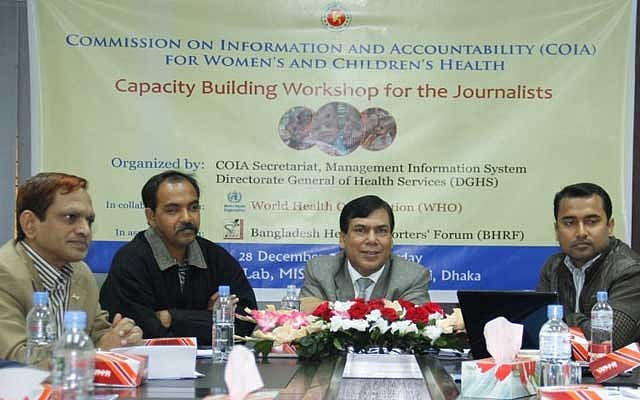
Prof Abul Kalam Azad, additional director general for planning and development of the government’s health services, said apart from WHO piloted two upazillas in Tangail districts they would implement the strategy across Bangladesh within the existing system.

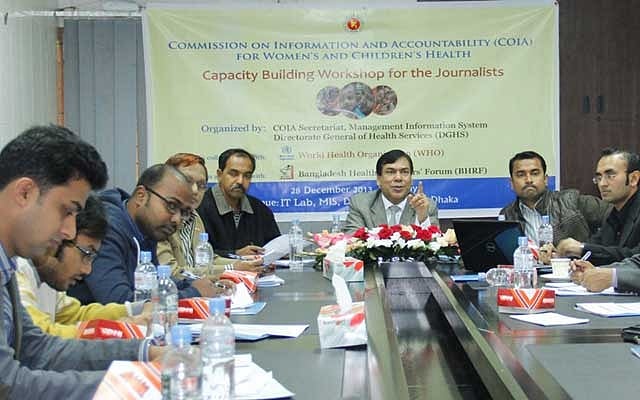
Management Information System (MIS) of the Directorate General of Health Services, of which Prof Azad is also the Chief, will act as its Secretariat, he said at a workshop jointly organised with the Bangladesh Health Reporters’ Forum.
A “Country Accountability Framework” has been devised that will guide the effort of tracking down resources and programmes.
All data related to the maternal and child health would be collected using “a single system”, he said.
“We have strong private sector, NGOs who work separately from the government. But in this system we will maintain a single standard for reporting and monitoring."
He said they had already prepared an online form that health workers, family planning workers, community healthcare providers at community clinics, NGO workers and others who work in the health sector would use.
With this form, they will collect all information related to maternal and child health that also include immunisation coverage and care during pregnancies.
“So it’ll give us a standard picture of the local health system and we will review this time to time and make plans for improvements,” he said, adding, they had identified which government institutes would play what roles.
The Health Economics Unit will monitor resources that include donors and UN funds for the country.
“It will be a cycle, ‘monitor, review and act’,” Prof Azad said.
He said the government facilities had computer and internet to fill up forms online.
“From next month, we’ll start giving laptop to community clinics across Bangladesh so that its workers can also collect information,” he said.
The COIA initiative came after the UN Secretary General launched a global strategy for women and children health with a goal to save 16 million lives by 2015 in the world’s 49 poorest countries.
The Secretary General set the target when a UN high-level meeting in Sep 2010 renewed pledges worldwide to achieve MDG 4 and 5 after review showed they were the furthest from being achieved by 2015 out of eight MDGs.
With Canadian Prime Minister Stephen Harper as Chairperson and Richard Horton, editor of the medical journal The Lancet’s as the member secretary, the Commission with 30 commissioners started its work in Jan 2011.
The Commission’s 10 recommendations focus on “improving information for better results, improving tracking of resources and stronger oversight of both results and resources at national and global levels”.
The initial target to implement it was by 2015, but it was found difficult to implement it in all countries.
“Now we basically look forward to carry it for full implementation after 2015 post-MDGs era,” Prof Azad said and that WHO started it in Bangladesh this month.
Health Reporters’ Forum President Toufiq Maruf chaired the workshop that was moderated by its General Secretary Badruddoza Sumon.