


Published : 13 Apr 2021, 10:58 PM
Updated : 08 Apr 2022, 12:52 PM


They insist that taking appropriate steps after identifying infected individuals can potentially be the key to reining in the runaway rate of positive cases.
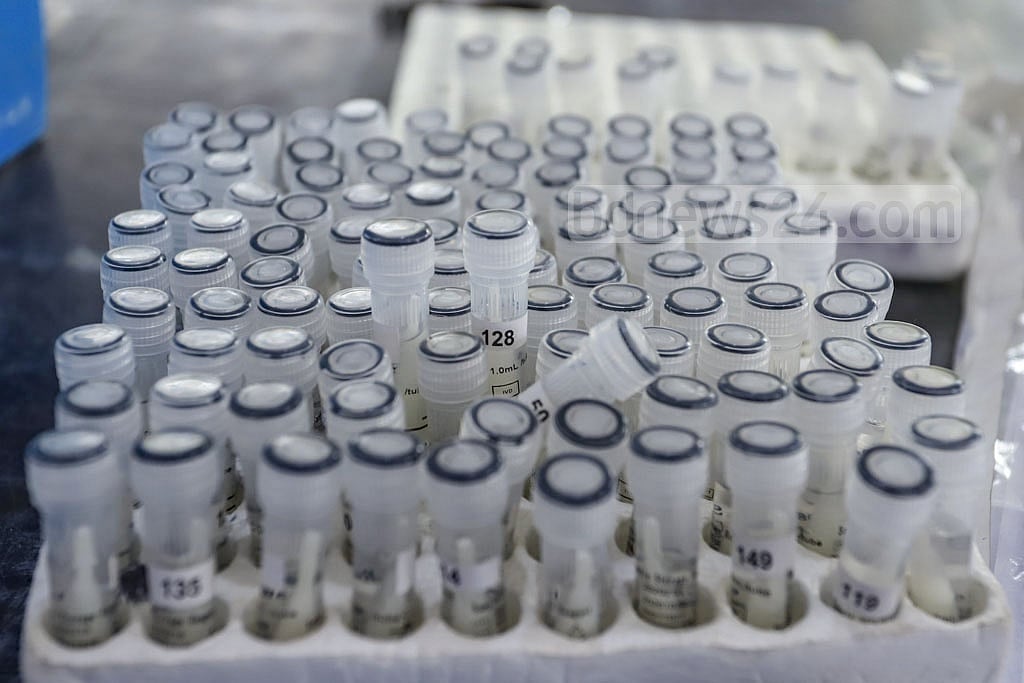
According to data released by the government, as many as 34,968 samples - the highest in a day - were tested across the country in the 24 hours to 8am Monday. From them, a total of 7,201 people tested positive, yielding a positivity rate of 20.59 percent.
Following the identification of the disease in China in December 2019, Bangladesh carried out its first tests on Jan 21, 2020 and the first positive case was identified on Mar 8 that year.
As of Monday, the caseload surged to 691,957 positive cases among 5,037,833 samples tested so far, which takes the infection rate to 13.74 percent.
Bangladesh has vaccinated more people in two months than it put through COVID-19 testing over the past 15 months.
According to Worldometers, a reference website that provides counters and real-time statistics for diverse topics, Bangladesh sits at 50th in terms of COVID-19 samples testing.
In Bangladesh, as many as 30,354 people in every million are undergoing tests.
The cases of infection of the 17 countries on top of this list are lower than that of Bangladesh, although the numbers of tests being carried out in those countries are higher.
However, the Directorate General of Health Services has increased the bulk sample tests since the infection rate in Bangladesh skyrocketed at the end of March.
Over the last two weeks, as many as 420,808 samples were tested, which is 30,058 tests per day on average.
During these record testings, the caseloads and daily fatalities have been jumping at record rates as well. In the last 14 days, Bangladesh registered an infection rate of more than 23 percent in five days.
Public health specialist Dr Mushtuq Husain told bdnews24.com, “We need to carry out more tests. Antigen tests in Dhaka city need to be increased drastically because the cases of infection are at an all-time high. Antigen tests are successful only where there are more infections.”
“The tests need to identify infections below 10 percent. That would be standard. So more tests to need be carried out as well. The infection will not spread if the infected can be treated in isolation,” added the former chief scientific officer at the IEDCR.
Dr ABM Abdullah, former professor at Bangabandhu Sheikh Mujib Medical University or BSMMU’s Department of Medicine, believes that apart from carrying out more tests, turning attention towards other methods of containing the pandemic is crucial.
“More tests would be good. It would be great if isolating and quarantining the infected could be ensured after tests… but no tracing is being done either. People are not maintaining isolation and quarantines. That does not help at all,” Dr Abdullah told bdnews24.com.
Professor Nazrul Islam, a member of the national technical advisory committee on COVID-19, feels failure in taking these steps effectively will be detrimental to containing the pandemic crisis.
A former vice-chancellor at the BSMMU said, Dr Nazrul said, “Are we being able to take any steps based on the information being drawn from the tests? Why did those who died ended up so?”
“If the number of tests are increased, infection would not drop below 10 percent. Isolation and quarantines are mandatory. Are we successfully isolating all those who are contracting the disease now?
“No we are not.”
Prof Nazrul feels proper steps must be tailored according to the daily coronavirus bulletin being provided by the health directorate.
“From the information we are getting from the tests everyday, we have to keep an eye out to see whether everybody was isolated, whether they were getting treatment… those who died, whether they did so after treatment? Or did they pass away naturally? Did they die due to a lack of treatment, or due to oxygen deficiency - we have to think about these things.”
However, ASM Alamgir, chief scientific officer at the IEDCR, claimed that ‘all methods’ are being followed in containing the infection, not just in testing samples.
He is hopeful that the positive results of the government’s steps in curbing COVID’s spread will ‘soon be visible’.
“It is one thing to reduce infections by testing samples, isolating and tracing contacts, but following the health rules as a compulsion is another.
“You can’t get out of home and have to stay in lockdown. It means all those places have to be avoided from where the disease is transmitted or those have to be shut down.”
“We were able to close down the tourism centres, like the beach. It’s been 10 days that a transmission site has been shut. It’s positive impact will be apparent within this week.
We’ve been able to cut off inter-district communication. So the disease can no longer spread from one district to another. That, too, is a protocol that travelling between cities have to be cut off. That was also done.”
Mask-wearing is on the rise and it’d be better if it increased more, if the people in the populated cities do not get out of home too much and maintain physical distance in Dhaka, Alamgir said.
“All these things have to be done at a time. Such high transmission has to be reduced by doing all these together, that’s the rule,” he added.







