EXCLUSIVEPricey polio campaign may stop
The government would say the National Immunisation Day was needed to get polio-free certificate from WHO, but there's no such certificate for a particular country, Nurul Islam Hasib reports.
bdnews24.com News Service
bdnews24.com
Published :
02 Oct 2012, 02:13 PM
Updated :
09 Aug 2022, 04:19 PM
Nurul Islam Hasib
bdnews24.com Senior Correspondent
Dhaka, Oct 2 (bdnews24.com)—Bangladesh may stop the costly special polio campaign it has been doing every year since 1995 since the target to be free of the virus has been achieved.
According to the Expanded Programme on Immunisation (EPI), the National Immunisation Day (NID) is observed regularly, barring in 2005, with each costing around Tk 1 billion.
But, as 2006 was the only year after 2000 when children were diagnosed presumably with vaccine-induced polio, questions were asked whether to continue with the special campaign in Bangladesh where EPI's routine immunisation coverage is more than 95 percent.
According to Global Polio Eradication Initiative's website, "Three to five years of NIDs are usually required to eradicate polio, but some countries require more time, especially those where routine immunization coverage is low."
Bangladesh was polio free after five years of NIDs, though it recurred only in 2006. The routine immunisation coverage was also globally acclaimed.
The Polio Eradication Initiative is a public-private partnership led by national governments and spearheaded by the World Health Organization (WHO), Rotary International, US CDC, and the UNICEF.
Before the NID, the government used to tell the media that they had to continue with the campaign to get polio-free certificate from WHO. They also argued that the neighbouring India was not polio-free.
But there is no such certificate for a particular country. According to the Polio Eradication Initiative website, WHO issues polio-free certificate to a region, not an individual country.
As on today, of the six WHO regions, three were awarded the certificate. The American region got the certificate in 1994 when 35 member states remained polio-free for three years, while Western Pacific region's 27 states collectively achieved the certificate in 2000 and Europe's 52 states in 2002.
In South East Asia region, Bhutan remains polio-free for the last 26 years, but did not get certificate as all the countries of the region were not polio-free.
According to WHO's Global Certification Status, this region' 11 countries are polio free now, but will be certified only after maintaining the status for three years.
National Professor M R Khan, who is a technical committee member for the NID observance, told bdnews24.com: "We don't need to observe NID now since India is free."
Asked why it was continued, he said: "It was needed as India was not free."
When asked, Health and Family Welfare Minister AFM Ruhal Haque told bdnews24.com: "We will stop after discussion (in the technical committee)."
"We'll not do it if it's unnecessary as it costs a lot of money." He said of the around Tk 1 billion needed for a single NID, the government has to spend more than 90 percent.
He, however, said the then BNP government continued it.
At least four officials of EPI who cannot be named also confirmed bdnews24.com that none of the 11 countries in this region now observe nationwide NID, except Bangladesh.
"In case of a new detection, there is a system of immunising 200 families around the new case."
They hinted at a 'vested interest' in observing the NIDs and pushing forward the idea of certification.
Only in 2006, according to the EPI record, they observed three NIDs when 18 cases were found saying that the virus came from India as there was no NID in 2005.
But a document obtained by bdnews24.com showed that the children who were found to have been contracted polio in 2006 were fed as many as 23 doses of vaccine, which points to the fact that it did not have anything to do with the absence of NIDs in 2005.
Before 2006, Bangladesh reported one polio case in 2000, 29 cases in 1999, 10 in 1998, five in 1997 and 16 in 1996.
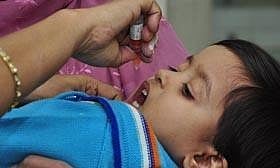
In a NID, children under five years receive oral polio vaccine (OPV) in two rounds, one month apart, and two doses in each round.
The last NID was observed on Jan 9 and Feb 11 this year.
Globally, polio remains endemic in three countries – Afghanistan, Nigeria and Pakistan. According to WHO, Nigeria belongs to Africa region while Pakistan and Afghanistan are bracketed in Eastern Mediterranean region.
bdnews24.com/nih/bd/1912h