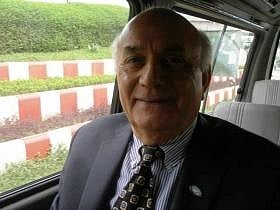
'Donate cornea, even religion supports it'
President of International Federation of Eye and Tissue Bank Mahmood Farazdaghi tells Nurul Islam Hasib how and why posthumous cornea donation should be encouraged.
bdnews24.com News Service
bdnews24.com
Published :
29 Sep 2012, 01:00 PM
Updated :
09 Aug 2022, 04:18 PM
Nurul Islam Hasib
bdnews24.com Senior Correspondent
Dhaka, Sep 28 (bdnews24.com) – 'Neglect' leads to low collection of posthumous cornea in Bangladesh, despite its growing need, President of International Federation of Eye and Tissue Bank Mahmood Farazdaghi says.
In an interview, the President of the USA-based membership network of eye and tissue banks told bdnews24.com that the government's 'two' initiatives and a 'special' attention can help thousands of blind to see the light.
"Religion is not the hindrance," he said. He is on a visit to review Bangladesh's two eye banks accredited by his Federation.
"These are technically and medically very good set-up, but the collection is very low," Farazdaghi says.
According to the Sandhani National Eye Donation Society that leads Bangladesh's cornea collection since 1984, only 100 corneas can be collected against the annual 800 enlisted demand.
"The actual demand is very high," Farazdaghi said. His estimate based on figures in neighbouring India suggests Bangladesh has 500,000 corneal blind right now.
"The number is adding up every year," he said calling it 'neglected blindness' in Bangladesh as he believes 'none accords it priority'.
"Ophthalmologists, the government and even patients do not pay attention," he said.
Farazdaghi said eye surgeons do not spend time to make people aware and they attach less importance as 'corneal grafting is not as easy as cataract surgery' that gets number one priority in Bangladesh since it is a leading cause of blindness.
"If you don't pay attention to corneal graft, you don't pay attention to corneal donation," he says.
"Patients ignore as corneal blindness mostly occurs in one eye."
According to Sandhani officials, they collect cornea mainly from the pledged donors, and also motivate some relatives of those dying in hospitals.
Farazdaghi says Sandhani should bring all together to make a concerted effort. "They have to work with the government authorities and the government needs to take two initiatives."
"The government in an executive order can direct that no matter who dies in the hospitals, authorities require to inform one of the donation organisation to give them a chance to motivate and counsel the deceased's kin.
"They would come and ask the kin – are you willing to gift the most important gift...just the cornea, not the whole eye…it's just cover of the eye."
Another directive, according to him, calls for legislative involvement.
"Whoever dies, if the body goes for autopsy, the examiners would have the authority to let an eye bank come and remove the cornea."
"These are not new, these are practised in other countries," he said.
He insisted that religion does not bar organ donation as believe many, including Muslims.
"This is lack of evidence, knowledge and motivation. We should let people know the fact."
Citing references of Grand Mufti of Al-Azhar University, the foremost institution in the Islamic world for the study of Sunni theology and Sharia, he said, "When a person dies, doctors can decide what is useable for another human being and what is not."
"The decision should be taken by doctors," he said, citing Mufti's fatwa: "Our body is not ours. It comes from the God. The God has given knowledge to doctors to take the decision."
He says Iranian religious leader Ayatollah Khomeini had also issued a similar fatwa.
Farazdaghi stressed on educating people and raising awareness. "It (the cornea collection) also depends on how much you educate people and raise awareness about it."
He says we can make the relatives understand that helping people with an organ is an extension of one's life.
He also suggested bringing changes in the law of declaring a body unclaimed.
As a body cannot be declared unclaimed before 24 hours as per Bangladeshi law, he said, "In the current context, when the cell phone is around, it should be changed."
"No tissue will be left usable after 24 hours in Bangladesh's hot weather."
Experts say infections, injury and nutritional deficiency lead to corneal blindness in Bangladesh.
bdnews24.ccom/nih/nir/1848h