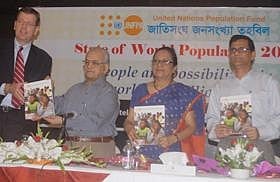
Bangladesh population at 150.5 mln: UN
Bangladesh's population stands at 150.5 million in 2011, according to a UN projection released on Wednesday, five-days ahead of when the world population is expected to reach 7 billion, 'a milestone, but also a wake-up call.' Full story
bdnews24.com News Service
bdnews24.com
Published :
26 Oct 2011, 09:33 AM
Updated :
10 Aug 2022, 05:43 PM
Dhaka, Oct 26 (bdnews24.com) – Bangladesh's population stands at 150.5 million in 2011, according to a UN projection released on Wednesday, five-days ahead of when the world population is expected to reach 7 billion, 'a milestone, but also a wake-up call.'
The UN Population Fund (UNFPA) in its annual flagship publication State of World Population 2011 also indicated the number of males and females at 76.2 million and 74.3 million respectively, and pegged the country's annual population growth rate at 1.3 percent.
Launching the report at a city hotel, planning minister AK Khandker said he was 'happy' to see the projection which were 'close to Bangladesh Bureau of Statistics' preliminary results of the 5th census, released on July 16.'
The preliminary report, adjustment of which a check is underway through post-enumeration, put the country's total population at 142.319 million on March 15, comprising of an almost equal number of males and females – 71.255 million and 71.064 million.
UNFPA representative in Bangladesh Arthur Erken said the organisation does not generate any population data.
A world population report is brought out every year 'using data from the Population Division of the Department of Economic and Social Affairs of the United Nations Secretariat.'
The UNFPA had to revise its 2010 population figure of 164.4 million for Bangladesh population after outright rejection by the government. The revised head count figure released on May 3, 2011, showed the population was 149 million in 2010.
According to the UN, the world's population grew to 1 billion in 1804, 2 billion in 1927, 3 billion in 1959, 4 billion in 1974, 5 billion in 1987, 6 billion in 1999 and 7 billion in 2011.
Experts, however, say the world at 7 billion will be marked by achievements, setbacks and paradoxes as in some of the poorest countries a growing population stands in the way of development, while some of the richest countries are worried about low birth rates and ageing populations.
"It's a milestone, no doubt, but also a challenge, an opportunity and a call to action," the UNFPA representative said while presenting the report
The report also foresees 9.3 billion people in 2050 and more than 10 billion by the end of this century. Much of this increase, the report expects, will come from high-fertility countries, which comprise 39 in Africa, nine in Asia, six in Oceania and four in Latin America.
The report states that in 2011, 60 percent of the world population lives in Asia while 15 percent live in Africa, despite the fact that Africa's population is growing about 2.3 percent a year, a rate more than double that of Asia at 1 percent.
Erken said the discussion about a population of 7 billion was 'not a matter of space' but a matter of 'equity, opportunity and social justice.'
He solicited that educating and empowering girls and women would ensure that they would have fewer children than their mothers or grandmothers did.
"We must tear down economic, legal, social, and cultural barriers to put women and men and boys and girls on an equal footing in all spheres of life," he said, emphasising investment in the health and education of young people.
Explaining Bangladesh's plans in a world of 7 billion people, the director general for family planning M N Neazuddin said they have already targeted to bring down the total fertility rate from the current of 2.5 to 2.1.
"Some parts of the country like Khulna have already achieved the target, while the situation is alarming in Sylhet and Chittagong," Neazuddin said, adding 'special' measures have already been taken for those divisions.
"You will not see any post (of the family planning department) vacant in those divisions in the coming days," he said. At least 15,000 posts in the family planning directorate has been lying vacant for a long time, hampering its activities.
Planning commission's member Shamsul Alam said the government's sixth five-year plan also aimed at cutting the total fertility rate to 2.1.
bdnews24.com/nih/tk/1600h