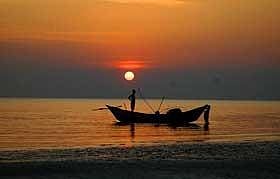
Rising sea devouring picturesque Kuakata
Some 45 acres of land along the Kuakata beach have disappeared into sea over the past two years. Ruby Ahmed reports
bdnews24.com News Service
bdnews24.com
Published :
14 Dec 2009, 07:32 AM
Updated :
12 Aug 2022, 02:12 PM
Ruby Ahmed
bdnews24.com correspondent
Kuakata, Dec 14 (bdnews24.com)---Some 45 acres of land along the Kuakata beach have disappeared into sea over the past two years.
Researchers attributed the cause to rising sea level or advancement of the Bay of Bengal.
Experts said saline water from the sea would submerge vast tracts of human habitation flowing through rivers and canals if the sea level continues to rise further.
Standing on the embankment of Kuakata sea beach, 75- year old Anwar Ali told bdnews24.com that he had been watching the sea for long 35 years.
The sea looks the same as before but three kilometres of land between his home and the sea has disappeared, he said. He has lost 33 kani (bigha) of land to the sea, he added.
Assistant commissioner of Kalapara Upazila Muhammad Jalaluddin echoed the same concern.
Jalal Uddin said the land map in Kuakata has changed radically and a vast tract of land of Kuakata coastal area has disappeared into the sea.
Of some 200 acres of land, 150 acres have already vanished, he said.
65-year-old Sekandar Ali Bhuiyab, a tea shop owner, told bdnews24.com, "A garden owned by Foyaz Mia was swept away by the sea.
Tamarisk bushes that stretch along the sea coast appeared to be lifeless, he said.
Local resident Montaj Ali said, "The leaves of the tamarisk have been turning red over the last two years."
Abu Naser Khan, chairman of 'Save the Environment' told bdnews24.com, "People near the costal areas will not only become unemployed but their health will be at risk."
Agriculture official of Kalapara, Niruttom Kumar Sarkar said some 16,000 acres of land were used for cultivation of Aus paddy during the monsoon.
Drought coupled with the rise of slainity in water reduced the cultivable land to 2,800 acres, he said adding Aus cultivation is on the verge of extinction.
The leaves of trees along the coast are drying, he said. The scene is common not only in Kuakata but also in other coastal districts including Boruna, Pirozpur, Jhalkathi, Bhola, Bagerhat, Khulna and Satkhira.
Niruttam Kumar said the salinity in the region is hampering agricultural production.
Former chief scientific officer Jalal Uddin Md Shoeb told bdnews24.com that all varieties of paddy except BR-47 can endure salinity up to 4,000 PPM.
Salinity exceeding the limit destroys production, he said.
Pointing to increased salinity in the coastal area, he said, Bangladesh must move for cultivation of products which can endure salinity.
Bangladesh must combat the challenge of salinity to ensure food security, he said.
Additional director of Directorate of Agriculture Extension in Barisal, Aftab Uddin Khan told bdnews24.com,"The increase of salinity will deter achievement of the target for food production nationwide."
Non-cultivable lands are increasing because of climate change and the situation will deepen in the coming years, he feared.
As per statistics of Agriculture Extension Directorate in Barisal, non-cultivable land in Barisal Division measures 20,266 hectares.
The size of cultivable land in Barisal is 1,81,659 hectares, 93,632 hectares in Pirojppur, 54,507 hectares in Jhalkathi,1,99,325 hectares in Patuakhali, 10,0481hectares in Borguna and 1,83,870 hectares in Bhola.
Monzur Morshed Khan of Coastal Health Advancement and Nutrition Centre in Borguna said, "The agriculture farms and fisheries are at great risk because of saline water."
Fishes are dying out fast due to intrusion of excessive saline water, he said.
bdnews24.com/ra/of/ec/saz/1330h