


Published : 04 Mar 2022, 02:03 AM
Updated : 21 Oct 2022, 03:37 PM


Speakers underlined it as the most critical aspect of achieving food security and ensuring safe drinking water in this region, a UNDP press release read on Thursday.
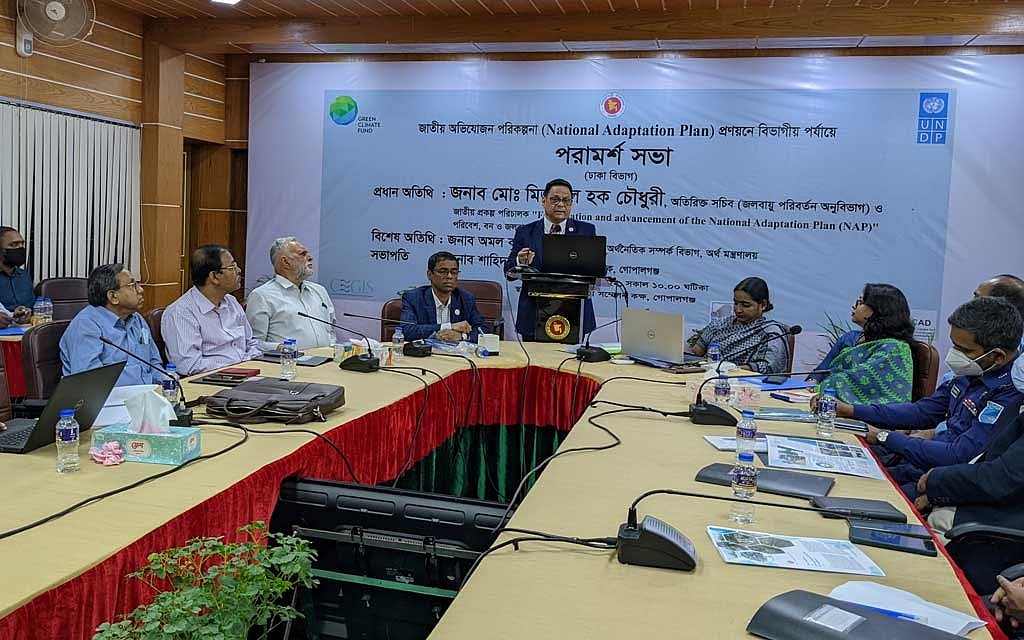
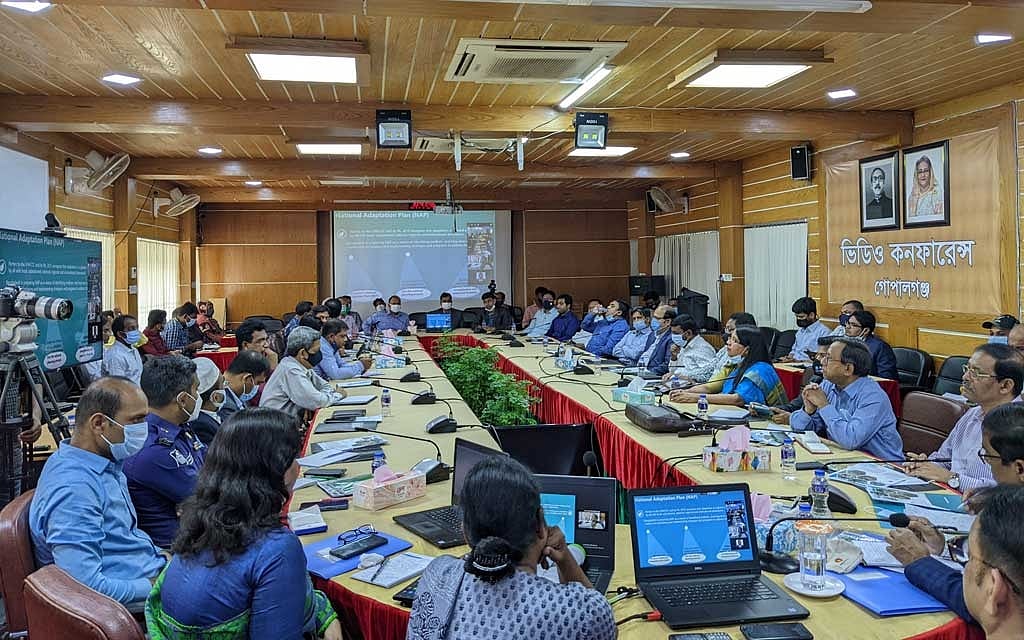
The Dhaka divisional consultation on the NAP formulation was held at the Deputy Commissioner's Office in Gopalganj on Thursday.
It was jointly organised by the Ministry of Environment, Forest and Climate Change , Economic Relations Division and United Nations Development Programme with support from the Green Climate Fund .
Additional Secretary of the MoEFCC and National Project Director of the NAP Formulation Project Md Mizanul Haque Chowdhury was present as the Chief Guest while Mr Amal Krishna Mandal, Joint Secretary and Wing Chief of the Economic Relations Division (ERD), Planning Commission attended the consultation as the Special Guest present as the Special Guest. Deputy Commissioner of Gopalganj Ms Shahida Sultanta chaired the consultation.
While delivering the keynote Professor Ainun Nishat, head of the NAP Formulation Consortium, drew examples of several region-specific climate change related hazards that Bangladesh is facing.
He stressed that achieving food security will be a major challenge in the coming years. So, NAP will give special emphasis on achieving food security.
In doing so, NAP will recommend special measures in combating floods, drought, extreme heat, cyclones and other hazardous events.
The divisional consultation discussed major climatic risks of different parts of Dhaka with a particular focus on Gopalganj.
Gopalganj and the adjacent areas have a large number of bills. However, salinity intrusion occurs from March-May that has emerged as one of the major threats to agriculture affecting the livelihood of vulnerable people living in bill areas.
Besides, siltation has resulted in the rise of farmlands which is making cultivation even more difficult. This is also threatening the aquatic life and fisheries in this region.
Participants spoke about the livelihood of smallholder farmers being affected by climatic risks such as cyclones, increasing soil and water salinity, storm surges and heavy rainfall that can cause flooding and waterlogging.
They called for a master plan to address these challenges.
Kazi Liakat Ali, mayor of Gopalganj Municipality, said: “Salinity intrusion is our biggest problem - first and foremost, we need to look for long term sustainable solution and ensure safe drinking water and water for irrigation”
Muhammad Abdul Latif, deputy commissioner of Manikganj said, “We need a holistic financing for climate-vulnerable districts to make our adaptation efforts successful.”
Abu Nayeem Mohammed Maruf Khan suggested, “Instead of sector-based impact, district-based impact assessment and mapping of climate hazards can be more effective.”
He asked for the inclusion of the local administration and public stakeholders during the formulation state and before their approval in the ECNEC.
Dr Arabinda Kumar Roy, deputy director of the Department of Agriculture said, “ We should explore ways on how to arrest salinity intrusion - feasibility and effectiveness of installing sluice gate should can be explored in this regard.”
AKM Azad Rahman, programme officer of UNDP’s Climate Change, said: “Apart from adaptation efforts, we should think about risk financing for the farmers so that they do bear the brunt of crop loss as an effect of climate change.”
Amal Krishna Mandal said, “As a climate-vulnerable nation, we have showcased our strength in climate change adaptation - we are now the chair of the Climate Vulnerable Forum (CVF)”.
“Our adaptation efforts will focus on local vulnerabilities and also strategies financing options”.
Md Mizanul Haque Chowdhury said, “Our adaptation efforts in the NAP will only be successful if we are aware of the looming challenges of climate change. We must act responsibly in protecting our environment and fight climate change collective involving both public and private sector stakeholders”.
He expressed high hope that Bangladesh’s NAP will be model to the world.
Shahida Sultana thanked the participants and said, “We have our share of responsibilities – we can easily solve some of our problems like water connectivity and its management, waterlogging and waste management on our own”.
“Efficient and smart waste management both at the domestic and industrial level can contribute less emission of methane protecting our environment”, she maintained.
More than 80 representatives from Gopalganj, Shariatpur, Manikganj, Tangail, Kishoreganj, Rajbari, Narsingdi, and Dhaka district administrations, local government representatives, civil society representatives, sectoral experts, professionals, journalists and academia attended the event both virtually and in-person and provided comments to enrich the plan with locally specific climate adversities and adaptation needs.







