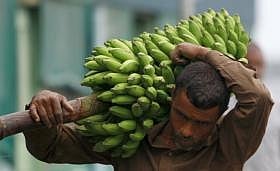
Bananas could become main staple source
Climate change could lead to the fruit becoming our key food source replacing maize, rice, wheat and potatoes, researchers say.
bdnews24.com News Service
bdnews24.com
Published :
31 Oct 2012, 10:20 AM
Updated :
09 Aug 2022, 04:27 PM
Dhaka, Oct 31 (bdnews24.com) - Bananas could very well become the replacement of maize, rice, wheat and potatoes as a critical food source as temperatures rise due to global warming.
In a report, based on the research carried out in response to a request from the United Nations' committee on world food security, researchers from the Consultative Group on International Agricultural Research (CGIAR) say the fruit might replace potatoes in some developing countries.
BBC, quoting the report, said that cassava and the little known cowpea plant could also play increasingly important role in agriculture with the rise in temperatures.
Formulated by a group of experts in the field, the report, which looked at the projected effects of climate change on 22 of the world's most important agricultural commodities, also said that the people will have to adapt to new and varied menus as traditional crops struggle.
Bananas key replacement
The researchers found out that due to the changes in climate, the world's three biggest crops in terms of calories provided - maize, rice and wheat - will decrease in many developing countries.
Potato, which has been the key alternative, could also suffer as temperatures increase and weather becomes more volatile since they grow best in cooler climates.
They also argued that these changes "could provide an opening for cultivating certain varieties of bananas" at higher altitudes, even in places that currently grow potatoes.
"While bananas also have limiting factors, they may be a good substitute for potatoes in certain locations," Dr Philip Thorton, one of the researchers, told BBC.
"It's not necessarily a silver bullet but there may be places where as temperatures increase, bananas might be one option that small holders could start to look at."
Cassava, an option?
Wheat, which has been marked as the world's most important plant-derived protein and calories source in the research, is forecasted to face a difficult future in the developing world as it is more vulnerable to climate change, and cotton, maize and soybeans have already been pushed to the margins due to higher prices.
A key substitute, especially is South Asia, could be Cassava, a woody shrub of the spurge family native to South America, which can withstand a range of climate stresses, the report pointed out.
But the question remains about how easily the people will adapt to new crops and new diets, in response to which Bruce Campbell, the programme director of the Climate Change, Agriculture and Food Security Research (CCAFS) group, told BBC that such adaptation did occur in the past.
"Two decades ago there was almost no rice consumption in certain areas of Africa, now there is. People have changed because of the pricing, it's easier to get, it's easier to cook. I think those sort of shifts do occur and I think they will in future as well."
Cowpeas next big veggie protein source?
One of the key concerns amongst the researchers is to mark a suitable replacement for Soybeans, which are the most common source of vegetable protein, but are very susceptible to temperature changes.
The scientists say that the cowpea, which is known in sub-Saharan Africa as the "poor man's meat", is drought tolerant and prefers warmer weather and could be a reasonable alternative to soya. The vines of the cowpea can also be used as a feed for livestock.
In some countries, including Nigeria and Niger, farmers have already moved away from cotton production to growing cowpeas.
The report also predicts likely developments of animal protein sources, including a shift from to smaller livestock.
This is an example of something that's happening already," says Bruce Campbell.
"There's been quite a shift from cattle keeping to goat keeping in southern Africa in face of droughts - when the farmers see the problems they are having with production, they really are willing to shift.
"Change is really possible. It's not just a crazy notion."
bdnews24.com/rn/nir/1616h