With an eye on the election, the Awami League-ruled coalition has produced a populist budget, raising spending 17 percent with an ambitious 7.2 percent growth target in its last year.
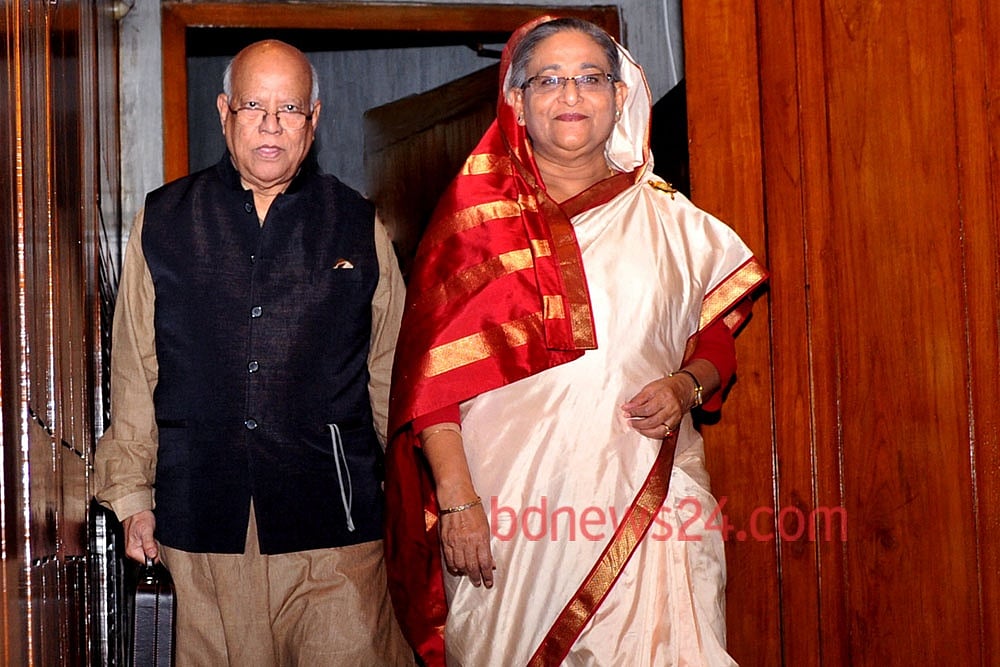
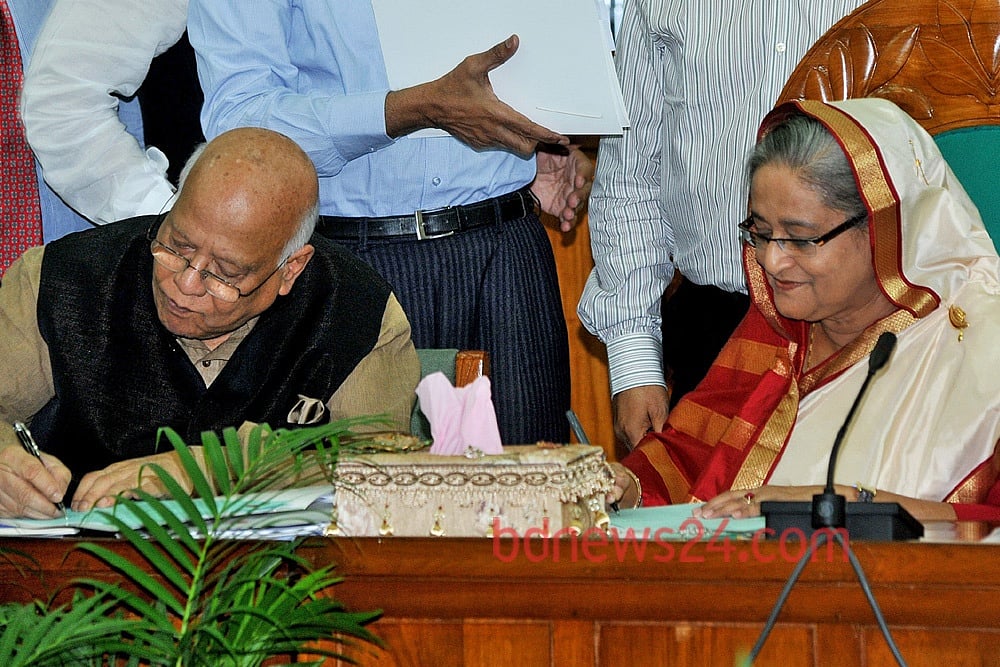
Finance Minister AMA Muhith crafted the Tk 2.22 trillion 2013-14 fiscal plan with a tally of tax policies and spending priorities as the impulse to spend more to please civil servants and influential middle classes prevailed over the push for fiscal austerity.
The announcement of a permanent Pay Commission to raise the salary of 1.3 million public servants, real estate-led money whitening measures, stock market incentives, cheaper old cars and the minimum tax-free income ceiling going up are all targeting middle and upper middle classes who could prove decisive come the vote.
With the economic growth languishing at nearly 6 percent after the sharpest slowdown in its term, he set the GDP growth at over 7 percent and revenue growth at 20 percent.
Muhith could only show revenues worth three-fourths of the total outlay with income tax and value added tax accounting for 22 percent each. The allocation for expenditure in the development sector has been estimated at Tk 722.75 billion.
The expenditure for the government’s annual development programme (ADP) has been estimated at Tk 658.70 billion.
This year, the allocation for non-development and other expenditure has been put at Tk 1346.21 billion. A major part of it will go towards paying the salaries, allowances and pension of government employees.
Interests on foreign borrowings will also be paid out of this allocation.
The Finance Minister hoped that total revenue earnings during the coming fiscal would be Tk 1674.49 billion or Tk 1.67 trillion.
The National Board of Revenue (NBR) itself is expected to generate Tk 1360.90 billion from income tax, import duty and value added tax (VAT).
Of the remaining revenue estimate, Tk 262.40 billion is expected to come from non-NBR sources, while non-tax revenue will be Tk 51.30 billion.
The overall budget deficit was pegged at Tk 550.32 billion, which is 4.6 percent of the GDP. The domestic borrowing target has been fixed at Tk 483.62 billion, which is 4 percent of the GDP.
The budget shortfall will be met through foreign borrowings, sale of savings certificates and borrowings from internal banks.
To meet the budget deficit, the government plans to generate Tk 237.29 billion from foreign sources, Tk 339.64 billion from local sources, including borrowing
Tk 259.93 billion from the banking sector, Tk 79.71 billion from the non-banking sector, and Tk 49.71 billion from savings certificates.
While the lowest income tax slab has been raised by 10 percent to Tk 220,000, the minimum tax for people in municipalities and villages was reduced. This, Muhith said, would hopefully motivate people to pay taxes.
Coupled with his investment incentives and increased rebates, revenue generation in an election year might indeed prove to be a daunting challenge but the Finance Minister sees it differently with a broadened tax net registering new taxpayers and “enhance the scope of revenue thereby”.
Muhith said there were two programmes towards this end, one of which is a cleansing programme for fake Tax Identification Numbers which has already come down to 2 million from 3.7 million. An intensive tax survey programme will “be able to enlist about 300,000 new taxpayers this year”.
The government targets three million new taxpayers and 5 million TIN registration next year.
The next budget, last one for the 78-year Muhith who has six budgets under his belt, proposes to several tax measures to encourage local industries in a populist. With that end in view, the minister has proposed to reduce import duty on capital machinery and intermediate goods along with duty measures to favour local manufacturers in newsprint, toiletries, dairy and even potato chips.
With little change in relative allocation compared to the outgoing budget, a 2.31 percent increase in transport and communication betrays a bid to appease the voters. Compared to an outlay of 6.96 percent in the outgoing budget, roads and bridges will get 9.27 percent of the total outlay.
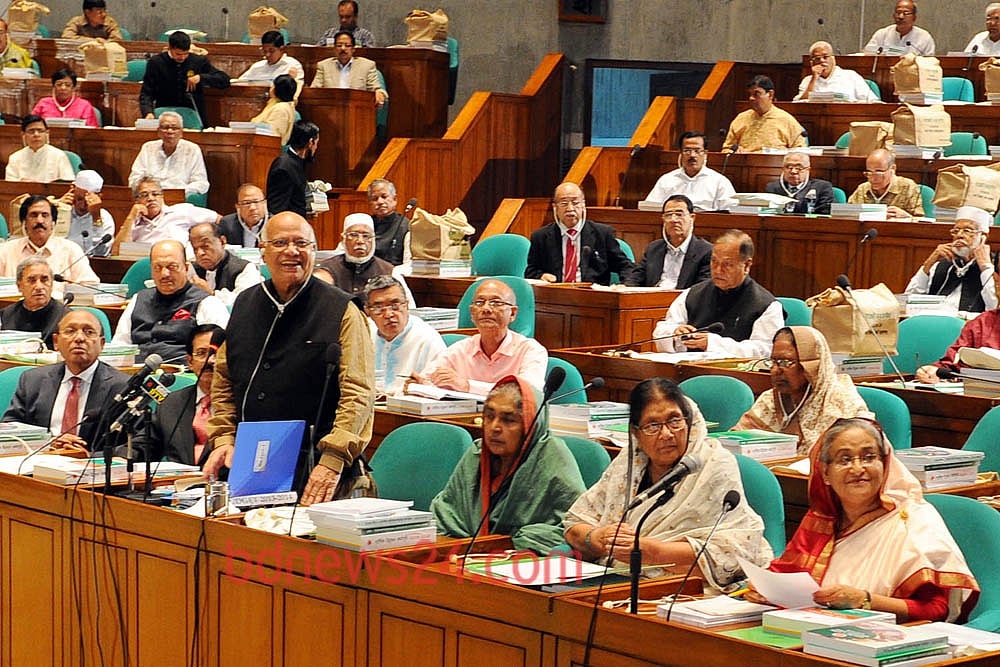
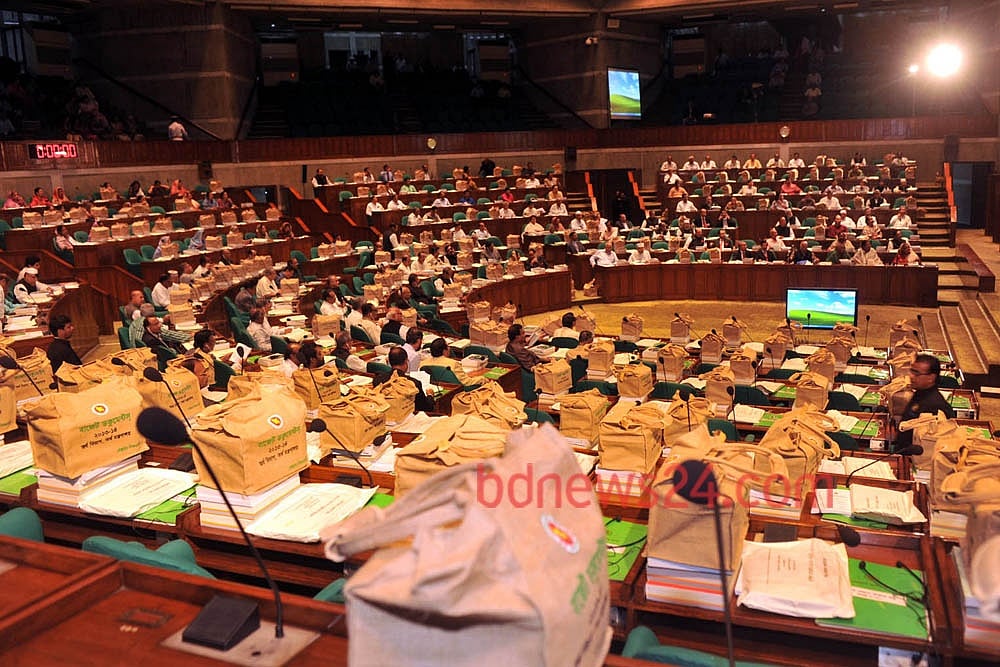
With a target of seven percent inflation, the finance minister presented his last budget amid yet another opposition boycott.
BNP had joined the budget session briefly on Monday and stayed for around two hours before walking out again which turned out to be merely a matter of formality to retain the parliament seats.
Muhith lamented the situation and said he had presented all the budgets of this ruling government with the opposition parties absent.
The new budget proposes to attract both private and public sector investors. Besides, allocations for the power, energy, and infrastructure have also been increased.
The 2013-14 budget demands attention for its nature and size. Bangladesh's first budget, in 1972-73, was of Tk 8 billion. In the four decades since then, its volume has grown 300 percent.
The first budget of the current coalition was Tk 1.13 trillion. After four years, the size has almost doubled.