


Published : 10 Jan 2013, 02:43 PM
Updated : 09 Aug 2022, 10:05 AM


Under the new agreement, the second phase of the project titled ‘Reaching Out-of-School Children Project - II’ will run 21,361 learning centres called Ananda Schools in 148 remote upazilas, 100 more than the first phase, until 2017.
It targets 0.72 million children, aged between 8 years and 14 years, who dropped out or missed out schools due to poverty.
According to the Ministry of Primary and Mass Education, which implements the project, the second phase has been planned based on the ‘successes’ of the first phase, which is being implemented from July 2004 to March 2013 covering at least 0.75 children.
Officials say children in Ananda schools learn through fun and games and the grade-5 pass rate of the children was 83 percent in 2012, 10 percent higher than the previous year.
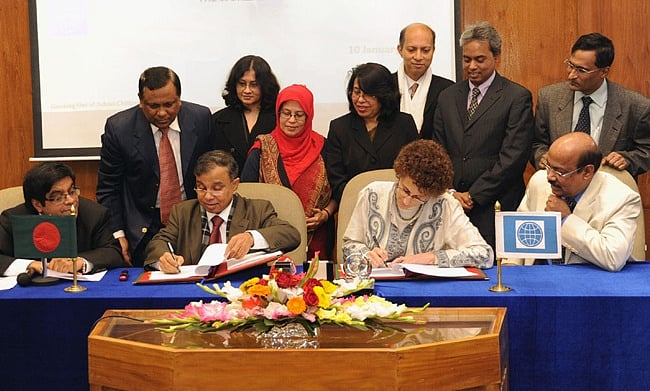
Economic Relations Division Secretary Md Abul Kalam Azad and World Bank Country Director for Bangladesh Ellen Goldstein signed the soft loan agreement in Dhaka. Bangladesh has to pay a 0.75 percent annual service charge for the 40-year loan and will have a 10-year grace period for repayment.
Goldstein said their engagement in the second phase project meant ‘the results of the first phase were very strong.’
“This is what we try to do here in Bangladesh,” she said. “We try something. If results are very good, we put additional investment to scale it up.”
The government started the special learning centres in 2004 with an aim to achieve ‘education for all’ by 2015 by mainstreaming the out-of-school children of poor families to primary education.
Official record shows almost 100 percent eligible children in Bangladesh get enrolled in schools, but more than a quarter of them drop out before completing grade-5, where the primary education ends.
One of the key features of the project is to recruit teachers locally. NGOs help the government in bringing the children in the special schools.







