Published : 09 Feb 2022, 03:43 PM
Updated : 03 Aug 2022, 11:30 AM


There was some background noise in the gym, and he has a disability that affects how he communicates. Usually, it does not keep us from talking at length. This time — with both of us masked — neither of us could follow what the other was saying. We smiled and gave up.
It was not a big deal, but it reminded me that masks have both benefits and costs. They can slow the transmission of the COVID-19 virus, especially medical-grade masks worn properly. They also impede human communication. Talking with a mask on, as Kathleen Pike, a psychology professor at Columbia University has written, “is like talking on your phone in a zone with weak cell service.”
If you scroll through social media, you will find no shortage of people proclaiming that mask-wearing is easy for them. I don’t doubt it. But it is not so easy for many other people, including young children, people with learning disabilities and people who are hard of hearing.
The national debate over mask mandates in schools is picking up again. On Monday, Democratic governors in Connecticut, Delaware, New Jersey and Oregon all announced the end of their statewide mandates, to take effect in coming weeks. It’s a sign that more Americans — and not just Republicans — are ready to move to a new phase of the pandemic.
The end of the statewide mandate is a “huge step toward normalcy,” New Jersey’s governor, Philip Murphy, said. “We can responsibly live with this thing.”
Still, parts of the partisan divide will continue. In some left-leaning communities, school mandates will probably remain even after Democratic governors lift statewide rules.
In a newsletter last week, I promised to revisit our recent poll on partisan COVID attitudes — and to consider a response from some liberal readers. The debate over school masking offers a way to do so.
COMMUNAL RISK
The poll found that many Democrats, especially younger Democrats, seem to be overstating their personal risk from COVID. In response, some readers argued that exaggerating individual risk is actually a good thing, because it leads to more support for COVID mitigation policies, like mask mandates and limits on public gatherings.
The real problem, according to this view, is that the US has done too little to protect people from COVID; if exaggerating individual risk can reduce COVID’s communal risk, isn’t that a good thing?
There is some logic to this line of thinking, because the US has indeed done too little to battle COVID. But the argument depends on the assumption that almost all COVID restrictions improve public health, and that isn’t necessarily true. Nearly every restriction has both benefits and costs. The question is, when do the benefits outweigh the costs?
With the vaccines and boosters, the answer is clear. The benefits (a huge reduction in the risk of death, hospitalisation and other symptoms) vastly outweigh the costs (a day or two of potentially feeling crummy). With many other mitigation strategies, however, the answer is murkier.
The disruption and isolation of the past two years have contributed to increases in educational inequality, mental-health problems, blood pressure, drug overdoses, violent crime and other serious ills.
Masks are an intriguing tool because they allow people to be together while also protecting themselves. Yet a growing number of Americans are nonetheless deciding that the costs of masks often fall short of the benefits, especially in schools.
Let’s dig into both the costs and benefits of school mask mandates.
THE EMPATHY GAP
The benefits of universal masking in schools remain unclear. Studies — in Florida and in England, for example — tend to find little effect on caseloads. One study that did find an effect has been largely debunked.
Some experts still favor masks in schools, saying they likely have an effect, even if few studies have yet shown it. A lot of other evidence suggests masking matters. Until the omicron wave ends and both hospitalisations and deaths fall much further, masks should stay on, these experts say.
Other experts believe that the universal mask mandates are almost worthless. Among the reasons: Medical masks are designed for adults, not children, Michael Osterholm, a University of Minnesota epidemiologist, notes. Even masks designed for children slip off their faces. Children take off their masks to eat. Add in omicron’s intense contagiousness, and the benefits of the current mandates may be tiny.
A universal mandate “doesn’t work,” Osterholm told me. Mandates focused on older children and high-quality masks can help when caseloads are rising rapidly, he added.
It’s also relevant that teachers and students who want to continue wearing masks can do so. One-way masking, with medical masks, provides protection, experts note.
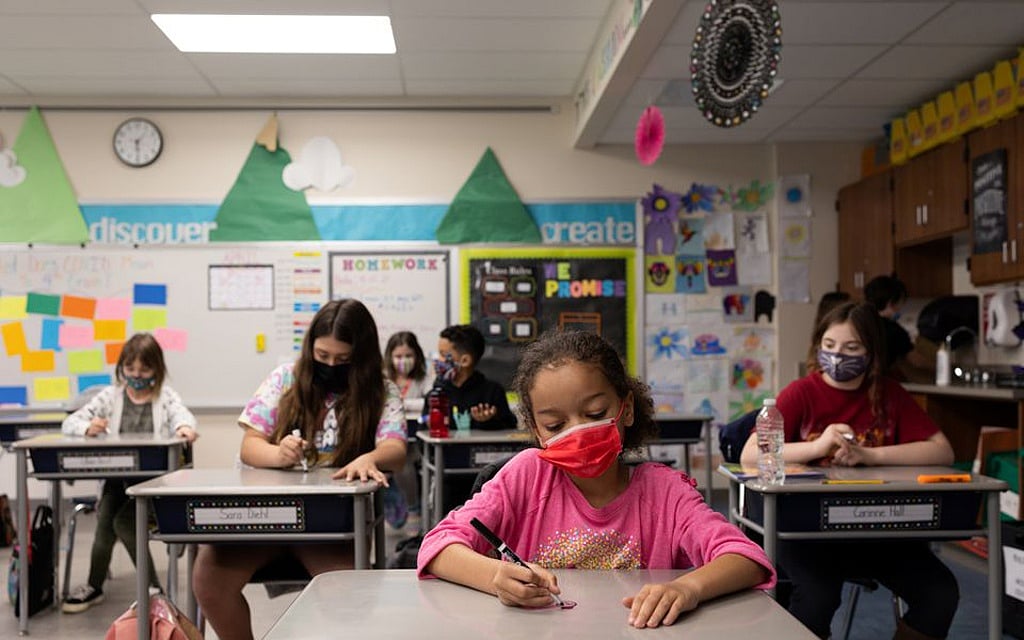
Of course, the costs of mandates may also be small for many children, especially older ones. For others, though, the costs seem larger. NPR’s Anya Kamenetz has catalogued them: Students can’t always understand teachers; young children, unable to see faces in classrooms, may not be developing emotional skills; and children of all ages are having a harder time making connections.
“They’re not developing empathy,” Stephanie Avanessian, a Los Angeles mother, told NPR. “It’s taken six months for my fifth grader to make friends because it’s so hard to tell what people are doing.”
For reasons like this, Europe’s infectious disease agency does not recommend masking for children under 12, and many countries avoid masking preschoolers. The US stands out for its aggressive use of masks on young children.
THE BOTTOM LINE
The evidence suggests that the benefits of mandated school masking are modest and that the costs are meaningful for some children, particularly after two years of pandemic life. This combination suggests that the removal of statewide mandates will probably do more good than harm, given that COVID cases are now plummeting.
But there is an important caveat: If another big COVID wave comes — and it may — the argument for a temporary return of masking will become stronger. When hospitals are overwhelmed, even small differences in caseloads can save lives. Different moments call for different COVID policies.
©2022 The New York Times Company