


Published : 28 Apr 2021, 03:07 AM
Updated : 14 Oct 2022, 06:33 PM



The risk of the virus spreading outdoors is so low that even unvaccinated individuals do not need to wear a mask if they hike, jog, bike or run alone or with a household member, according to updated advice released by the Centers for Disease Control and Prevention.
People who haven’t gotten their shots can also go without a mask to small gatherings held outside as long as they are with fully vaccinated friends and family.
The guidelines were further relaxed for immunised people: They can take their masks off when they attend small gatherings with people who haven’t gotten their shots, and when they dine at a restaurant outside with people from multiple households.
The CDC stopped short of telling even fully vaccinated people that they could shed their masks altogether in outdoor settings — citing the worrying risk that remains for transmitting the coronavirus, unknown vaccination levels among people in crowds and the still high-caseloads in some regions of the country.
But with the total number of vaccinations rising and the daily number of cases falling, Dr. Rochelle Walensky, the director of the CDC — who warned several weeks ago that she felt a sense of “impending doom” — said she now feels more “hopeful.”
The United States is averaging around 55,000 new cases a day, a roughly 20% drop from two weeks ago, according to a New York Times database.
“I know the quarantine and shutdowns throughout the pandemic have been exhausting,” Walensky said. “I know we all miss the things we used to do before the pandemic and I know we all want to do the things we love and soon. Today is another day we can take a step back to normalcy of before.”
President Joe Biden is to deliver remarks on the updated advice on Tuesday, linking the news with the administration’s public campaign to get most American adults vaccinated by summer and trying to offer reassurances that some semblance of normal life can return.
In presenting the new guidelines for wearing masks, public health officials on Tuesday emphasised how people who are inoculated could enjoy mask-free leisure activities, rather than how the guidelines also lifted some restrictions for those who had not gotten their shots. It was a concerted message at a time when vaccination rates have dipped, causing concerns about hesitancy in harder-to-reach populations.
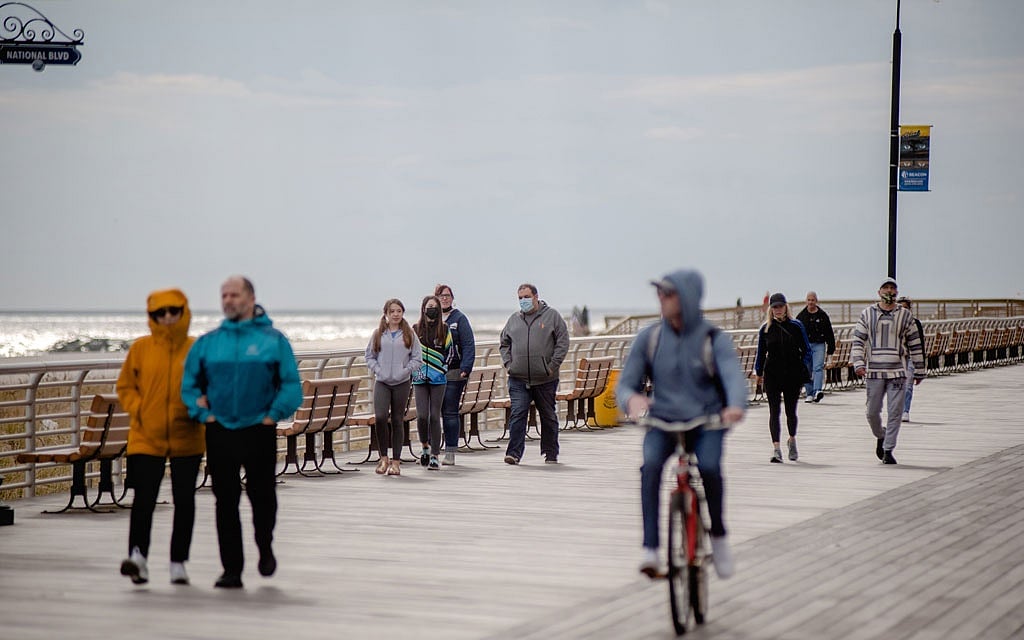
Masked and maskless pedestrians on the Long Beach boardwalk in New York on April 18, 2021. Americans who are fully vaccinated against the coronavirus no longer need to wear masks outdoors if they’re walking, running, hiking or biking alone, with members of their household, or if they attend small outdoor gatherings, federal health officials announced on Tuesday, April 27. (Johnny Milano/The New York Times)
“I welcome less restrictive guidelines about masking outdoors,” said Linsey Marr, an aerosol scientist at Virginia Tech. “We know that transmission outdoors is much less likely to occur than indoors, because the virus cannot accumulate in the air outdoors. It’ll become rapidly diluted.”
But the guidelines themselves, which outline different masking recommendations for a variety of scenarios, seem overly complex, she said. “I can’t remember this. I would have to carry around a sheet of paper — a cheat sheet with all these different stipulations.” She added: “I worry that this is not as helpful as it could be.”
Americans have been whipsawed on the issue of mask-wearing advice since the beginning of the pandemic, when top health officials said people did not need them — in part because of severe shortages of protective gear for health care workers on the front lines.
And mask restrictions since then have been a patchwork from state to state, despite growing evidence of a mask’s protection for individuals and those around them. Many states have already lifted restrictions they had put in place for indoor and outdoor activities. Others like New York, however, have maintained mask-wearing requirements for when people cannot stay 6 feet apart even for outdoor spaces, citing the threat of potentially more contagious variants.
But the pace of vaccinations has helped influence some easing of those limits. So far, about 42% of Americans have received at least one dose of a COVID-19 vaccine, and 29% have received both doses of the two vaccines requiring double shots.
The vaccines are highly effective at preventing people from becoming seriously ill from the coronavirus.
“Scientifically the vaccines are good enough that it’s highly unlikely that someone who’s vaccinated is going to be exposed to enough virus outdoors to have a breakthrough infection,” Marr said.
Early evidence also suggests that vaccinated people may be significantly less likely to transmit the virus, but the exact risks are not yet known.
Some experts also wondered if the new directives were confusing, by establishing different standards for those who are vaccinated and those who are not, even though it is impossible to know who is who.
“It’s not like you can go up to someone in public and say, ‘You don’t have a mask on — are you vaccinated?’” said Dr. Monica Gandhi, an infectious disease specialist at the University of California, San Francisco. “Those who aren’t vaccinated will promptly take their mask off outdoors because no one can check.”
But, she said, that is probably fine, since the risk of transmission in outdoor settings is very low, absent close or prolonged contact with someone.
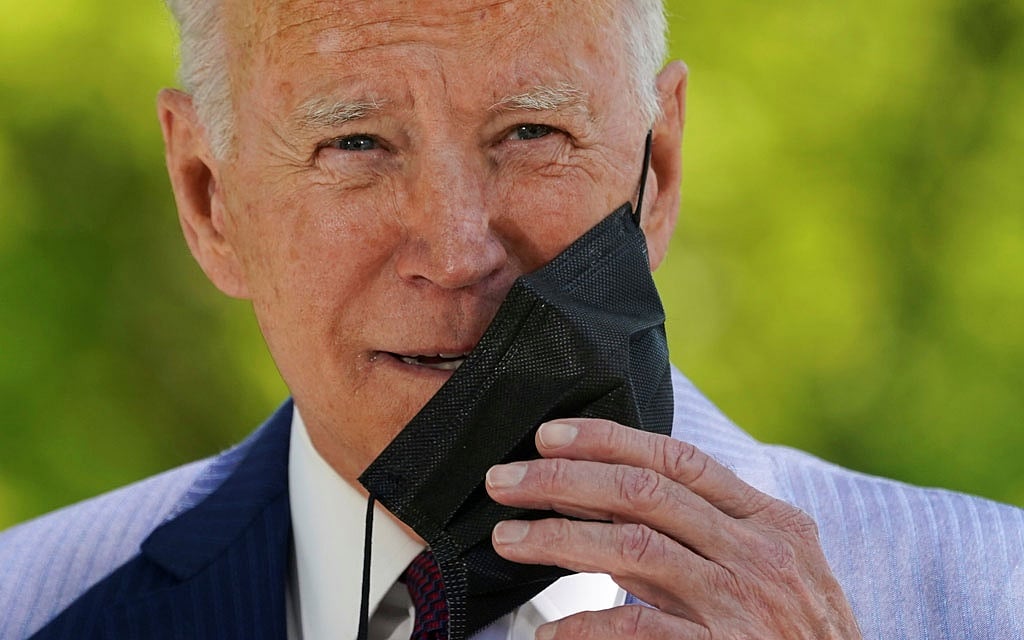
President Joe Biden resends to reporters questions after speaking about new COVID-19 guidance from the Centers for Disease Control and Prevention, from the North Lawn of the White House in Washington on Tuesday, April 27, 2021. President Biden and federal health officials said Tuesday that Americans who are fully vaccinated against the coronavirus no longer need to wear masks outdoors in most situations except for large gatherings. (Erin Scott/The New York Times)
Masking and distancing are still generally recommended when gathering with unvaccinated people from more than one other household or with an unvaccinated person who is at high risk of severe illness from COVID, or who lives with a vulnerable person.
And there are scenarios in which wearing a mask outdoors can still be an important social signal, Carnethon said. For instance, no vaccine has yet been authorised for children under 16. “And when we’re going to require children to wear masks, at school and on the playground when they’re at school,” she said, “I think that it is responsible for the adults in the situation to model that behaviour and normalise mask wearing even when outside.”
A growing body of research indicates that the risk of spreading the virus is far lower outdoors than indoors. Viral particles disperse quickly outdoors, experts say, meaning brief encounters with a passing walker or jogger pose very little risk of transmission.
But most if not all of the research about viral transmission outside was done before the vaccine was available.
A recent systematic review of studies that examined the transmission of the coronavirus and other respiratory viruses among unvaccinated individuals concluded that fewer than 10% of infections occurred outdoors and that the odds for indoor transmission were 18.7 times higher than outdoors. (The odds of super-spreading events were 33 times higher indoors.)
©2021 The New York Times Company







