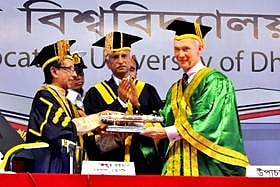
WTO policies benefitted Dhaka: Lamy
The global trade regulatory body chief assures Bangladesh of all help to continue its leadership role among LDCs Updates
bdnews24.com News Service
bdnews24.com
Published :
31 Mar 2012, 09:18 AM
Updated :
09 Aug 2022, 03:36 PM
Dhaka, Mar 31 (bdnews24.com) – World Trade Organisation's director general Pascal Lamy has encouraged Bangladesh to continue its leadership among the least developed countries (LDCs).
The chief of the global trade regulatory body, WTO, also pledged to continue to help Bangladesh achieve its development goals.
The fifth director-general of the multi-lateral organisation was addressing the 46th convocation of Dhaka University on Saturday.
Lamy, also a member of the French Communist Party, received 'Doctor of Laws' (Honoris Causa) degree from president and chancellor of the university Mohammad Zillur Rahman.
Praising Bangladesh's efforts in economic development and leadership role among LDCs, Lamy said: "A vibrant private sector, active civil society and profound social transformation means Bangladesh is poised to make the next leap to integrate into the global economy."
"WTO is your partner in achieving your development goals ... It's a platform where members can come together on an equal footing," he said.
The WTO chief encouraged and urged the graduates to deliver "on the vision of a 'golden Bengal' through your individual and collective efforts".
"Let me tell you how privileged, honoured and moved I am by the ceremony and by the honour given to me."
Reading out a citation note before announcing Pascal Lamy's name, Dhaka University vice-chancellor Prof AAMS Arefin Siddique said, "Lamy's affiliation with WTO has ushered in new opportunities for addressing trade openings and reducing trade barriers that are central to both economic development as well as poverty reduction for improvement of living standards throughout the globe."
The WTO chief's Dhaka visit is being viewed as 'very important' by the economists in Bangladesh in view of the current deadlock in Doha negotiations. Lamy said Bangladesh has done well and is well positioned for the future.
He said being world's most populous LDC, Bangladesh has a natural leadership role to play.
As the coordinator of the LDC group in 2003, 2007 and 2011, Bangladesh has ably advanced the interests of LDCs within WTO.
Lamy said Bangladesh's ability to translate WTO flexibilities for the world's poorest nations into trade and development is an example for all LDCs.
But, he said, if Bangladesh is to continue in its leadership role, it needs leaders. "This country needs internet generation that will twitter, blog and intertwine Bangladesh with the global economy."
Lamy encouraged the participating graduates, saying: "You are privileged to have the opportunity to be students at a time of momentous change for Bangladesh and the global economy at large."
Comparing General Agreement on Tariffs and Trade (GATT) with current WTO, Lamy said protectionism is by its very nature a source of conflict and it deprives others of the benefit of their talents.
GATT was signed in 1946 and lasted until 1993, and it was replaced by WTO.
He said: "Protectionism impoverishes. And for the least-developed, its impact is especially pernicious given the route which trade offers out of poverty.
"Opening markets under an umbrella of global rules has been a catalyst in the expansion of global trade."
On Doha negotiations, he said reaching a conclusion has become 'ever more challenging' with a growing list of issues and ever more members.
Difficulty in striking an appropriate balance of benefits and concessions, particularly between developed and emerging countries, is said to be part of the reasons for the current impasse in the global trade talks.
The Doha Development Agenda was launched in 2001.
Lamy said a more open, transparent, non-discriminatory and rules-based multilateral trading system can assist WTO members in realising their potential in an increasingly globalised economy.
"For LDCs," he said, "it is vital, too".
He said WTO provides consensus-driven decision-making giving LDCs a voice and a stake in the multilateral system, which neither any regional nor a bilateral trade scheme can deliver.
"Through trade – both imports and exports – LDCs can go a long way in development and poverty reduction.
"LDCs also face particular difficulties arising from specific structural and capacity constraints."
"But through negotiations to open markets and ensure a level-playing field, through various forms of special and differential treatment, through trade preferences, through larger periods for implementing commitments as well as through 'Aid for Trade' to build trade capacity, WTO can address these constraints," the director general observed.
Elaborating WTO's steps towards addressing LDCs' concerns, he said a 2001 decision on TRIPS has benefitted Bangladesh by extending its deadline on pharmaceutical patents to 2016.
"It has helped consolidate the emergence of national pharmaceutical manufacturing capacity in Bangladesh."
As a negotiating forum, he said, WTO also provides the space for LDCs to pursue their own commercial interests.
"Market access for industrial products is an area where Bangladesh has important interests.
He said the global trade regulatory body can play a role in providing trade-related assistance to government officials, parliamentarians and civil society in developing countries to help them better understand WTO rules and to more ably defend their interests in the global trading system.
He said they can also help academic and research institutions – such as Dhaka University – in building expertise on trade matters by educating future trade policy makers.
"But the challenge lies in ensuring that LDCs turn these opportunities into realities," Lamy said and added that in this regard, Bangladesh leads the way for other LDCs.
He also went on to describe how Bangladesh turned 'development flexibilities into development outcomes'.
Between 1974 and 2004, world trade in textiles was governed by quotas limiting the amount that developing countries could export to developed countries.
The phasing out of the Multifibre Arrangement began with the debut of WTO in 1995, and by Jan 1 2005 all quotas on textiles and clothing had been eliminated.
In many developing countries, including Bangladesh, there was considerable apprehension as economists issued 'dark predictions' of doom for Bangladesh and its fledgling garment sector.
"But the reality, I think you will agree, has been somewhat different."
"Bangladesh's garment sector has not just survived, it has thrived. Removal of quotas revealed Bangladesh's comparative advantage."
Lamy said readymade garment sector is the mainstay of Bangladesh's economy and the source of more than 75 percent of total exports and more than 3 million jobs, particularly for women.
Similar achievements have also been registered in Bangladesh's pharmaceutical industry which, according to Lamy, has seen its growth consolidated 'by the flexibilities offered to LDCs under the WTO's intellectual property rules'.
In this sense, Bangladesh is a model for other LDCs, he said and added that progressive trade opening has 'unquestionably' helped Bangladesh reduce poverty.
Citing last year's household poverty survey, he said, few countries anywhere in the world have recorded an 8.5 percent drop in absolute poverty over a five-year period.
But, Lamy said, one challenge for Bangladesh is to expand the progress in the garment sector to other sectors of the economy.
Insisting on the need to diversify, he said, it is necessary so that economic shocks like the one we experienced recently do not negatively affect the Bangladesh's trade and development outlook.
He extolled Bangladesh's Vision 2021 and said it provides a compelling image of how Bangladesh sees itself going forward.
The government is well on track to meet many of these time-bound targets, including achieving middle-income status by 2021. "The flexibilities in the WTO system are aiding Bangladesh's growth and development," he added.
But, the WTO chief felt, as the country starts to push against the middle-income bracket, some of those flexibilities will begin to fall away as LDC graduation beckons.
Managing this transition would require investing in services infrastructure and in trade facilitation programmes, and it will require helping Bangladesh business better integrate with the global value chains.
Industry hopes Bangladesh will request Lamy to consider extending TRIPS (Agreement on Trade- Related Aspects of Intellectual Property Rights) deadline due to expire for pharmaceutical products in 2016.
Once extended, it will help Bangladesh's booming pharmaceuticals industry to consolidate its foreign market further.
In his two-day visit, Lamy will meet the prime minister, finance minister and the foreign minister, besides various business bodies.
bdnews24.com/nih/jr/nir/2345h