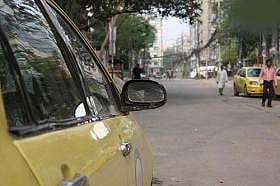
Taxicabs vanishing fast from Dhaka roads
Cab owners blame administrative difficulties and negligence of authorities for the vanishing taxicabs from Dhaka's streets. Ashik Hossain has the details
bdnews24.com News Service
bdnews24.com
Published :
07 Sep 2012, 11:52 AM
Updated :
09 Aug 2022, 04:13 PM
Ashik Hossain
bdnews24.com Correspondent
Dhaka, Sep 7 (bdnews24.com) – Following the launch of taxicab service, as many as 12,000 cabs had hit the capital's roads, but today the total number of taxicabs in operation has come down to a meagre 3,000 – a fourth of the initial number.
Cab owners blame administrative difficulties and negligence of authorities for the vanishing taxicabs from Dhaka's streets.
The diminishing number of cabs over the years has only compounded the commuting woes of the people. Also, the scarcity of cabs has given an opportunity to the rest of the cab drivers to charge exorbitant fares.
According to the Bangladesh Road Transport Authority (BRTA), there were at least 12,000 cabs plying on the roads in 2007. Those still running will hit lifespan-end by next year.
BRTA Engineering Department Director Mohammad Saiful Haque told bdnews24.com: "Owners will be given approval for new taxicabs if they want after those cabs' lifespan ends."
Asked whether new taxicabs would be imported to meet the requirements, he said, "The government has decided to import more taxicabs considering the public welfare. But according to the new system, only permitted companies will be able to import cabs from abroad to tackle the irregularities."
Haque said one importer would have to import at least 1,000 taxicabs. "Each cab will have to have GPS tracking device to ensure safety of the passengers."
The Communication Ministry in 1998 introduced the taxicab service on the streets of the capital and adjacent areas for better movement in both city and suburbs.
Then it was mandatory for a single importer to import at least 20 cabs. The number was raised to 1,000 in 2010.
The ministry published a gazette on taxicabs two years back which allowed only four types of taxicabs, each with a different colour, to run on the streets including both air-conditioned and non-air-conditioned ones.
Of those, only three types – 1300cc yellow cabs, 800cc blue cabs and non-CNG driven black cabs – have been left in operation. The 2000cc green ones, bigger than the other cabs, were never introduced.
According to the gazette, each taxicab would have a financial lifespan of 10 years.
Dhaka Metropolitan Taxicab (lease) Owners' Welfare Association General Secretary Mohammad Obaidul Haque told bdnews24.com that most of the taxicabs running in the capital were registered between 2002-2003. "So, according to the rules, most of cabs' lifespan will expire by 2013."
He blamed the government's negligence on the matter has led to this situation.
"It was mandatory before to import 20 cabs at once, but now the new systems mandates importing 1,000 cabs all together. Naturally the importers are not very interested."
"That's why BRTA has failed to strike deal with any company."
He said the association had proposed to the government to reduce the number to 50, but the government did not pay any attention.
"If it goes on like this, we doubt the government will be able to continue the taxicab service."
Obaidul Haque said to meet the ever-growing demand of public transport, there should be 15,000-20,000 taxicabs in Dhaka alone.
BRTA official Saiful Haque also confirmed that the government had failed to strike any new deals until now. "Negotiations with the importers on importing the cabs as per the new system were not fruitful. But we are still trying. Currently we are negotiating with a company. Let's see what happens."
On the cab owners' proposal, he said, "They did give a proposal but the Communication Ministry did not accept it."
Bangladesh University of Engineering and Technology's Urban & Regional Planning Department Professor Sarwar Jahan told bdnews24.com that people's desire to buy private cars would further increase if the taxicab service was allowed to meet with premature death.
"And as the number of private cars increases, the effects on the roads will be worse. The government's decision on the taxicab import should have been discussed in public fora."
'Cabs don't run on metre'
The provision of meter-based fares has been there since the introduction of the service, but the clause now is confined to papers.
Dhaka Metropolitan Taxicab (lease) Owners Welfare Association President Sarwar Hossain told bdnews24.com that the costs of plying cabs had increased four times since the time the fare rates were fixed.
"BRTA did not pay any attention even though we requested them to revise the fare rate several times."
He alleged that lack of coordination between the Communication Ministry and BRTA along with glitches in the policymaking had hit the taxicab trade hard.
bdnews24.com/aha/trb/nir/1743h