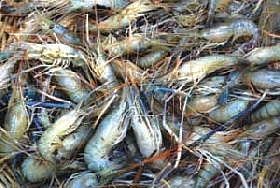
'Shrimp industry must respect environment, meet standards'
The growth of shrimp farming should not come at the cost of environment and the industry must comply with international standards to survive, an workshop heard on Wednesday. The two-day workshop titled 'Shrimp Export from Bangladesh: Potentials & Challenges' organised by the Market Development Forum kicked off at Sheraton Hotel to bring the industry stakeholders together to draw up the opportunities and challenges faced by the sector, organisers said.
bdnews24.com News Service
bdnews24.com
Published :
30 Sep 2009, 11:28 AM
Updated :
12 Aug 2022, 01:51 PM
Dhaka, Sep 30 (bdnews24.com)—The growth of shrimp farming should not come at the cost of environment and the industry must comply with international standards to survive, an workshop heard on Wednesday.
The two-day workshop titled 'Shrimp Export from Bangladesh: Potentials & Challenges' organised by the Market Development Forum kicked off at Sheraton Hotel to bring the industry stakeholders together to draw up the opportunities and challenges faced by the sector, organisers said.
The workshop came at the backdrop of the Bangladeshi shrimp industry seeing a six-month voluntary ban on exports from last May, after almost 100 shipments, over a four-year period, were subject to a 'Rapid Alert' notice, which circulates information on food safety problems among European nations.
Between 2005 and June 2009, sixty consignments of frozen shrimp from Bangladesh were rejected by the EU due to nitrofuran contamination, a banned antibiotic.
Speaking at the opening session, commerce minister Faruk Khan said that the government hopes that the problem of nitrofuran will be solved by the year-end.
Earlier, Bangladesh Frozen Food Exporters' Association president Musa Mia in his speech urged the government and development agencies for immediate support to the industry, "or within a year there would be no industry".
"I am sorry, you can't be saved that way; the only way is to comply with the global standards," the minister replied in his speech.
Talking to the media afterwards, he said the important thing was to keep an eye on the process of growth of the shrimp farming so that no environmental hazard occurs.
The US ambassador in Dhaka also picked the issue.
Speaking as a special guest, James F Moriarty told the workshop the industry should not grow at the expense of environment.
"Following environmentally safe shrimp industry practices, with an eye towards sustainability, is critical for the industry," he added.
Moriarty drew attention to issues like shrimp larvae collection from the open salt-water or the sea in such a manner that does not cause wiping out of many other species.
"Also punching holes in the coastal embankment to bring in sea water for the shrimp farms can be disastrous in the event of storm and tidal surges, as was witnessed after cyclonic storm Aila."
The envoy stressed adhering to global standards on health, environment and labour to expand markets for shrimp export.
On the crucial issue of labour, he said that consumers in the US and Europe pay a great deal of attention to the condition of workers.
"Farmers and producers here must continue their efforts to meet higher labour standards in order to guarantee continued access to international markets."
European Commission's Stefan Frowein echoed Moriarty. He said most of the employees of the shrimp industry live below the poverty line.
The head of the EC delegation in Bangladesh also said that they found out that the Bangladeshi industry lacks residue control and testing facilities.
He informed the audience about a new EU compliance issue for sea-going fishing vessels--"catch certification".
"However, it is applicable for fishing vessels of only the marine catch, not inland fishing," added Frowein.
The opening session also heard from commerce secretary Feroz Ahmed, chairman of Bangladesh Fish & Shrimp Foundation Syed Mahmudul Haque and director general of the Department of Fisheries Rafiqul Islam.
bdnews24.com/rhn/bd/1714h.