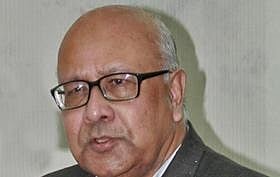
Share games still on: Ibrahim Khaled
The stocks market manipulation still goes unchecked, says Khandker Ibrahim Khaled, the head of the panel that investigated the Dec-Jan stocks bubble-and-burst that drove many investors away.
bdnews24.com News Service
bdnews24.com
Published :
12 Dec 2011, 01:48 PM
Updated :
10 Aug 2022, 05:56 PM
Dhaka, Dec 12 (bdnews24.com) — The stocks market manipulation still goes unchecked, says Khandker Ibrahim Khaled, the head of the panel that investigated the Dec-Jan stocks bubble-and-burst that drove many investors away.
"There are games being played in the market even now," said Khaled, who thinks that the market is influenced by 'wrong' instructions and the government does not keep an eye on the SEC.
He blamed share market regulator 'responsible for the failure to control the market' where rampant illegal trading is alleged.
The market is rife with fraud from insider trading to falsified financial reports.
"Everyone says that the problem is about capital," he said on Monday, "The government is trying to hide something by talking about liquidity crisis, but the real problem is the lack of confidence."
"No initiative is seeing success because of the problems being identified in wrong ways."
The former deputy governor of the Bangladesh Bank was speaking in a dialogue, 'State of the Capital Market and Recent Policy Initiative', at the BRAC Centre Inn organised by private research institute Centre for Policy Dialogue.
Formed in January this year, the four-member inquiry team, led by Bangladesh Krishi Bank chairman Khaled, in its April report based mostly on interviews with stakeholders had proposed further investigation into the volatility in the share market, saying that there had been games behind the instability.
The Securities and Exchange Commission (SEC) had been overhauled following a proposal by the Khaled-led panel. The government had said the other proposals of the committee will be executed in different terms.
The top level of the government moved recently following continuous fall in share prices in past few months. A prime minister Sheikh Hasina-led meeting with the stakeholders prompted the SEC, the Bangladesh Bank and the National Board of Revenue to take and implement a slew of measures to prop up the sagging market.
"It's shameful that the prime minister has to hold a four-hour meeting to correct the share market of the country. The prime minister wanted to save the SEC. But the SEC should be fired for its failure in market management," Khaled said.
He, however, said that the securities regulator has limitations. "The SEC is not independent. It has pressures on it."
"Those who play games with the market interfere in the share market regulator. So, proper work is not recieved from them. How can people be confident about this market?"
About the debates over the report his committee had submitted, Khaled said, "The finance minister had said before publishing the report that it can't be published as several powerful people were named in it."
"How can he say this?' Khaled asked. "Are they (people named in the report) more powerful than the minister?"
He suggested demutualising the market for proper management, adding that several quarters will try to stop that.
"The government will have to do it forcefully. Does anyone want to leave power?"
Former governor of the central bank Mohammed Farashuddin also blamed SEC for the market volatility.
"The market sees abnormal ups and downs…where is the SEC surveillance team? It seems that the SEC has no surveillance on the market.
Former SEC chairman Faruque Ahmed Siddiqui echoed Khaled, that the liquidity crisis is not the reason behind the instability.
"Actually the lack of coordination and problems in management are responsible. There is no coordination among the SEC, DSE (Dhaka Stock Exchange), CSE (Chittagong Stock Exchange) and the Bangladesh Bank. Proper management was not put in place to correct the market," he said.
Former advisor to the caretaker government A B Mirza Azizul Islam said only increasing the number of licences for brokerage houses will not resolve the problem.
"The SEC can't even monitor the existing brokerage houses. So, the decision [to issue more licences for brokerage houses] needs to taken after some pondering," he said.
Azizul, a former SEC chairman, said the current situation would improve within a few months.
"The market sees depression due to bank closing. But it may improve in January-February."
He also demanded execution of the recently announced incentives package to stabilise the market.
Former finance minister M Sayduzzaman, former CSE chairman Al Maruf Khan, DSE senior vice president Ahsanul Islam, Association of Bankers, Bangladesh (ABB) president K Mahmud Sattar, among others, spoke in the programme.
CPD researcher Gholam Moazzem presented the key papers in the preogramme presided over by distinguished fellow Debapryia Bhattacharya.
Moazzem said in his papers that SEC lacks skill as a market regulator.
Lack of coordination, transparency in BO (beneficiary owner) account and technology impact the market negatively, he said.
He termed insider trading in the capital market an 'open secret'.
"Unlawful deeds of commercial banks and their behaviour like retail investors are the major reasons behind the instability of the market," he asserted.
Apart from raising capital, Moazzem thinks, it is necessary to return investors' confidence in the market but added he does not see steps forthcoming.
The researcher proposed that the SEC be freed from influence from the finance ministry and politicians.
Moazzem said the central bank should be more alert, the SEC surveillance strengthened, and there should be more transparency in trade through BO accounts.
He also proposed overhauling the audit systems at the DSE and CSE, and demutualisation of the bourses.
bdnews24.com/ffs/sit/ost/bd/1939h