Scanty rain threatens Aman production
A drought-like situation is threatening the cultivation of Aman paddy in northern Bangladesh
bdnews24.com News Service
bdnews24.com
Published :
18 Aug 2012, 12:19 PM
Updated :
09 Aug 2022, 04:09 PM
Dhaka, Aug 18 (bdnews24.com) – A drought-like situation is threatening the cultivation of Aman paddy in northern Bangladesh.
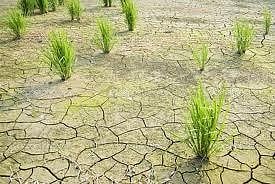
Scanty rainfall has resulted in cracks in the fields and farmers are finding it difficult to prepare beds for the crops.
Our correspondents in Chapainawabganj, Thakurgaon and Nilphamari say the three districts had much less rainfall this season than the previous year, forcing the cultivators to look for alternative modes of irrigation.
According to the Department of Agricultural Extension (DAE), half of the 53,527 hectares of arable land in Chapainawabganj are yet to be cultivated.
DAE's Nilphamari office said the farmers in the district transplanted Aman in 100,000 hectares of land but 9,000 hectares are not cultivated yet because of insufficient rain.
The farmers of the two districts expressed their concerns over meeting the Aman production target this season.
The DAE, however, says that time of transplaning Aman is not over yet and alternative modes of irrigation have been arranged to cope with the draught like situation.
According to the DAE officials in Chapainawabganj, the district had 23 millimetres (mm) of rainfall in May, 115mm in June and 184mm in July. This is in contrast to last year's figures of 148mm in May, 460mm in June and 124mm in July.
As the nature of land in the 'Barendra' (northern) area is not flat, water flows very quickly from one place to another. But this is not conducive for Aman cultivation, which needs stagnant water.
Qurban Ali, a farmer in the Chapainawabganj Sadar Upazila's Jhilim union, said he could cultivate two of the 15 bighas he had.
"I prepared the land by irrigating those using deep tubewells, but do not have enough water now."
Another farmer Ansar Ali said he cultivated six of his 16 bighas.
"It will impact the spring harvest," he said.
Abdus Samad from Nachole Upazila said Aman depends on rain and not irrigation.
"Much of the land will remain unused if it doesn't rain soon."
The DAE Deputy Director in the district, Abul Kalam Azad, however, said there was nothing to worry over achieving the target of 135,493 metric tons of paddy.
"We still have time. Half of the land has been cultivated. We'll be able to cover the remaining half," he said.
According to Azad, there are 1,640 diesel and power-run pumps and deep tubewells in the district to irrigate 32,820 hectares of land.
Our Nilphamari correspondent says cracks are seen in the arable land and they werefull of weeds.
Many farmers in the district say they do not have the money to irrigate their land for Aman cultivation as they made losses in the Boro season.
DAE Deputy Director S M Sirajul Islam said the arable land in the district was irrigated using water from the Teesta Irrigation Project.
The target to produce Aman crop this season in the district is around 300,000 metric tons.
The situation in the Thakurgaon district is similar.
"Rain is much needed now. The government is trying to save the crops by irrigating the land in alternative ways," DAE Deputy Director in Thakurgaon district Belayet Hossain told bdnews24.com.
Around 50,000 hectares of Aman fields in the district are facing a threat because of drought-like situation, the officials said.
"We've transplanted Aman in 127,885 hectares. Of these, 50,000 hectares will be destroyed if there is no rainfall within a few days," Belayet said.
The Barendra authorities are using 1,230 deep tubewells, while the farmers are using 46,737 tubewells to irrigate 65,000 hectares of land in the district.
The remaining 77,000 hectares of arable land is totally reliant on the rain for cultivation.
bdnews24.com/corr/ost/ano/1811h