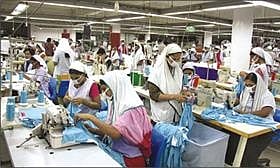
RMG traders see 'good times'
Readymade garment exporters ask the government to increase infrastructural facilities to seize the opportunity as major buyers are losing interest in China. Full Report
bdnews24.com News Service
bdnews24.com
Published :
11 Nov 2012, 05:00 PM
Updated :
09 Aug 2022, 04:29 PM
Dhaka, Nov 11 (bdnews24.com)—Readymade garment exporters believe Bangladesh is in for big business opportunities as buyers are planning to move away from China.
Apparel exporters on Sunday urged the government to concentrate more on increasing infrastructure facilities to make best use of this 'big opportunity.'
Leaders of Bangladesh Garment Manufacturers' and Exporters' Association (BGMEA) made the observation and hinted at the 'better days' after meeting with the visiting representatives of American Chamber of Commerce in Hong Kong (AmCham), one of the largest American Chambers outside the United States.
After the meeting at the BGMEA office in the morning, BGMEA President Shafiul Islam Mohiuddin told reporters, "Leading buying houses in the world are looking for sources as China's alternatives. In this case, they are considering Bangladesh as the first alternative."
"This is the moment we win the trust of the buyers. The opportunity may be lost if timely initiatives are not taken."
Currently, China is the biggest readymade garment exporter and Bangladesh is the third behind Indonesia.
President of the largest international chamber in Hong Kong, AmCham, Richard R Vuylsteke told reporters that Chinese companies were turning to the high-tech technologies. Increasing production cost meant it was not easy to get cheap products there.
That's why buying firms are considering new countries to source products, he added.
According to him, the buyers were giving priority to Bangladesh, Myanmar, Cambodia, Laos, Vietnam and Indonesia as China's alternatives.
Vuylsteke said Bangladesh was the top priority among them. Many of China's buyers were already buying products from Bangladesh.
People concerned with the business think the ready apparel sector flourished in Bangladesh because of the low-cost labour. But there is discontent among the workers over pay.
BGMEA leaders have asked the government to ensure development of necessary infrastructure, gas and power supplies, and to build skilled manpower to make any possible spurt in demand is met.
The AmCham Hong Kong President Vuylsteke, however, said there were some problems in Bangladesh including the infrastructure which cannot be resolved overnight.
He said everyone – the government, buyers, entrepreneurs – will have to work together to resolve this issue.
BGMEA chief Mohiuddin said, "The government will have to take the lead. Specially, infrastructural development and working capability of the ports including Pangaon Port will have to be increased. Gas and power connections must be provided to the industry."
BGMEA leaders also urged the government to decide whether the unskilled manpower can be used in the industries through proper training instead of export them to foreign countries.
BGMEA Vice-President Siddiqur Rahman told reporters that right now the average growth rate in the readymade garment industry is 15 percent, which was more than 17 percent in 2011.
"It can reach 20 percent even now if the government provides necessary assistance. The rate will reach 30 percent if the number of skilled manpower increases. Because 20 percent of machines are being kept off due to less skilled workers."
The representative team of AmCham Hong Kong has come to find out whether more garment products can be imported from Bangladesh.
The team will also visit Myanmar, Cambodia, Vietnam and Indonesia and decide at the end of their visit how much products would be imported from which country.
The team consists representatives from 20 leading buyer companies including H&M, PVH Corp, Wall-Mart, Spirit Nike, Tom Tailor, Amer Sports and American Eagle.
BGMEA President Mohiuddin said they inquired about capacity of the readymade garment sector in Bangladesh, condition of infrastructure and standard of living of the workers.
"We told them that we are doing very well even after facing many obstructions. The living standards of the workers have improved. Specially, initiatives have been taken to ensure improvement of their health. We also asked them [AmCham] to come forward and assist."
Asked how much products they were planning to import, AmCham President Vuylsteke said they were yet to make a decision.
bdnews24.com/sa/eh/trb/bd/2350h