'No TIFCA, no duty-free RMG access'
American Ambassador makes it apparently clear at a meeting with the BGMEA leaders.
bdnews24.com News Service
bdnews24.com
Published :
06 Jun 2012, 01:32 PM
Updated :
09 Aug 2022, 03:52 PM
Dhaka, June 6 (bdnews24.com)�Bangladesh's readymade garment products will not get duty-free access to its single largest export destination market in the United States unless Trade and Investment Cooperation Forum Agreement (TICFA) is signed, the US Ambassador in Dhaka says.
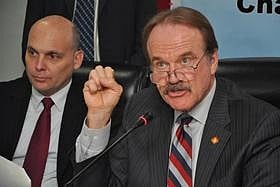
Ambassador Dan W Mozena made it apparently clear at a meeting with the leaders of Bangladesh Garments Manufacturers and Exporters' Association (BGMEA) on Wednesday when he sounded an alarm about the industry's future exports amid labour unrest and volatile politics in Bangladesh.
He described how American buyers were getting 'negative perceptions' of Bangladesh garment industries because of Labour activist Aminul Islam's murder and fire incidents at factory zones.
He said it could 'drive away' key American buyers, but 'I think Bangladesh needs American market'.
The Ambassador said duty-free access was a kind of issue that will be raised in the forum created in TICFA. "It (duty-free access) will be defined there (TICFA forum)."
The decision on duty-free access, according to Mozena, is a 'political' decision, 'but you need to create the environment.'
He blamed Bangladesh for what he said 'continued failure' to sign the agreement and that the failure was being interpreted by Washington "as the result of Bangladesh's trying to walk back from its international labour obligations."
"The TICFA is quite simple and has only a single action item � the establishment of a forum to identify and seek to resolve obstacles to increasing bilateral trade and investment � it has now been dragging on for four years."
He, however, said it (signing TICFA for duty-free access) was not a precondition, but a reality.
The demand for duty-free access of Bangladesh's apparels to the US market is a long pending issue as despite being a least developed country, Bangladesh has to pay high tariffs for the access.
Bangladesh also pressed the issue during the recent visit of US Secretary of State Hillary Clinton.
But the murder of a labour activist Aminul Islam who was associated with the AFL-CIO affiliated, USG-supported Solidarity Center in Dhaka pushed the duty-free access issue back.
The US Ambassador on Wednesday once again raised his concern about what he said the murder 'eliciting little attention or interest' in Bangladesh, that is not the case in the U.S where he said labour rights supporters have 'seized' on this issue.
He said several members of Congress have written to the Secretary to convey their concern about Aminul's murder.
"Secretary Clinton raised Aminul by name with the Prime Minister, Foreign Minister and Leader of Opposition. The Secretary discussed the labour situation in Bangladesh in each of those meetings."
"I don't know if you are paying attention, but you should be," Mozena said.
Citing media outbursts in America, he told the business leaders present at the meeting: "I don't know if you are watching it (reports in New York Times, ABC News), but Americans are watching."
Most of the Bangladeshi goods have duty-free access to the US market, but the list does not include garment, the main exportable good that wheels the economy.
Bangladesh currently pays on average 15.3 percent tariff for garment products to enter the US market whereas China, world's largest apparel supplier, pays 3 percent duty to access the same market.
Bangladesh's garment is now enjoying duty-free facility to the EU, Canada, Japan and even China, and partially to India.
The BGMEA leaders organised the meeting with the US Ambassador to brief him on the need for duty-free access of the thriving RMG sector.
But the ambassador's remarks have further fuelled their worry.
"We are very serious about the murder," BGMEA President Md Shaiful Islam said, "We condemned the murder (Aminul's) soon after we heard about it. We demanded investigation into it. The Inspector General of Police assured us of bringing the culprits into justice."
He said workers were the major contributor to their progress and that they were 'serious about improving workers-owners relationship.'
"The broader engagement with the ILO (International Labour Organisation) in the coming days would help resolve many problems in the sector," the President said.
The Ambassador gave several examples of how he was sensing the potential threats to Bangladesh garment industry. He said making the dream of becoming a middle-income country a reality would require the government as well as the business sector to take some tough decisions.
Mozena said many of the negative perceptions about Bangladesh that may be taking root in America are also growing in Europe.
"The Clean Clothes Campaign that is spreading in Europe largely targets clothes made in Bangladesh," he said.
He said recently he had received a call, for the first time of his career, from a CEO of one of Bangladesh's biggest buyers. He shared his increasing concern that the tarnishing Bangladesh brand may be putting his company's reputation at risk.
Quoting the CEO, the Ambassador said his company would gladly pay more for a Bangladeshi product if it were 'fair trade'; his company's reputation is worth more than saving a few cents per shirt bought from Bangladesh.
In another instance, he said at a recent dinner hosted by FBCCI President AK Azad, six buyers for major American brands took him aside and shared with him the increasing concerns coming out of their respective headquarters about what they see was happening in Bangladesh, as conveyed to the American public through negative stories in the media.
Closer to home, Ambassador Mozena said, Bangladeshi activists who monitor labour in the RMG sector tell him that workers are becoming increasingly 'restive', due mainly to the growing failure of wages to keep up with the rising cost of living and the increasing vulnerability labour leaders feel as a result of the murder of Aminul Islam and harassment of other labour activists.
"I'm told this frustration could spark wildcat actions such as the ones that recently occurred in Narayanganj and Ashulia. Such disturbances could add to buyers' unease about the Bangladesh label."
He said these developments could coalesce into a 'perfect storm' that could 'threaten Bangladesh and the Bangladesh brand in America, which could drive away key American buyers of Bangladesh RMG.'
The Ambassador said he shared these 'changing perceptions' of Bangladesh among American RMG buyers with BGMEA leaders as he believed 'these changes potentially threaten the economic well being of this country', about which he cared "most deeply".
He stressed bringing political stability as he said major political parties should reach an early agreement on a mechanism for holding 'free, fair, credible and participatory' elections, allowing the political process to focus on the decisions needed to build the infrastructure to support a middle-income Bangladesh.
With over 5000 factories employ around 4 million workers currently in Bangladesh, industry owners say, the RMG sector has tremendous potentials to grow further as it occupies only 4 percent of the world's market.
bdnews24.com/nih/bd/1502h