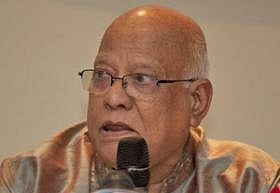
No power crisis in 3 1/2 years: Muhith
Finance minister A M A Muhith has said the government has taken three new projects and sees the nagging electricity crunch over in three and a half years. Full story
bdnews24.com News Service
bdnews24.com
Published :
09 Dec 2011, 12:19 PM
Updated :
10 Aug 2022, 05:55 PM
Dhaka, Dec 9 (bdnews24.com)—Finance minister A M A Muhith has said the government has taken three new projects and sees the nagging electricity crunch over in three and a half years.
"Under the projects, a total of 6000 megawatts power will be generated. Already 2000 megawatts have been added to the national grid. The target of feeding a further 4,000 MW will be reached soon," Muhith said on Friday.
"So, there will be no power crisis in the next three and a half years though it is taking some time."
The finance minister was addressing the inaugural function of a three-day seminar titled 'Bangladesh at 40: Changes and Challenges' at Jahangirnagar University organised by the Department of Business Studies.
Muhith said, "At its birth, Bangladesh was known as a "bottomless basket". But despite limited internal resources, we have come a long way and are on course for achieving 7 percent growth."
He remarked that the social discriminations has reduced, its human development index has risen and significant progresses have been made in infrastructure development of the rural economy and social security programmes.
The minister claimed that the foreign investors had shied away from doing business in Bangladesh due to corruption during the tenures of the previous governments. "But the situation has completely changed now."
He cited the lack of internal resources and low investment in the private sector as 'challenges' for Bangladesh.
Speaking at the seminar, Bangladesh Bank governor Atiur Rahman said that the country's per capita income growth had increased by 1.1 percent and 3.2 percent in the 1970s and '80s respectively while 'the growth has increased by 5.8 percent in the first decade of the century'.
"The poverty rate is now 30 percent though the rate was 57 percent in 1990." He added that Bangladesh made significant progress on the index of human resources development and in cutting rural poverty.
Former caretaker government adviser Akbar Ali Khan said the scope of the revolution is so vast that it is not possible to measure it in such a short time.
But he questioned the government statistics in fixing the poverty line. The government statistics show that 35 percent people of the country live below the poverty line but the World Bank puts it at 81 percent."
"The poverty in the country is huge if the per capita income is considered. The people of the country are yet to come out from the circle of hunger and malnutrition," he added.
The former secretary also said the economic discrimination has increased and cautioned that Bangladesh would turn into a highly discriminatory country if steps are not taken immediately.
English national daily Financial Express editor Moazzem Hossain, Business Studies dean Professor Abdul Bayes and JU vice-chancellor Dr Shariff Enamul Kabir also addressed the programme.
The seminar that consists of nine sessions will end on Dec 11. It will discuss the progress and challenges of Bangladesh in terms of its economy over the last 40 years since independence.
bdnews24.com/aha/jk/skb/bd/1743h