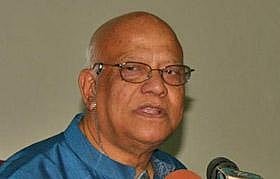
No alternative to rental power plants: Muhith
The finance minister rebuffs criticism that fuelling these plants had depleted foreign currency reserves
bdnews24.com News Service
bdnews24.com
Published :
07 Dec 2011, 11:30 AM
Updated :
10 Aug 2022, 05:54 PM
Dhaka, Dec 7 (bdnews24.com) — The finance minister has insisted that rental power plants are needed immediately to ease power shortage, scotching criticism that fuelling these plants had led to depletion foreign currency reserves.
"We had no other option," A M A Muhith said on Wednesday, claiming that without the rental plants, the outages would have been unbearable by now.
"Many are saying that fuel prices are rising due to the use of diesel and octane to run the plants. Their claims are baseless as there was no other option to address the power crisis," he said while inaugurating the National Power Week.
He added that establishing only long-term power plants would have seen the people suffering and said the government initially established the rental plants alongside making plans for long-term power plants to address the power crisis.
Opposition leader Khaleda Zia, in a press conference on Dec 1, said that the government's method of addressing the power crisis is 'questionable'.
"On one hand, foreign currency expenditure has trebled to subsidise the imports of additional fuel consumed by the plants. On the other, the government has to pay huge subsidies to sell the high-priced power brought from these plants in the retail market. As a result, the government's treasury is under pressure."
The finance ministry admitted that fuel sector subsidy has spiked due to the consumption of liquid fuel in these plants, a fact that was also used by the Bangladesh Power Development Board to justify their decision to hike retail power prices.
The Bangladesh Energy Regulatory Commission (BERC) recently announced that they will soon be declaring the new prices.
The incumbent government targeted power production of 15,000MW within 2016. It also struck deals to set up 48 power plants. Of them, 17 are quick-rental plants, three rental plants, 10 independent power producers and the rest 18 are state-owned ones.
Power generation has already started in 22 while the rest are scheduled to start feeding the national grid in-between Jan 2012 and mid-2013.
"The government is working to secure electricity for everyone within 2021," the minister added, "Development of the country will get hindered without sufficient power generation and we do not want any disasters in this sector."
The power ministry has organised, for the second time, a five-day National Electricity Week at Bangabandhu International Conference Centre in a bid to increase public awareness against power misuse.
Muhith asserted the possibility to add an extra 4,000MW to the national power grid within 2012. "Half of it will come from the rental power plants and half from the peaking plants and private plants," he added.
The finance minister hoped that it would be possible to maintain the current power production rate and that the government will be able to keep the GDP at 8.00 at the end of its term.
Though harmful for the environment, Muhith emphasised on setting up coal-based power plants, as it would lessen the power prices. "We can compromise 'a little' when it is a question of life and death."
"Such crisis would not have been there if the previous government had taken steps to extract gas," Muhith accused.
Prime minister's advisor Tawfiq-e-Elahi Chowdhury said the initial agenda of the incumbent government was to add 5,000MW within 2011 and another 7,000MW of extra electricity to the national grid.
"We will be able to add 6,000MW within 2011 and another 9,000MW within 2013 to the national grid," he said.
Chowdhury said that around 50 percent of the population is currently using electricity and hoped to upgrade the current percentage of users to 60 percent by the end of the incumbent government's term.
bdnews24.com/arr/zk/rn/bd/nir/2030h