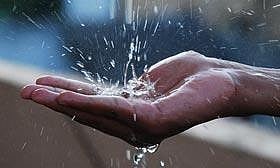
New skills to harvest rainwater
Japanese firm brings the low-cost technique that requires Tk 4,300 to set up a unit
bdnews24.com News Service
bdnews24.com
Published :
26 Nov 2012, 03:48 PM
Updated :
09 Aug 2022, 04:33 PM
Dhaka, Nov 26 (bdnews24.com)—Japan has brought a new technique of harvesting rainwater to Bangladesh where a large number of people face hurdles to manage potable water due to arsenic contamination and salinity.
With average 2000mm annual rainfall, the technique called 'AMAMIZU', a Japanese word meaning sky water, has been seen as 'simple and economical' to adopt and operate in rural Bangladesh as it does not require electricity and advanced technology.
"It's low-cost, strong and easy to maintain," Dr Makoto Murase, who invented the technique, and which is widely used in Japan, said at a seminar in Dhaka on Monday.
He said it requires Tk 4,300 to set up a unit – a specially designed mortar jar and connecting devices from the rooftop – that can store 1,000 litres of rainwater.
He said the mortar jar is a Thai technology brought to Bangladesh to keep the price lower.
"Initially we tried with concrete ring tank but that costs Tk 20,000 which we found the poor people cannot afford. Then we searched for an affordable container where we can collect the water germ-free."
He said: "We sent two masons from Bangladesh to learn the technique. They received one month's training."
Dr Murase, who is the Chief Executive Officer of Sky Water Harvesting Co. Ltd Japan, said they had been piloting a project of rainwater harvesting in southern Bagerhat district where salinity has triggered a water crisis.
A family of five members will need three jars to collect water for use during dry seasons, he said.
Based on their experiences, Dr Murase said rainwater harvesting system would not be sustainable if the project runs only on donations.
"People have to own it," he said. "That is why we decided to make it social enterprise with cooperation from JICA, and we are now looking for investors who agree on our project and vision."
He said they had surveyed in the project areas how people manage drinking water. "It showed local people had to spend about Tk 3,000 every year for fetching water elsewhere and treating waterborne diseases like diarrhoea."
JICA Bangladesh Chief Representative Dr Takao Toda at the seminar said securing safe and clean water 'is one of the critical factors in development of Bangladesh'.
"We are sure that AMAMIZU can make the poor and the poorest benefit, and even the entire nation."
As AMAMIZU does not require electricity or power, he said, it can also contribute to reduction of global warming.
The participants at the seminar from private sector and NGOs showed their interest in investing in the project.
bdnews24.com/nih/ssr/bd/2135h