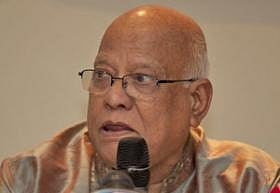
Muhith himself doubts 7% growth projection
The finance minister calls for more investments, rejects claims of increased govt spending Updates
bdnews24.com News Service
bdnews24.com
Published :
21 Dec 2011, 10:41 AM
Updated :
10 Aug 2022, 05:59 PM
Dhaka, Dec 21 (bdnews24.com) - With the rising inflation casting its shadow on the economy, finance minister A M A Muhith is uncertain about meeting the 7 percent growth target.
Muhith, who was speaking at seminar organised by the Bangladesh Institute of Development Studies here on Wednesday, however, thinks heavy duty investments could save the day.
"Investment levels have remained under 24 percent of the GDP for a decade now. That is not a happy picture for a country that is aiming for 7-8 percent growth," he said. "I am not sure where we are heading."
The economy grew at 6.7 percent in 2010-11 and budget 2011-12 pegs it to grow at 7 percent for this financial year.
According to the Bangladesh Bureau of Statistics, point-to-point inflation in Nov was 11.58 percent, up 0.16 percent over the last month. Inflation has been in the double digits for the last six months, with 11.42 percent in Oct.
Responding to criticisms from the opposition BNP and concerns of economists over the state of economy, Muhith had earlier stated that he was concerned about investment and trade balance, and not inflation. Prime minister Sheikh Hasina had also said the country's economy was doing fine.
On Wednesday, however, admitting that steps taken to tame inflation had gone in vain, the minister rejected claims of a runaway government spending, saying it had never been over 14 to 15 percent in Bangladesh. "Even Nepal spends more than us. In the last 40 years our spending has been between 7 to 15 percent," he added.
"The media and the economists are pounding us over the high-cost power production. Last year's 41 percent export growth was due to the growth in power production," he said.
On Monday, Muhith said inflation had been steadily heading north not only due to rise in prices globally but also owing to several internal policies, putting the economy under pressure.
"Government subsidies have been more than the target. The main reason is the delay in adjustment of fuel oil and power prices. But subsidies have helped develop industries and increased domestic production," he had said.
bdnews24.com/arh/ost/std/2135h