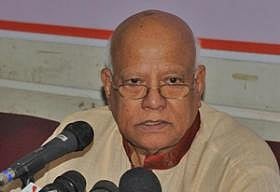
Muhith critical of bid to fix dollar price
Only if we hadn't fixed the price, the dollar wouldn't have hit this level, says the finance minister Full report
bdnews24.com News Service
bdnews24.com
Published :
04 Nov 2011, 07:47 AM
Updated :
10 Aug 2022, 05:45 PM
Abdur Rahim Harmachi
bdnews24.com Chief Economics Correspondent
Dhaka, Nov 4 (bdnews24.com) – Finance minister Abul Maal Abdul Muhith has expressed his concern over the taka hitting a low against dollar.
"It has been a wrong move to fix the Dollar-Taka exchange rate at Tk 69," he said referring to an 'unofficial' 2009 step of the central bank.
"Recently, the price of dollar has been steadily rising against the taka. As a result, the reserves are under pressure, especially because of the rising import cost," he told bdnews24.com on Friday.
The minister thinks another reason pushing the dollar exchange rate recently is Hajj. "Those who went to perform Hajj had to carry dollars with them. So, the price escalated in line with the demand."
"Another reason is that we have been trying to lock the price at Tk 69. That decision was wrong. Only if we hadn't taken that decision, the price of dollar wouldn't have suddenly jumped this high. It would have increased slowly…"
Asked whether the government or the Bangladesh Bank was going to take any measures to decrease the price in these circumstances, Muhith ducked the issue.
Following a central bank request, Bangladesh's foreign exchange dealing banks at a meeting on Oct 10 decided to cap the dollar-taka exchange rate at 76 for imports and at 75 for remittance and exports.
Bangladesh Foreign Exchange Dealers Association (BaFEDA) chairman and Janata Bank managing director S M Aminur Rahman told reporters about the decision after the meeting.
The exchange rate of dollar against taka, however, did not stop rising after the move, even though the flow of remittance increased ahead of Eid-ul-Azha.
Uttara Bank bought dollars at Tk 75.40 and sold Tk 76.45, while HSBC bought dollars at Tk 76.35 and sold at Tk 75.35 on Thursday.
The BaFEDA chairman could not be reached for his comments on the matter.
Another BaFEDA official seeking anonymity told bdnews24.com, "We actually decided at the Oct 10 meeting that the difference between selling and buying rates of dollar will not exceed Tk 1. No decision to cap the rate of exchanging dollar was taken."
According to the Bangladesh Bank website, a dollar was sold for Tk 76.29 and bought by Tk 76.24 on Thursday, the last business day before the Eid. Before the Eid-ul-Fitr, a dollar had been sold at Tk 73.61 on Aug 29. On Oct 5 last year, a dollar had been sold at Tk 70.45, which means that the value of taka against dollar has decreased by eight percent in the past one year.
In 2003, a floating currency system was launched to co-ordinate the dollar-taka exchange rate. Earlier, the banks had been exchanging dollar with taka at a rate fixed by the central bank.
But the Bangladesh Bank unofficially interfered in currency exchange again in 2009 and 2010 to stabilise the rate. The rate stayed between Tk 69 and Tk 70 in those two years. From January this year, the rate has started increasing again.
'REASON BEHIND INFLATION'
Bangladesh Institute of Development Studies (BIDS) director general Mustafa K Mujery thinks that the high dollar-taka exchange rate is boosting inflation. The former chief economist of the central bank also alerted that the inflation will raise more if the situation does not improve.
"The rate of dollar against taka has reached an alarming level. Our economy is import-based. The expense of import increases if the price of dollar increases, driving prices of goods and inflation up," he told bdnews24.com.
K Mujery said, "The decreasing value of taka is also increasing pressure on the foreign currency reserves and budget management."
"Every import cost has to be paid with dollar. So, the foreign currency reserves goes under pressure if the price of dollar increases. This also pushes prices of goods in the local market," he said.
Although the export earning saw a 22.65 percent growth in the first three months of the current fiscal, the import cost was 24.79 percent higher than it had been in the same period last year.
According to latest Bangladesh Bureau of Statistics (BBS) data, the rate of inflation was 8.8 percent in 2010-2011 fiscal and 11.97 percent in September this year, highest in past 10 years.
Mujery also thinks that it will be difficult to keep the average rate of inflation below 7.5 percent, a target set by the government.
"It will be a matter of concern where the inflation goes if price of dollar continues to increase," he said.
The foreign currency reserve of the central bank was $10.3 billion on Thursday. It had decreased to $9.8 billion in September but crossed the $10-billion mark later.
bdnews24.com/arh/trb/tk/ost/nir/2124h