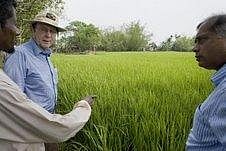
INTERVIEWFAO country chief advises caution over GM crops
FAO's country representative in Bangladesh Adrianus Spijkers underlines the need to protect farmers' interests to ride out the present food crisis, and be cautious about the introduction of GM crops to meet growing food demands, in an exclusive interview with bdnews24.com's Sumon Kaiser.
bdnews24.com News Service
bdnews24.com
Published :
20 Apr 2008, 07:27 PM
Updated :
24 Apr 2022, 08:26 PM
Sumon Kaiser
bdnews24.com Assistant News Editor
Dhaka, April 20 (bdnews24.com) -- FAO's country representative in Bangladesh Adrianus Spijkers underlines the need to protect farmers' interests to ride out the present food crisis, and be cautious about the introduction of GM crops to meet growing food demands, in an exclusive interview with bdnews24.com.
A few years ago the country put more emphasis on importing rice as it was cheaper and the need to increase output took a back seat. What should be the position of rice production in terms of priority?
Spijkers: Increasing the yield—crop intensification (number of crops per year and more land) by increasing irrigation facilities—is crucial. At the same time it is important not underestimate the importance of economic incentives and not to close the domestic market to the opportunities and efficiency stimuli that can come from the international markets. In other words, a reinforced focus on technology development should be accompanied by a comprehensive review of agricultural, food and trade policies.
Does FAO have any plan to build cold storages for potatoes or other farm products in Bangladesh?
Spijkers: The cold storage facilities for potatoes in Bangladesh are owned by the private sector. FAO has limited own funds; it is a technical agency and therefore depends on the funds of bilateral or multilateral donors to implement the projects. Only a few donors support the private sector. This is a matter for development banks and part of a master plan for enhanced agriculture. FAO can provide complementary technical support if projects in this field are financed.
What is FAO's position on growing hybrid varieties of rice in Bangladesh?
Spijkers: FAO does not oppose them, provided that available of seeds can be ensured over the long term and farmer access them at reasonable costs.
Some experts say we should use GM varieties to meet rising demand for food—but only the ones developed in our own laboratories. What is your opinion?
This is a controversial issue: promises of substantial productivity gains have to be assessed against concerns for food and environmental safety. The issue of the public vs private ownership of the GM varieties is also crucial. While wider debate and further scrutiny of the issue is certainly necessary, it is also good to develop the capacity of the national research institution in this field.
Does FAO have any programme on protecting out native/indigenous varieties of freshwater fish and rice that face extinction?
Spijkers: We are procuring and distributing 300 metric tons of local varieties of
amon
rice seed that were severely damaged by Cyclone Sidr.
We produce only something like a 10th of our annual edible oil? What can be done to increase the production? Does FAO have any programme to encourage the edible oil sector here?
Spijkers: No, but we are ready to provide technical assistance in response to specific requests.
Please tell us about any FAO/EC project on food safety.
Spijkers: An FAO/EC project on food safety is underway and will include food quality, food hygiene and food control components. It will help to reduce food safety and quality risks for consumers and promote economic growth in the food sector. Specifically, it will help to develop effective food control management, food control and legislation, food inspection, food risk analysis, networking of national analytical capability including quality assurance, accreditation and improve food export-import control and certification system.
Do you have any programme in collaboration with the government of Bangladesh on food safety?
Spijkers: Bangladesh is a member of the Codex Alimentarius Commission with Bangladesh Standards and Testing Institution (BSTI) under the Ministry of Industries as the focal point. As the Secretariat of the Codex Alimentarius Commission, FAO provides advice to Bangladesh on the harmonisation of food standards and regulations with Codex. FAO also provides technical assistance for the operation of sophisticated equipment such as liquid chromatography-mass spectrometry (LC MS-MS) for detection of antibiotics and quick testing of formalin in fish.
What do you think should be done to help farmers earn more from their crops?
Spijkers: Bangladesh should grow more high-value crops such as cashew nuts and coffee. China and Vietnam have done this sort of thing successfully. Devasish Roy (special assistant to the chief adviser on the CHT affairs) requested me to come up with some advice about producing coffee in the CHT.
Bangladesh should put agriculture, still the chief source of employment, more on the frontline. Only the production of shrimps makes up 5 percent of total economic earnings.
Poor farmers want to improve their standards of life. So they expect good prices for their produce. Farmers should be rewarded to encourage them to work harder.
The pertinent role of agriculture adviser CS Karim in farm and food security is vital for the future.
What measures do you think Bangladesh should take to increase agricultural production?
Spijkers:
• More high-yield varieties compatible with changed climate conditions
• Availability of timely inputs
• Availability of credit
• Increasing farmers' knowledge on modern farming
• Structured/cooperative marketing facilities
• Enabling policy support
• Crop insurance
• Farmers' access to information
• Appropriate technology and adequate investment
bdnews24.com/sk/ad/0059 hours