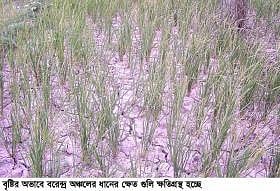
Insufficient rainfall impacts Aman crop
The level of rain in the greater Rajshahi are is much less than last year. Ismail Hossain talks to local people and experts about how the low rainfall is affecting rice cultivation.
bdnews24.com News Service
bdnews24.com
Published :
11 Aug 2010, 11:43 AM
Updated :
24 Apr 2022, 05:35 PM
Rajshahi, Aug 11 (bdnews24.com) — The enduring draught during the rainy season has turned the fertile cultivable land of the Barendra area in greater Rajshahi into a barren wasteland.
Cultivation of Aman (a kind of paddy) faces grave danger due to the draught in the area and the lack of other systems for irrigation. Farmers fear that the land may remain uncultivated unless there is rain.
Farmers of different upazilas of Rajshahi have said that despite it being the season for cultivating Aman, they were facing difficulties because of the shortage of rainwater. However, farmers, who had the means, were irrigating their fields using tube wells.
The meteorological office confirmed that the amount of rain has been less than that of the past few years.
Md Younus Ali, director general of the Agricultural Expansion Department Rajshahi office, said "The amount of targeted land for Aman cultivation this year is 85,635 hectares, but this will not be manageable if sufficient rain does not fall."
Prakash Chandra Ghosh, from the local Rajshahi meteorological office, added that "The amount of rainfall in June, July and August last year was 127.6 mm, 186.7 mm and 240.1 mm whilst this year they are 221 mm and 94.5 mm in June and July, and 15.6 mm so far in August. This shows a 222.1 mm decrease this year."
As a consequence, farmers are being compelled to use tube well water for irrigation – either using their own initiative of through the assistance of the Barendra Multipurpose Development Authority (BMDA).
According to BMDA data, more than 8,000 among the total 12,000 deep tube wells in the 16 northern districts of Bangladesh are being used for irrigation. A total of 2,546 tube wells are being used in the Rajshahi district.
Rajshahi district executive engineer of BMDA, Jahangir Khan, told bdnews24.com that other than some low-lying areas like Mohanpur and Bagmara, deep tube wells are being used in most of the agricultural land of the district.
It is feared that the inadequate rain will greatly damage the Aman and Aush crop for the year.
Meanwhile, incessant load shedding has made things more difficult for the farmers as even the deep tube wells are unable to pump out enough water.
Farmers of different areas have said that the Aush fields are being destroyed for lack of irrigation and currently they are not even thinking of planting the Aman seeds.
Commenting on the adverse weather, Golam Sabbir Sattar, a teacher of the geology department at Rajshahi University, told bdnews24.com "China is seeing a heavy downpour this season. However, the atypical reduced amount of showers has also created a negative impact on the flow of the Ganges."
The RU teacher explains that humidity and low temperatures are required for the cloud to freeze, "but the high temperature is not letting the clouds to form. This is why this area is growing drier day by day."
bdnews24.com/corr/kms/adk/tk/db/1720h