Govt enters deal with ConocoPhillips
The government has struck a production-sharing contract (PSC) with US firm ConocoPhillips to conduct seismic survey and exploration of oil and gas resources in the deep sea. Full story
bdnews24.com News Service
bdnews24.com
Published :
16 Jun 2011, 07:51 AM
Updated :
10 Aug 2022, 04:58 PM
Dhaka, June 16 (bdnews24.com)—The government has struck a production-sharing contract (PSC) with US firm ConocoPhillips to conduct seismic survey and exploration of oil and gas resources in the deep sea.
The agreement came when the country is reeling under severe energy crisis and many factories are out of operation or cannot come on stream due to gas crisis.
Petrobangla secretary Imam Hossain and energy division deputy secretary A K M Mohiuddin from the government and ConocoPhillips Asia Pacific vice-president (business development) William G Lafferrandre signed the agreement at Petrocentre in the city's Karwan Bazar on Thursday.
Finance minister A M A Muhith, prime minister's energy advisor Tawfiq-e-Elahi Chowdhury, state minister for power and energy Enamul Huq, energy secretary Mesbahuddin Ahmed and US ambassador James F Moriarty were also present at the signing ceremony.
The energy giant will start its seismic survey by December in deep sea blocks 10 and 11, an area of 5158 square kilometres.
The depth of water is between 1000 to 1500 metres and the blocks are about 280 kilometres from Chittagong port.
The firm under its mandatory work programme must initiate seismic survey in a grid of 10km by 10km space over the whole of the blocks.
The Texas-based company has pledged $160 million bank guarantee for working in three phases and the contract period is for nine years.
Muhith in the ceremony said the government had protected the interest of the country in the deal.
"After maximum negotiations with the company, the government has prepared the agreement," he said.
On the gas export provision, he said it was even incorporated in the PSC signed in 1974.
"The basic thing is that the company will offer whatever they produce to the government and if the government declines to buy it then they will opt for other options," he said.
"Our interest has not been compromised," he asserted.
Advisor Chowdhury said the export provision is part of source diversification.
"We want to import LNG and at the same time we will allow export of LNG to keep all the option open," he explained.
"The export is only possible when Bangladesh will refuse to buy gas from the company."
The advisor said after settlement of maritime border disputes, the government will vigorously pursue deep-sea exploration.
The oil giant won blocks 10 and 11 in 2008 in the second-round bidding for the PSC, but could not sign the PSC with state-run Bangladesh Oil, Gas and Mineral Corporation, or Petrobangla, as parts of these blocks were also claimed by India and Myanmar.
Petrobangla chairman Hossain Mansur said exploration in the deep sea is a must to find out new gas fields.
"Even Gazprom (Russian company) is not interested in offshore exploration where the water is more than 200 metres deep," he said.
"We neither have high technology nor have enough financial resources to conduct such huge operations and it is better to strike a deal with a multinational to explore the deep sea," he added.
Myanmar and India have already started exploration in the deep sea and Bangladesh must start the process now, Mansur said.
Laflarrendre said environment would be their top priority during the exploration.
Energy secretary Mesbahuddin said the government is planning to import liquefied natural gas to meet the growing gas demand.
US ambassador Moriarty said General Electric, Chevron and ConocoPhillips are poised to invest in gas and power projects.
The bid for deep-sea exploration began in 2008 and in the next year. the cabinet approved signing of the agreement, which apparently seems heavily tilted in favour of the US firm, and a suicide note for Bangladesh – a country in the jaws of a severe gas crisis, which is sure to spell slowdown in industrialisation and cause immense trouble to the households.
The final go-ahead for inking the PSC was given on May 23 by the cabinet committee on economic affairs.
The country is divided into 52 blocks, 28 of which are in the Bay.
The country currently produces around 2,000 million cubic feet (mmcfd) gas per day against a demand of over 2,500 mmcfd. The proven gas reserves are 7.3 trillion cubic feet (tcf) and probable reserves 5.5 tcf.
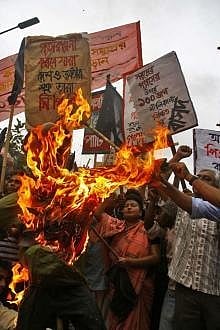
The National Committee on Protection of Oil, Gas and Mineral Resources, Power and Ports, comprising academicians, students, professionals and media activists, has been holding a series of demonstrations to protest the proposed deal.
Several left parties and experts are also against the deal, saying Bangladesh would lose ownership of the blocks once the contract was signed.
The citizens' platform demands that the government strengthen its own relevant institutions, so as to explore the twin precious commodities–gas and oil–on its own by sub-contracting the job to foreign companies, which the US firm would eventually do.
Experts say ConocoPhillips will have the authority to export 80 percent of gas, and Petrobangla will get the rest, which will have to be carried to the shore at its own cost — not an economically viable proposition for Bangladesh, in any case.
Mansur, however, said on Wednesday, "According to the PSC, the firm will have to sell 20 percent of the LNG to Bangladesh."
However, contrary to the Petrobangla chairman's contention, Bangladesh University of Engineering and Technology (BUET) professor M Nurul Islam and the National Committee member secretary Anu Muhammad termed the deal 'suicidal'.
Ruling Awami League's ally Workers Party president Rashed Khan Menon in parliament declared the proposed PSC 'a tragedy' for the country.
The BUET teacher told bdnews24.com on Wednesday, "We'll be given the gas at a place nearly 150 miles away from the coast. The foreign firm is not obliged to carry the gas [for us]."
"Finally, they'll be given the opportunity to export the gas as it will not be financially and technically profitable for Bangladesh to carry the gas," he added.
Prof Anu Muhammad on Tuesday said Bangladesh Petroleum Exploration and Production Company (Bapex) and Petrobangla could be toned up with necessary investment, machinery and manpower for the job ConocoPhillips would do.
"It'll allow Bangladesh to produce gas at a relatively lower price than buying from foreign companies," he said.
bdnews24.com/arr/ssz/pks/bd/1536h