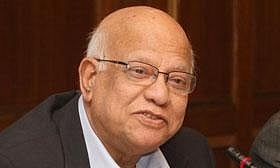
Crisis is being blown up: Muhith
The finance minister says the media and civil society are cooking up many of the financial troubles Updates
bdnews24.com News Service
bdnews24.com
Published :
01 Feb 2012, 03:31 PM
Updated :
09 Aug 2022, 03:22 PM
Dhaka, Feb 1 (bdnews24.com) – The finance minister on Wednesday said the media and civil society are cooking up many of the financial troubles the country is facing.
However, A M A Muhith in his next words said the global depression had dragged the nation into a crisis.
He was speaking to business leaders from the Federation of Bangladesh Chambers of Commerce and Industries on Wednesday.
Muhith said press reports on inflation, poor investment and government loans causing economic crisis were a fabrication of the media and the civil society.
"There has always been an economic crisis in Bangladesh, but it's not the sort that they say it is," he remarked.
He went on to elaborate on the government's borrowings from the beginning of its term and said, "The government takes loans when it needs and pays them back, too.
"You only report the loans and not the returns. It's wrong to make big reports and big speeches on everyday changes," he charged reporters.
Reports on government loans are based on Bangladesh Bank's three-month statistics books.
"From now on, we will publish them every six months. Let's see what the reporters do then," a visibly touchy minister said.
FBCCI president A K Azad at the discussion complained that the government was increasingly moving away from the businesses.
"The banks are charging high interest. No private entrepreneur will be interested in investing if the interest rates are so high," he said.
He added that the government has reviewed the VAT and insurance laws without consulting the businesses.
The business leader sharply criticised the government on its borrowing from the private sector.
"Revenue growth would not be the same in the next six months as it was in the first six, because liquidity flow in the private sector has fallen.
"The government exceeded its limits of loans in the first five months. The banks are therefore suffering from liquidity crisis and loans to private sector have fallen," Azad said.
"Businessmen are not getting loans. If they do get any loans, they have to pay 17 to 21 percent on it. The private sector is being harmed most," the FBCCI chief added.
Responding to these allegations, the finance minister said private sector loan supplies were too high last year and therefore they had to be reined in.
"The high interest problems that you are talking about are temporary. They will bring good results in the long run," Muhith added.
The finance minister refused to take responsibility for bad use of foreign aid.
"My job is to procure them, and I did. It's used by different ministries and it is their failure if they couldn't (put them to good use)," he said.
He also remarked that there were no errors in the government policy. On the subsidy in power sector, he said, "There is a 30 percent systems loss in power production. At this moment 26-27 percent power comes from rental sector. By 2015, that will decrease to 8-9 percent," he added.
The Policy Research Institute executive director Jahid A Sattar said the government should look at internal sources for its income.
Economist Anu Mohammad advised in the same vain, saying, "We are now falling into a vicious cycle of loans. Taking an IMF loan to resolve present-day crises may spell bigger doom for the future."
The Center for Policy Dialogue executive director Mostafizur Rahman emphasised checking inflation and urged the government to facilitate the increase of foreign investments and remittance.
Banker Mamun Rashid, however, held a different opinion and said, "We should sit with development partners. I don't think we can cover all our expenses with our incomes."
Pubali Bank chairman Hafiz Ahmed Majumder said banking sector was not playing a responsible role.
FBCCI vice-president Mostafa Azad Chowdhury Babu also blamed banks. He said the financiers would not renew loans even after getting paid up regularly.
"Rather the businessmen are being harassed, and they're getting frustrated," he said.
bdnews24.com/sit/sh/bd/2345h