'Capital market must fund apparel industry'
Bangladesh's capital market must replace banks as a source of funds to ensure that industries have it cheaper, with updated regulatory laws to achieve the shift, a seminar was told Tuesday.
bdnews24.com News Service
bdnews24.com
Published :
21 Oct 2008, 01:10 PM
Updated :
24 Apr 2022, 08:52 PM
Dhaka, Oct 21 (bdnews24.com)—Bangladesh's capital market must replace banks as a source of funds to ensure that industries have it cheaper, a seminar was told Tuesday.
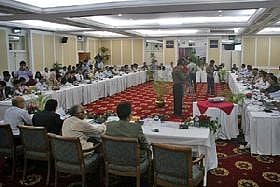
The BKMEA-hosted seminar on 'Opportunities and Challenges for Bangladesh in Global Apparel Sourcing' also heard a top industrialist say that regulatory laws needed updating to achieve the shift.
"There has to be some changes in the Securities and Exchange Commission laws so that the apparel companies can get listed with the bourses," said Ghulam Faruq, chairman of SQ Group, who spoke as special guest.
Faruq focused on the need of developing the capital market for funds as bank finance was costly.
Faruq and others stressed a new dimension of sourcing policy to take benefit of a possible erosion of the Chinese and Turkish apparel industry in the wake of the present economic recession.
BKMEA vice president MA Baset, the key note speaker, pointed out that the Chinese and the Turkish were likely to lose their position in the global apparel market.
Between them, China and Turkey hold almost 50 percent share of the global apparel export.
"Factors like economic development, high wage, high production cost, environmental issues and lack of labour forces in these countries (China and Turkey) are the reasons behind the possible erosion," he said.
This erosion would create a big pie for countries like Bangladesh, Vietnam, Indonesia and Cambodia, according to Baset.
Baset said he saw opportunity for attracting investments from China and Turkey as both of the countries were now trying to relocate their factories where cost would be lower.
Faruq called upon researchers to conduct studies to identify the strengths, weaknesses and necessities for the industry.
" ... As they (research firms) are taken more seriously by the policymakers than the businessmen."
CPD executive director Mustafizur Rahman agreed with Faruq, but said that they often found businessmen reluctant to provide information for research.
Prof Wahiduddin Mahmud, the chief guest, said urgent measures were needed to enhance supply of power and gas.
"Otherwise no industry would witness growth," he said.
On wages for RMG workers, Mahmud warned that labour would become costlier as most of the factories were now located in the 'prime lands' in Dhaka city, leading to high living costs for workers.
"In addition the hike in food prices would also contribute to this," he said.
Mahmud disagreed with to government position that the current global financial turmoil would not affect Bangladesh's financial market. "It hides the fact that it (Bangladeshi financial market) is highly inefficient."
BKMEA president Fazlul Hoque said he would emphasise on the need for product diversification as well as policy and infrastructural support.
"Bangladesh's export figures amount to four digits (in million US$) only in 5 to 6 categories in knitwear and woven products out of the 34 items," he said.
Business leaders, government officials and representatives of aid agencies attended the seminar coinciding with the Knit Exposition 2008 that kicked off Monday.
bdnews24.com/rhn/rah/1843hrs