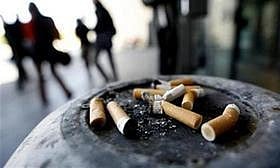
Budget draws anti-tobacco backlash
They say it brings 'cheers' to the tobacco industry instead of protecting public health Nurul Islam Hasib reports
bdnews24.com News Service
bdnews24.com
Published :
08 Jun 2012, 09:07 AM
Updated :
09 Aug 2022, 03:52 PM
Nurul Islam Hasib
bdnews24.com Senior Correspondent
Dhaka, June 8 (bdnews24.com)—The budget for 2012-13 fiscal has sparked an intense backlash from anti-tobacco activists who say it brings 'cheers' to the tobacco industry instead of protecting public health.
Much to their chagrin, Finance Minister A M A Muhith 'ignored' every quarter's request on tobacco taxation in his proposed outlay and surprisingly did not utter a single word on locally made hand-rolled, cheaper bidis and smokeless tobacco.
Even more than 60 Members of Parliament (MPs) wrote to the National Board of Revenue (NBR) for the first time this year before the beginning of budget session with a call to slap increased taxes on tobacco products particularly on bidis that kill 'poor and unsuspecting' people.
The Minister in his budget speech on Thursday said: "Considering the harmful effects of smoking, we are committed to reduce the use of tobacco every year."
But he proposed only 3 percent more supplementary duty on the cheapest brand of cigarettes and 1 percent on the other three slabs. Economists as well as anti-tobacco activists had demanded lifting price slabs and slapping 70 percent taxes on all tobacco products.
The supplementary duties will now be 39, 56, 59 and 61 percent from existing 36, 55, 58 and 60 percent.
Without abolishing price slabs of cigarettes, the Finance Minister proposed 10 percent price hike in all four slabs that economists earlier argued only benefited tobacco manufacturers.
"Once again the strong demands for protecting public health have been ignored (in the proposed budget)," said Taifur Rahman, an expert on tobacco economics.
He said the Finance Minister's silence on bidi taxation has 'surprised' them as economists, doctors, and MPs this year joined anti-tobacco activists to make the Finance Minister understand the danger backed with evidence.
"Increasing price slabs by 10 percent would give industries opportunities to earn millions of taka in additional profits."
"It will raise prices of cigarettes, but the amount will be so tiny that it'll not deter smokers," he said, "industries have now got what they wanted."
Rahman said no additional tax has been proposed for the smokeless tobacco, the consumption of which is increasing by the day.
With 20 percent supplementary duty, bidis currently enjoy lowest tax rates.
Health Minister AFM Ruhal Haque in a press conference earlier said they requested the NBR to increase the supplementary duty on bidi to 30 percent.
A doctors' platform United Forum Against Tobacco presented the victims of cheaper tobacco products who are mostly poor to media before budget session began.
Economists in a study showed if government levied 70 percent taxes on bidis and cigarettes, it would have encouraged nearly 11 million smokers to quit, and keep 10.5 million youths away from taking up the habit.
The study also showed the government's earnings from the tobacco taxation would have been Tk 22.2 billion more in the first year.
On the other hand, thousands of lives would have been saved in Bangladesh where more than 150 people are estimated to be dying every day due to tobacco-related illness.
"But all these demands and appeals for protecting public health have been overridden by the Finance Minister's sympathy for the tobacco industry," Rahman, also the coordinator of Campaign for Tobacco Free Kids in Bangladesh, said.
He believed the need for cutting tobacco use that kills 57,000 people in Bangladesh each year has been 'ignored' once again by the Ministry of Finance, which has earlier been seen as a 'stumbling block' to reducing tobacco harms in Bangladesh.
Health minister Ruhal Haque earlier said the draft of the amended 2005 Tobacco Control Act has been stuck with the Ministry of Finance.
Even before that, bdnews24.com found a letter from tobacco giant British American Tobacco to the Finance Minister stopped the process to frame a tougher anti-tobacco law.
Study showed with 43.3 percent adults smoking or chewing tobacco, the medical cost of the habit is twice the revenue the government earns from the tobacco industry.
The Health Minister said they had also demanded 2 percent 'health tax' on tobacco products as the use of tobacco has burdened the health system with over 350,000 people sufferings from tobacco-related diseases.
bdnews24.com/nih/bd/1421h