Published :
08 Jun 2012, 12:27 PM
Updated :
09 Aug 2022, 03:52 PM
Dhaka, Jun 8 (bdnews24.com)—Finance Minister Abul Maal Abdul Muhith has said that the tax amnesty to legalise black money has been persisted with to draw in more investment.
Citing a research finding, he said on Friday, "About 42 to 82 percent of the total money of the country is black money. We definitely want that it is invested. The budget has provided the scope of whitening black money considering the matter, not to please any vested quarter."
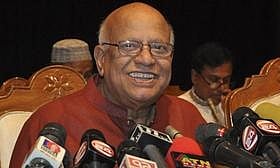
In keeping with custom, he took questions from the media in an open discussion at Osmani Memorial Auditorium, a day after he presented the Tk 1.9 trillion budget for 2012-13 fiscal to Parliament.
The budget proposed to expand the facility for legalising 'black money' with a 10 percent penalty without any bars on where that money has to be invested.
Defending the provision, Muhith said, "The opportunity was offered so that black money may be invested. It has to be paid by adding 10 percent fine on top of the regular tax rate. It has not been offered to facilitate money laundering.
The Minister promised a rethink of the government proposal to slap 2 percent tax at source of mobile phone bill when a journalist asked him about the issue.
"It is really a matter to look back on. We will obviously review the decision."
The next budget proposes the tax on the total bill for post-paid subscribers and on the sale of top-up cards or during recharge in case of pre-paid users.
Currently, 90 million mobile-phone users across the country pay 15 percent Value Added Tax (VAT) on bills, according to the Bangladesh Telecommunication Regulatory.
"We have tailored a budget that benefits people, villages, and agriculture," said Muhith when asked for his take on it.
Many economists and analysts are of the opinion that it would be difficult to contain annual average inflation within 7.5 percent and achieving 7.2 percent GDP growth would not be easy either.
Muhith was confident, though, arguing, "We have taken a host of measures to encourage investment. We hope the steps will lead us to the goal of 7.2 percent GDP."
Regarding inflation, he argued, "The rate has already been brought down to 9.1 percent. We hope food inflation will decline further due to bumper production in agriculture."
The minister said strategy to contain inflation should not be disclosed before it is put in operation.
"I said I would reduce subsidy to contain inflation and its timing would be determined on circumstances."
"Besides that, it has been predicted the global economy will recover from the impact of recession by the next year. It is also predicted that different countries will achieve a good GDP growth in the next fiscal. It will also affect our country.
"After considering all these matters, we think we will be able to achieve our expected GDP growth," he explained.
Finance secretary Mohammad Tareq said investment has increased to 25 per cent of the GDP from 24 per cent and with this amount of investment, it target can be achieved.
Tax on export
The minister lamented that those who create more wealth pay less tax and readymade garment manufacturers belong to that group.
The proposal to increase tax at source on all export products has also faced widespread criticism. Apparel exporters Bangladesh Garments Manufacturers and Exporters Association has said that the decision will hamper readymade garment industry.
Facing a question over the criticism, the minister invited Chairman of National Board of Revenue Nasiruddin Ahmed, present at the discussion, to explain.
"We have conducted research on the issue and found that 0.7 percent tax on readymade garments against the profits the sector is earning is much lower. In addition, readymade garment sector has made additional profits this year because of currency devaluation," the revenue board chief said.
"It is for logical reasons that imposition of 1.2 percent tax on export products has been proposed," he added.
RMG manufacturers made a windfall profit of Tk 75 billion in the fiscal due to taka devaluation, according to him.
Ahmed thought the government should impose more tax on the readymade garments sector.
"Considering that the manufacturers have 10 percent operating profit, the government proposed 1.2 per cent tax at source for exportables," he said.
During the period of the current government, it revised price of non-urea fertiliser thrice to have balanced used of the farm commodity.
"It pays off," she said.
Asked how much money was allocated for subsidy in the next fiscal, Finance Secretary Dr Mohammad Tareq said, Tk 345.33 billion was proposed in subsidy for different sectors, which is 3.3 percent of GDP.
Agriculture Minister Matia Chowdhury said the government would provide only effective subsidies.
At the news conference, the Minister was accompanied also by Planning Minister AK Khandaker. It was attended by Bangladesh Bank Governor Atiur Rahman, Economic Relations Division Secretary Iqbal Mahmud and Planning Secretary Bhuiyan Shafiqul Islam.
Information Minister Abul Kalam Azad and Prime Minister's Finance Advisor Mashiur Rahman and Energy Advisor Tawfiq-e-Elahi Chowdhury and State Minister for Power and Energy Enamul Haque were also present.
bdnews24.com/arh/ssz/eh/bd/2147h